
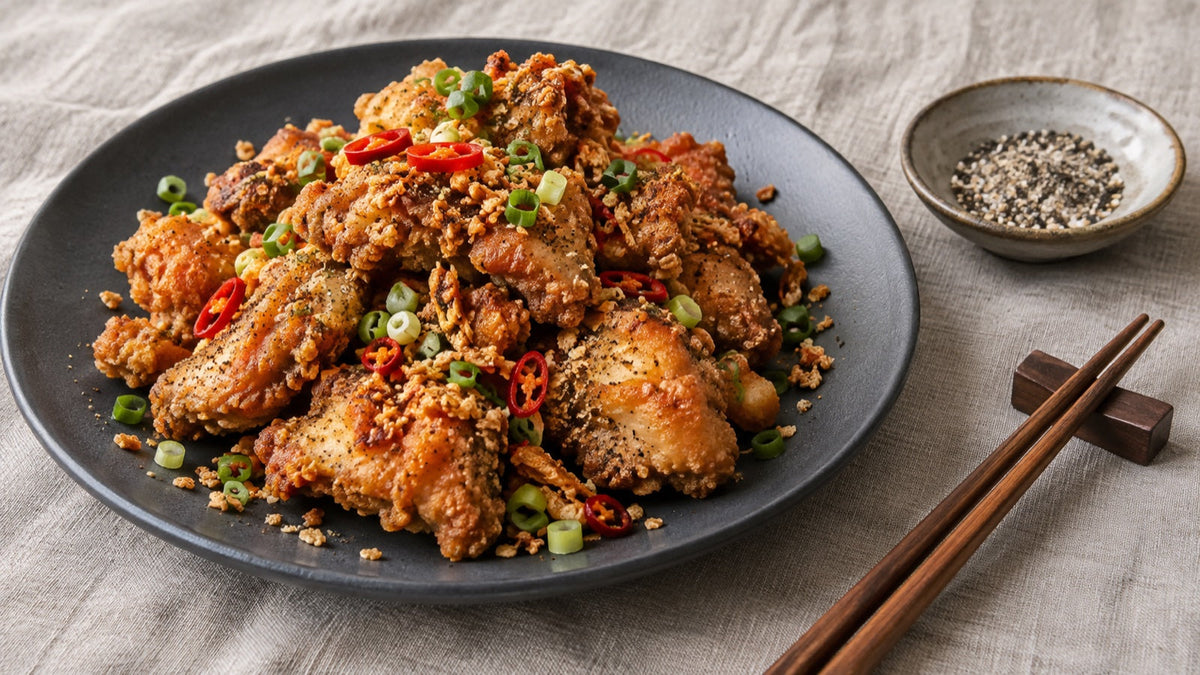
You've made this at home before. It came out fine. It also came out slightly soft, a bit dusty on the tongue, and nothing like the container you get from the local Chinese shop. 🍗
The gap isn't the chicken. It isn't your stove either.
It's when you add the seasoning.
Salt and pepper chicken is thigh meat cut into chunks, coated in maize cornflour, fried twice, then tossed off the heat with garlic, chilli, spring onion and a dry five-spice salt. The seasoning goes on last, after the second fry, with the burner switched off. Put it in the coating instead and the aromatics scorch in the oil, which is exactly why the home version tastes flat.
That's the whole secret. The rest of this is the timings.
Why the seasoning goes on at the end
The dish's Chinese name is 椒鹽 (jiāo yán), which translates as "peppery salt". It isn't the name of a marinade. It's the name of a dry finishing blend, and it describes a cooking style: fry something plain and crisp, then coat it in seasoned salt at the pass.
Ground spice in 170°C oil has about four minutes to live. The volatile oils in star anise, fennel and cassia are what you're actually after, and they flash off long before the chicken is cooked. What's left behind on the crust is the dull, slightly bitter part of the spice. That's the dusty note.
Keep the dredge boring. Salt, starch, a spoon of plain flour for colour. Save every bit of flavour for the ten seconds at the end when the wok is off the heat and nothing can burn.
Most recipes ranking for this dish tell you to mix five spice into the coating. It's the most common instruction on the internet for salt and pepper chicken, and it's the reason so many people think their wok isn't hot enough.
The Australian cornflour trap
This one's worth thirty seconds at the shops.
Walk down the baking aisle at Woolies and you'll find two boxes that both say cornflour. One is maize cornflour, which is pure corn starch. The other is wheaten cornflour, which is wheat starch and contains gluten. They sit next to each other, cost about the same, and look nearly identical.
For thickening a gravy, either works. For a fried coating they don't behave the same way. Pure starch fries into a thin, glassy, brittle shell. Wheat starch carries protein, which browns faster and sets softer, and it goes limp sooner once the aromatics hit it.
Check the box says maize. If you're cooking for anyone avoiding gluten, this matters twice over, because "cornflour" on an Australian label tells you nothing about what's inside it.
(The two tablespoons of plain flour in the recipe below are deliberate and do help the coating take colour. The point is that the bulk should be corn.)
Ingredients (serves 4)
Chicken and marinade
- 600g chicken thigh fillets, cut into 3cm chunks
- 1 tbsp light soy sauce
- 1 tbsp Shaoxing wine (dry sherry works)
- ½ tsp ground white pepper
Coating
- 100g maize cornflour (about ⅔ cup)
- 2 tbsp plain flour
- ½ tsp fine salt
The finishing salt — the important bowl
- 2 tsp YumYum Emperor's Dust (Dynasty 5 Spice)
- ¼ tsp fine salt, plus more to taste
Aromatics
- 4 garlic cloves, finely chopped
- 1 long red chilli, sliced
- 3 spring onions, whites and greens separated
- 1 eschalot or ½ small brown onion, sliced thin
To fry
- About 1L neutral oil (rice bran, sunflower or canola), roughly 4cm deep in a wok or deep pan
Method
Prep 15 min · Cook 15 min · Serves 4
- Marinate. Toss the chicken with soy, Shaoxing and white pepper. Leave it 15 minutes while you do everything else. Don't add the five spice here.
- Mix the finishing salt now. Emperor's Dust and fine salt in a small bowl, sitting right next to the stove. Do this before your hands are covered in starch, because the last step happens fast and you won't have ten seconds to spare.
- Dredge. Combine the cornflour, plain flour and salt. Drop the chicken in a few pieces at a time and press the coating on firmly. Then leave the coated chicken alone for 5 minutes. It'll go from powdery to tacky as the starch hydrates on the wet marinade, and that's what stops the crust sliding off in the oil.
- First fry: 170°C, 4 minutes. Fry in two batches so the oil doesn't crash. The chicken should be pale gold and cooked through, not brown. Lift it onto a wire rack, never paper towel.
- Rest 5 minutes. This is the step everyone skips and it's the one that matters most. Steam escapes instead of getting trapped under the crust, and the coating dries and sets. Skip it and the second fry spends its whole life fighting moisture.
- Second fry: 190°C, 60–90 seconds. Both batches together is fine now. You're after deep gold and a shell that sounds hard when you tap it with the tongs. Longer doesn't mean crispier, it just means drier thigh meat. Back onto the rack.
- Aromatics: 15–20 seconds. Tip out all but about a tablespoon of the oil. Medium heat, then garlic, chilli, eschalot and spring onion whites. Fifteen to twenty seconds is the entire window. The second the garlic turns from white to pale straw, you're done. Brown garlic is bitter garlic.
- Kill the heat. Then season. Burner off. Chicken back in, finishing salt over the top, spring onion greens, and toss for about 10 seconds. Taste one piece and add a pinch more salt if it needs it. Serve immediately, straight from the wok.
The optional upgrade
If you want the inside to match the outside, velvet the thigh first. Toss the raw chicken with 2–3 tbsp YumYum Meat Velvet plus the same amount of water, rest 30 minutes, then pat it properly dry before the marinade and dredge. Wet chicken and hot oil don't get along. It's a good habit if you're the sort of cook who ends up with tough, rubbery stir-fry chicken more often than you'd like.
Chef's note
Growing up around my dad's kitchens, I assumed the double fry was a technique someone had worked out. It isn't. It's just how service runs.
Salt and pepper chicken is never cooked start to finish in one go in a restaurant. The chicken is par-fried during afternoon prep, sits on a tray, and only meets the oil again when the docket lands. Nobody is hiding that from you. You simply can't build a wok dish from raw in ninety seconds when there are fourteen other dockets on the rail.
But that accident of scheduling is precisely why the takeaway version out-crisps yours. They fry it twice because they have to. You have to choose to. And the bit you'll be most tempted to cut, five minutes of standing there doing nothing while it sits on the rack, is the bit doing the work.
Common questions
What is Chinese salt and pepper seasoning made of?
Salt and pepper seasoning (jiāo yán) is a dry blend of salt with ground pepper and warm spice, usually white pepper or Sichuan peppercorn with Chinese five spice. It's a finishing seasoning, sprinkled over food after frying rather than mixed into a marinade or batter.
Why isn't my salt and pepper chicken crispy?
Four usual culprits, in the order they cause trouble: no rest between the two fries, too much chicken in the pan at once (the oil temperature drops and the coating stews), oil that never reached 190°C for the second fry, and wet chicken going into the dredge. Draining onto paper towel instead of a rack undoes the rest, too.
Thigh or breast?
Thigh. Breast dries out in the second fry and the whole point of frying twice is a hard shell over meat that's still juicy. If breast is what's in the fridge, cut it slightly larger, velvet it, and take the second fry down to 45 seconds.
Can I make salt and pepper chicken in an air fryer?
You can, and it's decent, but be honest with yourself about what you're getting. Spray the coated chicken generously with oil, 200°C for 12 minutes, shake halfway, then run the aromatics in a pan on the stove and toss everything together off the heat. The crust comes out drier and more powdery than fried, because circulating air can't do what submerging in 190°C oil does. Good on a Tuesday. Not the same dish.
Can I make it ahead?
Do the first fry up to four hours ahead, exactly like a restaurant does. Keep it uncovered on a rack in the fridge, then bring it out while the oil heats and go straight into the second fry. Fully finished salt and pepper chicken doesn't keep. The seasoning draws moisture and the crust softens within about fifteen minutes.
Which seasoning to use
Emperor's Dust is our Dynasty 5 Spice, and this is the dish it was built for: warm, roasty, a little sweet from the fennel and cassia, and balanced enough that you can use it as a finishing salt without it taking over the plate. That's the standard we hold every can to. It doesn't overpower. It elevates. ✨
Grab a single can of Emperor's Dust for $17, or if you're feeding a household, the Three-Pack of Emperor's Dust at $50 and the Four-Pack of YUM at $60 both ship free (free AU shipping over $50), and work out cheaper per can.
Once you've got the finishing-salt habit, it goes on everything. Same blend, same timing, on five spice roast vegetables. And if you're out of five spice entirely, we've written up which substitutes actually work and the one that ruins the dish.
This is one piece of a bigger puzzle. The full breakdown of why home Chinese cooking falls short of the shop is in how to make Chinese food taste like takeaway, and if the cornflour question above got you curious, baking soda vs cornflour for velveting covers what each one is actually doing.
Written by Vincent Lim — chef, cookbook author, and co-founder of YumYum. Vincent grew up in his family's Chinese restaurants and learned to cook from his father, Danny. He shares the restaurant techniques most home cooks are never told.
Researched and drafted with AI assistance, edited and kitchen-checked by the YumYum team.