
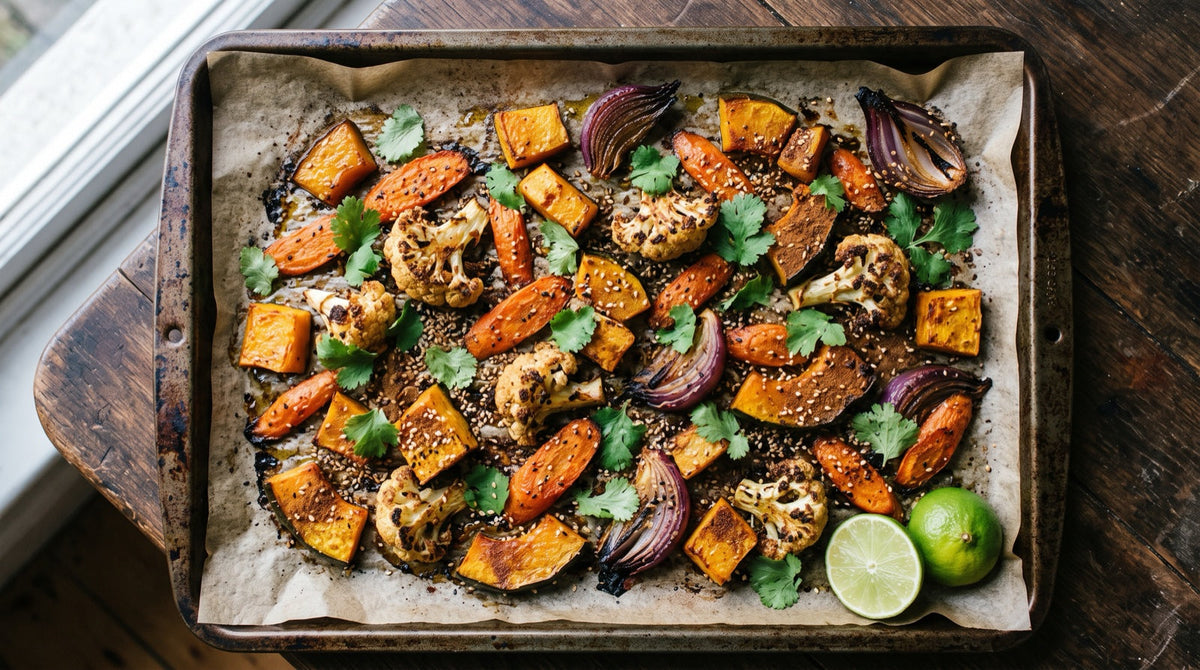
Ever roasted a tray of veg with Chinese five spice and ended up with a weird bitter, almost medicinal edge? 🌿
You're not imagining it. And it's not the spice's fault.
Five spice is one of the best things you can put on roast pumpkin, carrots and cauliflower — sweet, warm, a little liquorice, properly moreish. But most recipes tell you to toss it on raw and blast it for 40 minutes. That's exactly how you turn a gorgeous blend into something acrid.
I grew up on the roast and BBQ section of my family's Chinese restaurants — Emperors of China, my dad Danny's kitchens. Five spice was the backbone of that whole station: char siu, roast duck, roast pork. And the first thing you learn there is that five spice doesn't like a long, dry hammering. Handle it right and it's magic. Handle it wrong and it's bin material.
Here's how to get it right at home. Two moves the recipe blogs skip, one tray, about 40 minutes.
Why your five spice roast veg goes bitter (the real reason)
Chinese five spice is built on star anise, cassia (cinnamon), fennel, cloves and Sichuan pepper. Beautiful aromatics — but they're delicate. When you sprinkle them on dry and roast at 220°C for the full time, the volatile oils scorch, and star anise and cassia especially tip from "warm and sweet" into "burnt and bitter."
Restaurants get around this two ways: they bloom spice in oil, and they add it in stages. You'll do a home-cook version of both below.
The other half of the problem isn't the spice at all — it's that most people throw pumpkin, carrot and cauliflower on one tray and pull them all at once. Dense pumpkin is still raw in the middle while the cauliflower florets have gone to charcoal. That's the mush-and-scorch tray everyone knows.
Five Spice Roast Vegetables
Serves 4 as a side · Prep 15 min · Roast 40 min
Ingredients
- 500g pumpkin (butternut or jap), peeled, 3cm chunks
- 3 carrots, cut into 2cm diagonal pieces
- ½ head cauliflower, broken into medium florets
- 1 red onion, cut into wedges
- 2 tbsp neutral oil (rice bran, sunflower or peanut)
- 2 tsp YumYum Emperor's Dust (Dynasty 5 Spice), divided
- ½ tsp fine salt
- Optional finish: fresh coriander, sesame seeds, a squeeze of lime
Method
- Heat the oven to 220°C (200°C fan). A properly hot oven caramelises; a cool one steams. Put the tray in to heat while you prep — veg hitting hot metal is half the crisp.
- Cut for even cooking. Keep the dense stuff (pumpkin, carrot) a touch smaller than the quick stuff (cauliflower, onion). Same finish time, no half-raw chunks.
- Pat everything properly dry. Wet veg steams. This one step changes the whole tray.
- Bloom the spice. In a big bowl, mix the oil with 1 tsp of the Emperor's Dust and the salt. Letting the five spice sit in the oil for a minute wakes it up and protects it from scorching — that's the restaurant move.
- Toss and spread. Coat the veg in the spiced oil. Tip onto the hot tray in a single layer — crowding is the No. 1 reason roast veg goes soggy. Use two trays before you pile one high.
- Roast 25 minutes, then flip everything.
- Second hit of spice. Sprinkle the remaining 1 tsp Emperor's Dust over the flipped veg. This second, late dose is what keeps the flavour bright and fragrant instead of baked-out and flat. Roast another 10–15 minutes until the edges are deep gold and crisp.
- Finish. Coriander, sesame, a squeeze of lime. Done.

How long each veg actually takes (so nothing's raw)
If you'd rather roast a single veg — or you're mixing your own tray — this is the pecking order at 220°C:
| Vegetable | Cut | Roast time |
|---|---|---|
| Pumpkin / sweet potato | 3cm chunks | 35–40 min |
| Carrot / parsnip | 2cm diagonals | 30–35 min |
| Cauliflower / broccoli | medium florets | 20–25 min |
| Red onion / capsicum | wedges | 20–25 min |
| Brussels sprouts | halved | 20–25 min |
The rule: dense and sweet go in first (or get cut smaller); quick and delicate go in later (or bigger). Match the times and one tray works.
How much five spice per tray?
For a full tray (roughly 700–800g of veg), 1½–2 tsp total is the sweet spot — split half at the start, half near the end. Five spice is potent; more than that and it stops elevating and starts dominating. It doesn't overpower — it elevates. That balance is the whole point.
The chef note
On the roast section at Dad's restaurants, five spice was never dumped on and forgotten — it went on in stages, and it went on late as much as early. That's not a fussy chef thing; it's the difference between "smells like a spice market" and "tastes like it got burnt."
The reason I reach for Emperor's Dust for this and not a random supermarket jar is honestly just balance. A lot of cheap five spice is heavy on cassia and clove, so it tips bitter fast under heat. Ours is blended as a proper roast-and-BBQ five spice — the same profile we built for char siu and roast pork — so it holds up to the oven. It's also vegan-friendly and has no added MSG, if that's on your radar. (And no, there's no scare story here — MSG was never the villain the internet made it. But that's a whole other article. 😉)
Make it a meal
This tray is a side, but it wants to be dinner. Pile it over rice or quinoa, add a fried egg or some crispy tofu, and hit it with an extra pinch of five spice. Same blend on roast potatoes or a whole roast pumpkin is a revelation.
Grab the five spice that holds up to the oven
This recipe lives or dies on the blend. YumYum Emperor's Dust — Dynasty 5 Spice ($17) is our Beijing-style roast five spice — bold, warming, built for exactly this kind of high-heat roasting. Vegan-friendly, no added MSG, chef-made. 🔥
Cooking for the table (or just hate running out)? The Three-Pack of Emperor's Dust ($50) ships free (free AU shipping over $50) and works out cheaper per jar. Want to branch out? The Essences Duo ($34) pairs Emperor's Dust with Shanghai Nights for your soy-and-scallion nights.
Keep reading: What Is Flavour Enhancer 621? (the umami number on your label, explained) · Why Your Fried Rice Tastes Flat (the one scoop that fixes it).
Written by Vincent Lim — chef, cookbook author, and co-founder of YumYum. Vincent grew up in his family's Chinese restaurants and learned to cook from his father, Danny. He shares the restaurant techniques most home cooks are never told.
Researched and drafted with AI assistance, edited and kitchen-checked by the YumYum team.