
You did everything the recipe said.
Hot pan. Oil shimmering. Chicken in, chicken out, sauce on. And it still came out like something you'd use to rub down a cricket bat. 🔥
Here's the thing nobody tells you: "tough" isn't one problem. It's four, they feel different in your mouth, and they need different fixes. So before you buy anything or change anything, work out which one you've actually got.

Why is my chicken tough in stir-fry?
Nine times out of ten it's overcooked, and it got overcooked because the pieces were too thick and the pan was too full. Thick slices need a long cook. A full pan drops the heat and the chicken steams in its own juice instead of searing. Fix the slicing and the batch size before anything else.
Diagnose it in ten seconds
Chew a piece. Which row is yours?
| What it feels like | What went wrong | Go to |
|---|---|---|
| Dry, crumbly, falls apart chalky | Overcooked. The fibres squeezed their water out | Fixes 1, 2 and 4 |
| Springy, rubbery, bounces back | Cooked wet — it steamed instead of searing | Fixes 2 and 3 |
| Stringy, long fibres between the teeth | Sliced along the grain, or sliced too thick | Fix 1 |
| Grey outside, pale liquid in the pan | Pan was overloaded and cold | Fix 2 |
| Rubbery AND weirdly hard even raw | Not you. It's the meat | Fix 5 |
That last row is real and almost nobody writes about it. We'll get there.
Fix 1: Your slices are too thick (and the grain thing is oversold)
Every page on the internet tells you to cut against the grain. Fine. But for breast fillet that's the smaller lever, and leaning on it is why people keep cutting carefully and still eating rubber.
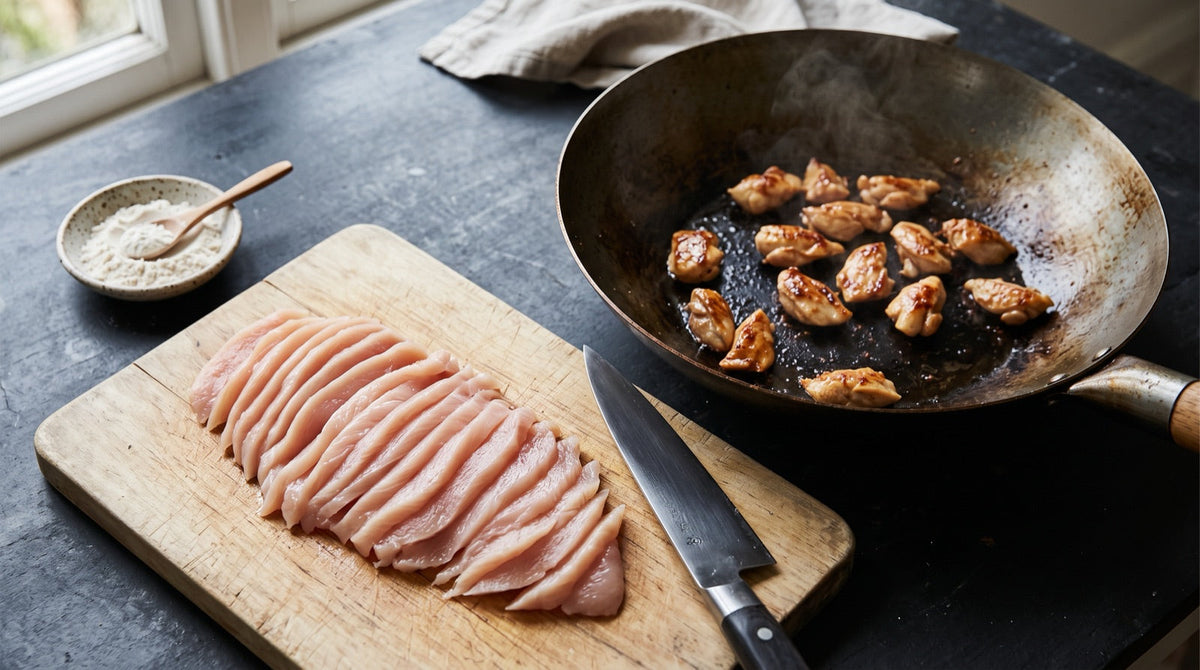
Thickness is the big one. 3–4mm. Thin enough to see a bit of light through if you hold a slice up. At that thickness the piece is cooked through in under a minute, which means it physically cannot sit in the pan long enough to dry out. At 10mm you need three times the time, and the outside is ruined before the middle is safe.
Two things that make thin slicing easy:
- Freeze the fillet for 20 minutes first. Firms it up so the knife tracks straight instead of skidding. This is the single best knife trick for home cooks and it costs nothing.
- Cut on an angle, roughly 45°, not straight down. You get a wider face on each slice, so it sears faster and picks up more sauce.
Grain still matters on thigh, where the fibres run every which way, and it matters a lot on beef and lamb. On breast the fibres are fine and mostly parallel. Get the thickness right and the grain mostly sorts itself out.
Fix 2: You're cooking one big batch, and that's why your "hot" pan isn't hot
This is the one that surprises people. Your stove is probably fine. Your batch isn't.
A home burner puts out a fraction of what a restaurant wok burner does. When you drop 600g of cold chicken into a pan, the metal temperature falls off a cliff and takes a minute or two to climb back. In that minute the chicken is sitting in a lukewarm pan releasing water. Now it's boiling. Boiled chicken then fried is exactly the springy, grey, rubbery texture in row two of the table.
Cook 250–300g at a time. Two batches. Set the first one aside on a plate, do the second, then combine at the end with the sauce.
It feels like extra work the first time and then it feels like the obvious thing you should have been doing all along. Two batches of two minutes beats one batch of seven, and the chicken is in the pan for less total time.
While you're at it: get the chicken out of the fridge 15 minutes before, and pat it dry with paper towel. Wet surface means the pan spends its heat boiling off water instead of browning meat.
Fix 3: You skipped the velvet
Velveting is the step between home stir-fry and takeaway stir-fry, and it's not a marinade for flavour. It's insurance.
What it does mechanically: the meat's surface proteins are stopped from clenching tight, and a very thin coat holds the moisture in while the pan does its worst. The meat comes out silky rather than fibrous, and it stays that way even if you're thirty seconds late pulling it off the heat. On a home stove, where the heat is unpredictable, that margin is worth more than it is in a restaurant.
You can do this the long way with bicarb and cornflour — we wrote the full breakdown of what each one actually does, including the doses, because getting bicarb wrong is how you end up with that soapy, metallic taste people complain about.
Or you use a velveting powder that's already balanced, which is why we bottled one.
YumYum Meat Velvet: 1–2 tbsp plus 1–2 tbsp water per 250g of chicken. Mix it through with your hands until every slice is coated and slightly tacky. Rest 30 minutes. Straight into a hot pan — no rinsing, no second step. Works the same on beef, pork, lamb, prawns and firm tofu.
Thirty minutes is the sweet spot. Ten will do something. Two hours doesn't do more, so there's no prize for planning further ahead.
Fix 4: You cooked it to "safe" twice
Chicken carries on cooking after it leaves the pan. Thin slices in a hot pan hold enough residual heat to climb several degrees on the plate while you're making the sauce.
So the target isn't "cooked" when it comes out. It's just barely opaque, with maybe a whisper of translucence at the thickest edge. Sixty to ninety seconds for 3–4mm slices over proper heat. Pull it, rest it on a plate, and let it finish there.
Then — and this is the part that gets skipped — the chicken goes back in at the very end, once the vegetables are done and the sauce has thickened. Thirty seconds to coat and warm through. If your chicken has been sitting in a simmering sauce for four minutes waiting for the broccoli, you've cooked it twice and no amount of velveting saves it.
Danny used to say the wok isn't where you cook the meat, it's where you finish it. Took me years to understand he meant that literally.
Fix 5: Sometimes it's the chicken, not you
Here's the honest one, and you won't find it on the other pages you've read tonight.
Modern broiler chickens have been bred to grow big breast muscle very fast, and a side effect is a muscle condition the poultry industry calls woody breast. The fibres go hard and dense. Affected fillets feel stiff and rubbery raw, they cook up chewy and stringy no matter what you do, and they don't take a marinade properly because the muscle structure won't let it in. Industry research tracked it rising from around 5% of flocks in 2012 to roughly 29% by 2015, with some studies reporting up to half.
It is not a safety problem and it's not a sign the meat has gone off. It's a texture problem, and it is not your cooking.
How to spot it: press the raw fillet. Good meat gives and slowly springs back. A woody one feels firm and springy like a stress ball, often with pale ridged striping through the muscle, and it's usually one of the enormous fillets.
What to do about it:
- Buy smaller breast fillets. The condition tracks with size, so the giant ones are the higher risk. Two small fillets beat one monster every time.
- Switch to thigh. Thigh fillet doesn't get this, it's more forgiving of a hot pan, it's cheaper, and honestly it makes a better stir-fry. Slice it 5mm rather than 3–4mm since it's a looser muscle.
- If you're stuck with a woody one, slice it thinner than you think is reasonable and velvet it. That won't cure it, but it makes it edible.
I'd rather tell you that than let you keep buying gadgets to fix a fillet that was never going to work.
The 3-minute version
For 500g of chicken:
- Slice 3–4mm on an angle. Freeze 20 minutes first if the knife is dragging.
- Velvet. 1–2 tbsp Meat Velvet plus 1–2 tbsp water per 250g. Mix through, rest 30 minutes.
- Split it into two batches of about 250g. Pan on high until it's genuinely hot, not warm.
- Sear batch one for 60–90 seconds, moving it once. Pull it while it's just barely opaque. Repeat for batch two.
- Cook your vegetables and sauce in the same pan.
- Return the chicken for the last 30 seconds to coat and warm through. Off the heat.
Serves 4. About 12 minutes of actual cooking, plus the 30-minute rest.
🥢 Chef's note
I grew up in my family's Chinese restaurants — Emperors of China, run by my late dad, Danny Lim. On the wok line, nobody stood there tenderising chicken to order. It was prep work, done in tubs hours before service, because a wok chef cannot babysit a piece of meat during a Friday night rush. The meat had to be already going to behave.
That's the mental shift for home cooks. You're not trying to cook chicken more carefully. You're trying to make it so that cooking it carelessly still works — because between the kids, the sauce and the rice you were never going to give it your full attention anyway. 🍗
Dad's line about fried rice applies just as well here: "Until you get your fried rice right, you aren't able to serve customers. It's the easiest dish to cook, but the hardest to master." Stir-fried chicken is the same kind of easy.
Common questions
Should I use chicken thigh or breast for stir-fry?
Thigh, if you're asking us. It has more fat running through it, it stays juicy across a much wider window of cooking time, it doesn't suffer from woody breast, and it's usually cheaper. Breast is leaner and takes a velvet beautifully, but it punishes you for thirty seconds of inattention.
Does marinating chicken longer make it more tender?
No. A flavour marinade sits on the surface and barely penetrates, so an overnight soak mostly gets you salty outside meat. Tenderising works on a different mechanism and is done in about 30 minutes. Longer isn't better, it's just later.
Why is my chicken rubbery but not dry?
That's the steaming failure, not the overcooking one. The pan was too full or not hot enough, so the chicken released water and poached in it before it ever seared. Cook in two batches and pat the meat dry first.
Can I fix chicken that's already tough?
Not really — you can't un-tighten cooked protein. Best salvage is to slice it thinner across the grain and fold it through a saucy dish so the sauce does the work. Then fix it properly next time.
How long should chicken cook in a stir-fry?
Sixty to ninety seconds for 3–4mm slices in a properly hot pan, then it comes out. It goes back in for a final 30 seconds at the end to coat in sauce. Anything past about two minutes of direct heat and you're into overcooked territory.
Get the tender bit sorted
Slicing and batch size are free — go and fix those tonight. The velvet is the part worth buying, because it turns a technique you have to nail into a step you just do.
👉 YumYum Meat Velvet is $17 and gets you around ten dinners' worth. One step, no rinsing, works on every protein you'd put in a wok.
Cooking for a family, or you go through it fast? The Meat Velvet Three-Pack is $50 and ships free (free AU shipping over $50) — cheaper per bottle, and one less thing to run out of on a Tuesday. ✨
Next: if you want the reasoning behind the powders rather than the shortcut, read velveting vs meat tenderiser powder, or take the same method to lamb for a Xinjiang-style cumin stir-fry.
Written by Vincent Lim — chef, cookbook author, and co-founder of YumYum. Vincent grew up in his family's Chinese restaurants and learned to cook from his father, Danny. He shares the restaurant techniques most home cooks are never told.
Researched and drafted with AI assistance, edited and kitchen-checked by the YumYum team.