
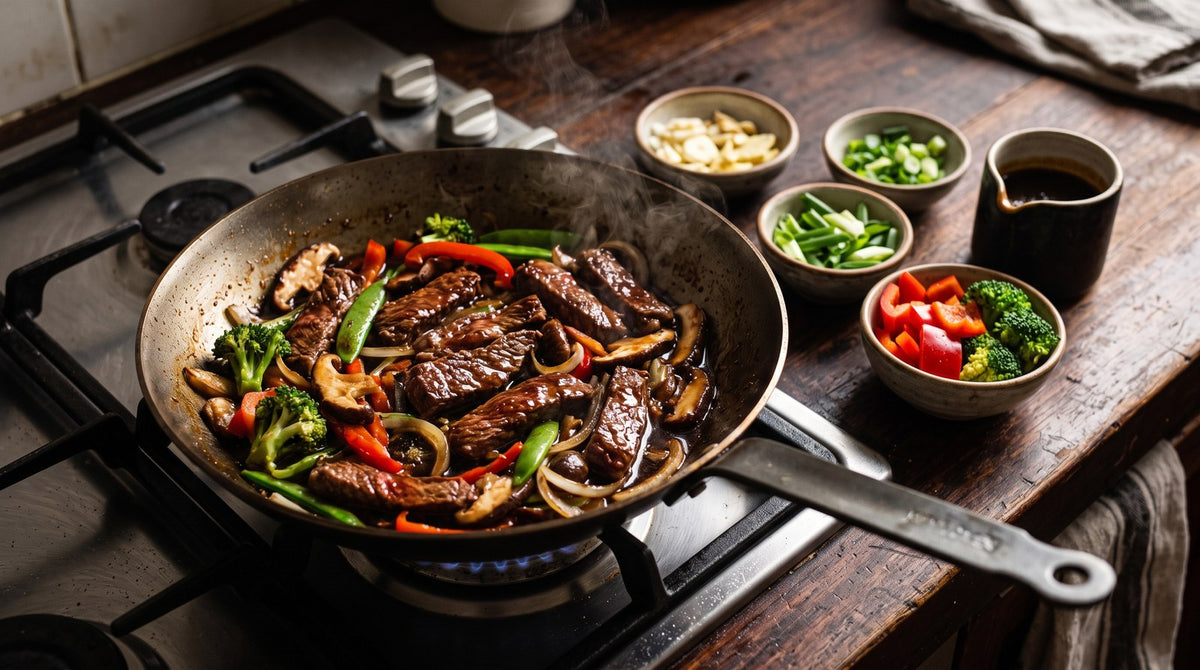
You bought the dark soy. You bought the sesame oil. You followed the recipe to the gram.
And it came out tasting like… stir-fried chicken. 🍗
Fine. Edible. Not takeaway.
The short answer: how to make Chinese food taste like takeaway comes down to five things almost every home cook skips. The meat is treated before it's cooked. The pan is loaded in small batches. The sauce is pre-mixed and goes in at the very end. Everything is chopped before the heat goes on. And the last thing added isn't salt — it's umami. Fix them in that order and the gap closes fast.
I grew up in the back of those kitchens. My dad, Danny Lim, ran Chinese restaurants called Emperors of China, from Texas to Australia, and I spent my childhood on the wrong side of the pass watching him do this eight hours a night. None of what follows is a secret ingredient. It's five habits.
Work out which of the five is actually your problem
Most people fix the wrong one. They go buy a bottle of something when their real issue was that they put 700g of chicken in a 24cm pan.
Ten-second diagnosis:
| What your dish does | Which reason it is |
|---|---|
| Meat is chewy, dry, or squeaks on the tooth | 2 — no velveting |
| Grey meat, liquid in the bottom of the pan, nothing browned | 1 — crowded pan |
| Tastes like soy sauce sitting on food rather than in it | 3 — the sauce |
| Garlic burnt, capsicum raw, all in the same dish | 4 — prepping while cooking |
| Genuinely fine. Just… flat. Something's missing | 5 — umami |
Two of these will be you. Start there.
1. Your pan is crowded, so you're steaming — not frying
Every article on this topic tells you the same thing: restaurant burners are ten times hotter than yours, that's the whole answer, sorry.
It isn't, and I've always found that a lazy answer. Here's what the heat is actually for.
That giant flame exists because a shop wok is holding four serves at once. It has to dump enough energy into two kilos of cold food to keep the metal above the point where water flashes off instead of pooling. You are cooking for two. You need a fraction of that power, and your stove already has it.
What you don't have is the discipline about load. Meat hits a cool, wet, crowded pan, releases its moisture, and now it's simmering in its own juice. Grey. Bland. Weeping.
The fix, in numbers:
- 250–300g of meat per batch. Cooking for four? Two batches, straight into a bowl, both back in at the end.
- Preheat 3–4 minutes on your highest setting before the oil goes anywhere near it. Flick a drop of water on: if it skitters and vanishes, you're there. If it sits and bubbles, you're not.
- Dry meat. Paper towel, both sides, properly. Surface water is the enemy of browning and there's more of it on supermarket chicken than you'd think.
- Don't stir for the first 45 seconds. Let it sit and take colour. "Stir-fry" is a terrible translation — most of the time the food is standing still.
You'll hear the difference before you taste it. A loaded pan hisses. A correctly loaded one cracks.
2. You seasoned the meat. You never velveted it
This is the big one, and it's the reason the phrase "tastes like takeaway" is misleading. Half the time people don't mean taste at all. They mean the chicken in the takeaway container is soft, slippery and juicy, and theirs is a bit like a pencil eraser.
That's not seasoning. That's velveting: a coating step done before the meat ever sees heat, which raises the surface pH and holds moisture in during the fast, brutal cook. Every piece of meat in every Chinese restaurant you've eaten at has been through it. Nobody tells home cooks this, and it drives me mad.
The traditional version: a pinch of bicarb soda, a teaspoon of cornflour, a splash of water, 30 minutes in the fridge, then rinse. It works. Overdo the bicarb by a whisker and it tastes soapy, which is the mistake I see most.
The version I use now is our own bottled one, because I got sick of teaching people the ratio: 1–2 tbsp YumYum Meat Velvet plus 1–2 tbsp water per 250g of meat, massaged in, rest 30 minutes. No rinsing, no soapiness, and it seasons at the same time. Beef, chicken, pork, lamb, same numbers.
If you only change one thing this week, change this one. Full method here: How to Velvet Meat at Home, and if your chicken specifically has been letting you down, Why Is My Chicken Tough & Rubbery in Stir-Fry? goes through the five causes one at a time.
3. Your sauce is a pour, not a mix
Watch a home cook and a takeaway cook make the same dish. The difference is visible in one moment.
The home cook reaches for the soy bottle mid-cook and glugs. Then the oyster sauce. Then a bit more soy because it needed something. Each addition hits a screaming hot pan and half of it evaporates on contact, leaving salt behind and taking the aroma with it.
The shop cook has a bowl of sauce, mixed before service, sitting next to the wok. It goes in once, at the end, and it's out in twenty seconds.
Two things that bowl has that your glugging doesn't:
A thickener. That glossy coating that clings to the broccoli instead of pooling under it is cornflour. Roughly 1 tsp cornflour per 125ml (½ cup) of liquid, whisked in cold. Cold, or you get lumps. It also has to boil for a good 20–30 seconds or it stays chalky and tastes raw.
Sweet against salt. Nearly every Australian Chinese takeaway sauce has a small amount of sugar in it, and most home cooks leave it out entirely because it feels wrong. A teaspoon of sugar in a stir-fry sauce doesn't make it sweet. It makes it round. Take it out and the soy sticks out like a splinter.
A base that works for almost anything: 2 tbsp light soy, 1 tbsp oyster sauce, 1 tsp sugar, 1 tsp cornflour, 125ml water or stock, splash of Shaoxing if you have it. Mix it in a mug in the morning if you like. It keeps.
For a fresher, greener version to spoon over chicken, noodles or rice, we've got the whole method here: The 5-Minute Soy Scallion Sauce.
4. You're chopping while the pan is hot
The actual cooking of a stir-fry takes about ninety seconds. Everything else is prep.
A takeaway kitchen is designed around that fact, which is why it looks like a surgery from the back. Every ingredient is already cut, portioned into a tray, within arm's reach, in the order it goes in. The chef isn't cooking faster than you. The chef is cooking the same speed as you, with an hour of prep already banked.
When you chop garlic while the beef is in the pan, you have made an unforced choice: either the garlic goes in raw and late, or the beef overcooks while you catch up. Both show up in the final dish.
Line everything up before the burner goes on. Aromatics in one bowl. Hard veg in another. Soft veg in another. Sauce in a mug. Meat drained and dry on a plate. It feels fussy for exactly one meal, and then it feels like the only sane way to do it.
Order of operations, which is the same in every wok dish worth eating:
- Oil, then meat. Sear, don't touch, then remove to a bowl while it's just underdone.
- Aromatics — garlic, ginger, white parts of spring onion. 10 to 15 seconds. They burn fast and burnt garlic ruins the whole plate.
- Hard veg first (carrot, broccoli stem, onion), soft veg after (capsicum, beansprouts, greens).
- Meat back in, sauce in, toss until it goes glossy. Twenty to thirty seconds.
- Off the heat. Finish. Serve immediately. A stir-fry that sits for five minutes stops being a stir-fry.
5. You're seasoning with salt. The shop is seasoning with umami
Here's the last gap, and it's the one people can taste but can't name. The dish is cooked properly, the meat is tender, the sauce is glossy, and it still reads as slightly less than the container from down the road.
Salt makes food taste seasoned. Umami, the fifth taste, the deep savoury one behind parmesan, anchovies, mushrooms and a long-simmered stock, makes it taste finished. Restaurant kitchens have that depth built into everything they touch: the stock that's been on the back burner since ten in the morning, the oyster sauce, the fermented pantry, the wok itself.
You've got twenty minutes and a Tuesday. So the shortcut is a dry one.
Half a teaspoon of a good umami seasoning tossed through at the end of a two-serve dish does what an afternoon of stock-making does. It doesn't overpower. It elevates what's already there. That's the whole job of the YumYum Umami Red Can — and if you want the theory behind why it works, we wrote the long version: Umami: The Fifth Taste. If your food has been reading flat across the board and not just in Chinese cooking, Why Does My Cooking Taste Bland? is the diagnostic version.
Start at half a teaspoon per two serves. Taste. If the dish already has a lot of soy or oyster sauce in it, halve that again.
The house stir-fry: everything that makes Chinese food taste like takeaway, in one dish
Not a recipe so much as a template. Swap the meat, swap the veg, keep the shape.
Serves 2 · 30 min (25 of it hands-off) · one pan
You need
- 300g chicken thigh, beef rump or pork loin, sliced thin against the grain
- 1–2 tbsp YumYum Meat Velvet + 1–2 tbsp water
- 2 tbsp neutral oil
- 2 cloves garlic, sliced · 1 tsp grated ginger · 2 spring onions, whites and greens separated
- 400g mixed veg — whatever's in the crisper
- ½ tsp YumYum Umami Seasoning
- Sauce: 2 tbsp light soy · 1 tbsp oyster sauce · 1 tsp sugar · 1 tsp cornflour · 125ml water · 1 tbsp Shaoxing (optional)
Method
- Massage the Meat Velvet and water into the sliced meat. Cover, fridge, 30 minutes. Go and do something else.
- While it rests: cut everything, separate hard veg from soft, mix the sauce in a mug, line it all up next to the stove.
- Pat the meat dry-ish. Heat the pan on high, 3–4 minutes, until a water drop skitters. Add 1 tbsp oil.
- Meat in, spread flat, don't touch it for 45 seconds. Toss, another 30 seconds, out to a bowl while still slightly underdone.
- Second tbsp of oil. Garlic, ginger, spring onion whites — 15 seconds, moving constantly.
- Hard veg, 90 seconds. Soft veg, 45 seconds.
- Meat back in with its juices. Sauce in. Toss until it turns glossy and coats, 20–30 seconds.
- Off the heat. Umami seasoning and spring onion greens over the top, one last toss. Straight onto rice. 🔥
If it tastes 90% of the way there, it's the sauce balance: a splash more soy, or a pinch more sugar, and taste again.
Chef's note
Dad had a rule about who was allowed near the wok, and it had nothing to do with stir-fries.
"Until you get your fried rice right, you aren't able to serve customers. It's the easiest dish to cook, but the hardest to master." — Danny Lim
He meant that fried rice hides nothing. No sauce to cover a mistake, no marinade doing the work. If your heat control is wrong, or your rice is wet, or your seasoning is timid, it's right there on the plate.
Everything on this page is really the same lesson. Takeaway food doesn't taste better because of a bottle you haven't found. It tastes better because five boring habits are in place before anything hits the pan. Get those, and the bottles become optional.
Well. Mostly. 😄
If you want the fried-rice version of this conversation specifically, that's where the whole thing started for us: Why Your Fried Rice Tastes Flat.
Common questions
Do I need a wok to make Chinese food taste like takeaway?
No. A wide, heavy frying pan works better than a thin wok on a domestic stove, because a home burner can't heat a round wok's sides anyway. What matters is that the pan is heavy enough to hold its heat when cold food lands, and wide enough that 250–300g of meat sits in one layer. Carbon steel is ideal. A cast-iron or stainless pan is fine.
Why is my stir-fry watery?
Three usual causes, in order of likelihood: too much food in the pan at once, meat that wasn't patted dry, and vegetables added straight from a rinse. Cook in smaller batches, dry everything, and if you're using frozen veg, thaw and drain it first. A cornflour-thickened sauce added at the end will also bind the moisture that's already there.
Can I get wok hei on an electric or induction stove?
Not the real thing. Wok hei needs a flame licking the metal. But you can get most of the flavour benefit by preheating a heavy flat-bottomed pan for a full 3–4 minutes, cooking in small batches, and leaving the food undisturbed long enough to brown. Browning is doing most of the work people attribute to wok hei.
Is the secret ingredient just MSG?
Umami is doing the work, and umami comes from plenty of places — stock, oyster sauce, fermented pantry ingredients, and yes, MSG, which is what most Chinese restaurants reach for. It's less controversial than its reputation suggests. We covered the how-much-and-when properly here: How to Use MSG in Cooking.
What sauce do Chinese takeaways actually use?
There's no single bottle. Most shops build one house sauce base (soy, oyster sauce, a little sugar, stock and cornflour) mixed in bulk before service, then adjust per dish with things like hoisin, chilli bean paste, black vinegar or sesame oil. That's why every dish on the menu tastes related. Copy the structure, not a specific recipe.
The short version
Batch size. Velveting. A pre-mixed sauce. Prep before heat. Umami at the end.
Nobody at the shop is doing anything you can't do on a Tuesday night. They're just doing all five, every time, without thinking about it.
The two that move the needle fastest are the tenderising step and the finish, which is exactly why they're the two products we make: Meat Velvet for the texture, the Umami Red Can for the finish. ✨
Cooking for the family? The Four-Pack of YUM ($60) ships free (free AU shipping over $50), works out cheaper per can, and gives you the Meat Velvet and the Red Can plus the two signature blends for the nights you want the takeaway menu rather than the technique. It's the one most people end up on.
Written by Vincent Lim — chef, cookbook author, and co-founder of YumYum. Vincent grew up in his family's Chinese restaurants and learned to cook from his father, Danny. He shares the restaurant techniques most home cooks are never told.
Researched and drafted with AI assistance, edited and kitchen-checked by the YumYum team.