
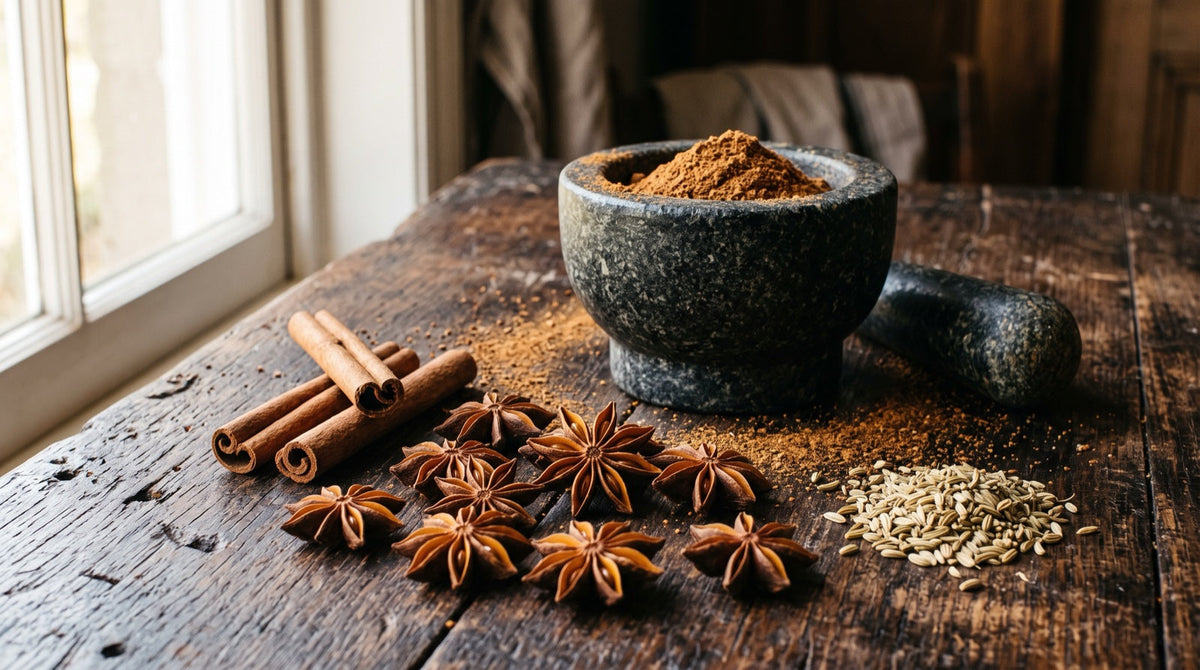
The pork's already marinating. The oven's on.
And the five spice jar is empty. 🔥
Here's the honest version: there is a good substitute, most of the internet gets it slightly wrong, and one popular swap will genuinely wreck the dish. Let's fix your dinner first, then I'll explain why.
The 30-second answer
| If you have… | Use this per 1 tsp five spice | Works for |
|---|---|---|
| Star anise + cinnamon | ½ tsp ground star anise + ½ tsp ground cinnamon | Almost everything — the best 2-ingredient fix |
| Allspice + fennel | ½ tsp allspice + ¼ tsp ground fennel | Roasts, marinades, braises |
| Garam masala + star anise | ¾ tsp garam masala + ¼ tsp ground star anise | Marinades, stir-fries |
| Allspice only | ½ tsp | An emergency. Warm, but not Chinese |
| Pumpkin pie spice | ½ tsp, sweet dishes only | Baking, glazes. Not savoury mains |
| Za'atar or ras el hanout | Don't | Nothing. See below |
The move, if you only remember one line: star anise plus cinnamon gets you 80% of the way there.
What five spice actually is (and why swapping is fiddly)
Chinese five spice is built around five aromatics:
- Star anise — the licorice-warm one. The signature.
- Cassia or cinnamon — sweet woody warmth.
- Fennel seed — a second, softer anise note.
- Cloves — deep, almost medicinal if you overdo it.
- Sichuan pepper — citrusy, faintly numbing.
"Five" is more a concept than a headcount, by the way. Plenty of regional blends swap in ginger, dried orange peel or licorice root. Nobody's cheating.
The reason substituting is fiddly: four of those five are warm-sweet spices you probably do have. The one that makes it taste Chinese — star anise — is the one people leave out.
The myth that page one keeps repeating
Search this question and nearly every result says the same thing: use allspice.
It's not terrible advice. It's just built on a misunderstanding baked into the name.
Allspice is not "all the spices." It's a single dried berry — pimento — that happens to taste like clove, cinnamon and nutmeg had a meeting. It's one note pretending to be three.
So allspice covers the warm end of five spice nicely. What it has none of is anise. No licorice, no fennel, no sweet aromatic lift. You end up with something that smells like Christmas and tastes like a spiced roast — pleasant, but nobody at the table is thinking Chinese takeaway.
That's the whole fix: if you use allspice, add fennel. A quarter-teaspoon of ground fennel seed per half-teaspoon of allspice puts the missing note back. Fennel is in almost every Aussie spice rack because it's in curry powders and Italian sausage — check before you assume you're out.
Pick your substitute by what you're cooking
This is the part the listicles skip, and it matters more than the ranking does.
Char siu, honey soy, sticky pork marinades
Go star anise + cinnamon, slightly heavy on the star anise. Marinades sit for hours, so the anise has time to bloom and it needs to survive a hot oven. Garam masala also works here — it's the one job where its extra coriander and cardamom read as "aromatic" rather than "wrong cuisine."
A braise or master stock
Use whole spices, not ground. Crack a whole star anise and a cinnamon quill straight into the liquid. Long wet cooking pulls flavour out of whole spices beautifully, and ground powder just goes cloudy and slightly gritty. This is the one case where not having the powder is an upgrade.
Roast vegetables, pumpkin, cauliflower
Star anise + cinnamon, and go light — roasting concentrates everything. (We've written the full method for five spice roast veg that comes out crispy instead of bitter, including the two-stage spicing trick, if you want the whole thing.)
A dusting for stir-fry or fried rice
Honestly? Skip the substitute. Five spice is a cooked spice — it wants oil and heat to open up. Thrown over a finished dish it tastes raw and dusty. Season with salt and white pepper instead and save the five spice for the next thing you roast.
The one that genuinely ruins it
Za'atar. And close behind it, ras el hanout.
Both turn up on those substitute lists, and I'd love to know who tested them.
Za'atar is thyme, sesame and sumac. Sumac is sour — sharply, deliberately sour. There is no sourness anywhere in five spice, so it doesn't read as a near-miss; it reads as a mistake. Herbal, tangy, toasted sesame. Lovely on a flatbread. Nowhere near a char siu.
Ras el hanout is a fairer swap in that it's at least warm, but it's built on cumin, coriander and often rose or chilli. Cumin is loud. Put cumin where anise should be and the dish stops being Chinese and starts being vaguely North African.
And the quiet one that ruins more dinners than either: using too much. Which brings me to the bit I actually care about.
Chef note: the real mistake isn't the substitute
Growing up in Dad's kitchens, five spice lived in two places — the braise pot and the char siu marinade. It never got shaken over things the way home cooks shake it.
That's because five spice is strong. Cloves and star anise are two of the most assertive spices in the rack, and both are in there. Get heavy-handed and it goes bitter and faintly medicinal — that "too perfumed" flavour people blame on the spice being old when it's really just too much of it.
The dose most recipes should say and don't: about ¼ to ½ teaspoon per 500g of meat or veg. Not a tablespoon. Not "a good shake."
So if your five spice dishes have been disappointing, there's a decent chance the jar was never the problem. My father used to say that until you get your fried rice right, you aren't able to serve customers — it's the easiest dish to cook, but the hardest to master. Same logic applies here. The simple spices are the ones that punish a heavy hand.
One more thing worth knowing: ground spice blends go flat in about six months once opened. If yours has been in the cupboard since a Christmas ham two years ago, you're not tasting five spice, you're tasting dust. A tired jar and no jar are closer than you'd think — which is a decent argument for buying smaller and using it faster. (We got into this properly in our guide to what all-purpose seasoning to actually buy, where "how long has it been open" beats almost every other buying test.)
Make your own (if you've got the spices)
If you've got the individual spices, this makes a genuinely good blend — better than most jars, because it's fresh:
Ingredients
- 2 tsp ground star anise
- 2 tsp ground cassia or cinnamon
- 2 tsp ground fennel seed
- 1 tsp ground Sichuan pepper (or black pepper at a push)
- 1 tsp ground cloves
Method
- If you're starting from whole spices, toast them dry in a pan over medium heat for 2–3 minutes, until they smell like something. Don't walk away — cloves and fennel catch fast.
- Cool completely. Warm spices sweat and clump in the grinder.
- Grind to a fine powder in a spice grinder or mortar.
- Sieve out the gritty bits. Star anise pods are woody and won't fully break down.
- Store in a sealed jar away from the stove. Use within about six months.
Makes roughly 8 tsp — enough for a lot of pork belly.
Tip: toasting is not optional if you want it to taste like a restaurant rather than a spice aisle. It's 3 minutes and it's the entire difference.
Or just don't run out
All of the above works. None of it is as good as having the blend already balanced for you — which is the actual job a five spice does. Getting the ratio of anise to clove right is the whole craft, and it's the bit that goes wrong when you're improvising at 6pm with the oven already hot.
That's what we built Emperor's Dust — Dynasty 5 Spice for: a five spice balanced by chefs who cook with it, so it lifts pork, duck, roast veg and char siu without that bitter over-anise edge that puts people off the spice for years. One scoop, no arithmetic. It doesn't overpower — it elevates. ✨
Cooking for a family or a bit of a spice obsessive? The Three-Pack of Emperor's Dust ($50) ships free (free AU shipping over $50) and works out cheaper per can — or grab the Four-Pack of YUM ($60) if you want the whole range on the shelf. And if you're still working out which seasoning does which job, start with what umami actually is and why it's the thing you're missing.
Frequently asked questions
What is the best substitute for Chinese five spice?
Half a teaspoon of ground star anise plus half a teaspoon of ground cinnamon, per 1 teaspoon of five spice called for. Star anise is the spice that makes five spice taste like five spice, so any substitute without it will taste warm but not Chinese.
Can I use allspice instead of Chinese five spice?
Yes, at about half the quantity — use ½ tsp allspice per 1 tsp of five spice. It's an imperfect swap because allspice is a single berry with no anise or fennel notes at all. Adding ¼ tsp of ground fennel seed alongside it gets you much closer.
Is garam masala a good substitute for five spice?
It's usable in marinades and stir-fries at roughly ¾ tsp garam masala plus ¼ tsp ground star anise per 1 tsp of five spice. Straight garam masala on its own leans toward cumin and coriander, which pulls the dish away from Chinese flavours.
What should I never use instead of five spice?
Za'atar and ras el hanout. Za'atar contains sumac, which is sour — there's no sourness in five spice at all. Ras el hanout is cumin-forward. Both change the cuisine of the dish rather than substituting within it.
How much five spice should I use?
About ¼ to ½ teaspoon per 500g of meat or vegetables. Five spice is potent — cloves and star anise are both assertive — and the bitter, medicinal flavour people blame on the spice is usually just too much of it.
Can I make Chinese five spice at home?
Yes: 2 tsp each of ground star anise, cassia or cinnamon and fennel seed, plus 1 tsp each of ground Sichuan pepper and cloves. Toast whole spices for 2–3 minutes before grinding — that step is the difference between homemade and restaurant.
Written by Vincent Lim — chef, cookbook author, and co-founder of YumYum. Vincent grew up in his family's Chinese restaurants and learned to cook from his father, Danny. He shares the restaurant techniques most home cooks are never told.
Researched and drafted with AI assistance, edited and kitchen-checked by the YumYum team.