
You've got two recipes open.
One swears by bicarb. The other says cornflour, absolutely never bicarb. Both promise chicken like the takeaway down the road, and they can't both be the whole story. 🔥
They aren't. Here's the bit neither recipe tells you.

The 30-second answer
Baking soda and cornflour aren't rivals — they do two different jobs. Baking soda raises the meat's pH so the proteins can't clench up, which is what makes it tender. Cornflour is a coat: it holds moisture in during the hit of the wok and gives you that glossy, sauce-clinging surface. Tenderness comes from the bicarb. The velvet comes from the cornflour. A proper restaurant velvet uses both, in that order.
| Baking soda (bicarb) | Cornflour | |
|---|---|---|
| What it actually does | Raises pH, stops proteins tightening | Forms a thin barrier and holds moisture |
| Makes meat tender? | Yes — this is the tenderising step | No. Not even slightly |
| Makes it silky/glossy? | No | Yes — this is the velvet |
| Helps sauce cling? | No | Yes |
| Dose per 500g meat | ½–1 tsp | 1 tsp–1 tbsp |
| Rinse before cooking? | Only at the higher dose | Never |
| Ruins the dish if you overdo it | Yes — soapy, metallic, mushy | Gluey, pasty coating |
How I'm judging this
I grew up in my family's Chinese restaurants — Emperors of China, run by my late dad, Danny Lim. Velveting wasn't a technique we looked up. It was prep. Tubs of sliced chicken and beef done before service, so that when a wok order came in the meat was already going to behave.
So I'm not grading these two on what a food-science page says. I'm grading them on the two things a wok line actually cares about: does the meat come out tender, and does it come out looking like the photo. 🍗
What baking soda actually does
Bicarb doesn't "break down" the meat. That's the line you'll read everywhere and it's the wrong mental model — it makes bicarb sound like a papaya-style tenderiser chewing through the fibres, which is not what's happening.
What it does is shift the pH of the surface upwards. Muscle proteins at a higher pH can't bond as tightly to each other when they hit heat. Tight bonds are what squeeze the water out and hand you a dry, springy piece of chicken. Loosen the bonds and the water stays put.
That's the whole trick. Nothing is being dissolved. The meat is just being talked out of clenching.
Dose, per 500g of sliced meat:
- ½ tsp — light touch. Chicken thigh, chicken breast, pork. No rinse needed.
- 1 tsp — for tough beef: chuck, blade, budget rump. Rinse this one.
- More than 1 tsp — don't. This is where dinner goes wrong.
Now, the internet on this point is a mess. I've seen ½ tsp per pound, 1 tsp per 8oz, and 1½ tsp per 500g all published as the correct amount, and the gap between the smallest and the biggest is about fourfold. That spread is why so many people try velveting once, get a mouthful of soap, and never try again.
Two things that go wrong:
You left too much bicarb on. It tastes soapy and faintly metallic, and the surface goes slightly slimy in a way you'll notice immediately. There's no rescuing it once it's cooked — it's a rinse-and-restart. If that's already happened to you, the fix for the baking soda taste is a whole article of its own.
You put the bicarb into an acidic marinade. Bicarb and acid react — that's the school volcano. Tip it in with lemon juice or vinegar or a heavily acidic sauce and a chunk of it is spent fizzing instead of working on the meat. Bicarb goes on plain meat first, on its own. Marinade after.
One more thing worth knowing: bicarb works from the outside in and doesn't travel far. Which is exactly why every velveting recipe nags you about slicing thin — a 3mm slice is almost all "surface", and a 25mm cube is mostly untouched middle. The slicing isn't a serving-suggestion. It's part of the mechanism.
What cornflour actually does
Cornflour tenderises nothing. Zero. If cornflour is all you're using, you've got a coated piece of meat that's exactly as tough as it was before.
What it gives you is the velvet — the reason the technique has that name. Whisked with a splash of water or egg white and rubbed over the slices, it sets into a barrier so thin you can't see it, and that barrier does two useful things in a screaming-hot pan. It slows the water escaping, so the meat stays juicy through a hard sear. And it gives the sauce something to grab, which is why takeaway beef looks lacquered and yours slides around in a puddle. ✨
Dose, per 500g of sliced meat:
- 1–2 tsp — a bare silk coat. You want tender meat, not a coating.
- 1 tbsp — a proper glossy jacket. Use this when there's a real sauce to hang onto.
Two rules with it. Cornflour goes on last, after every liquid is already in and absorbed, or it seizes into lumps you'll be picking off. And it needs actual heat and a bit of oil to set — a lukewarm pan turns that lovely coat into wallpaper paste.
The Australian cornflour trap
Here's one the American blogs can't warn you about, because it isn't a thing where they live.
In Australia, "cornflour" on a supermarket shelf is two different products. One is maize cornflour, made from corn. The other is wheaten cornflour, which is made from wheat — same white box, same word on the front, different plant entirely.
For velveting, both will coat your meat and both will work. But wheaten cornflour is a wheat product and is not gluten free, and it browns a touch differently. If it matters to whoever you're feeding, the pack tells you — it'll say maize or it'll say wheaten, usually in small print under the name. Flip it over before you assume. 🌿
The two-step velvet (this is the actual restaurant order)
Both, in sequence. It takes about 35 minutes, most of which is standing around.
- Slice thin — across the grain. 3–5mm. Find the direction the fibres run and cut at ninety degrees to it. Cutting with the grain gives you long chewy strings no amount of bicarb will save.
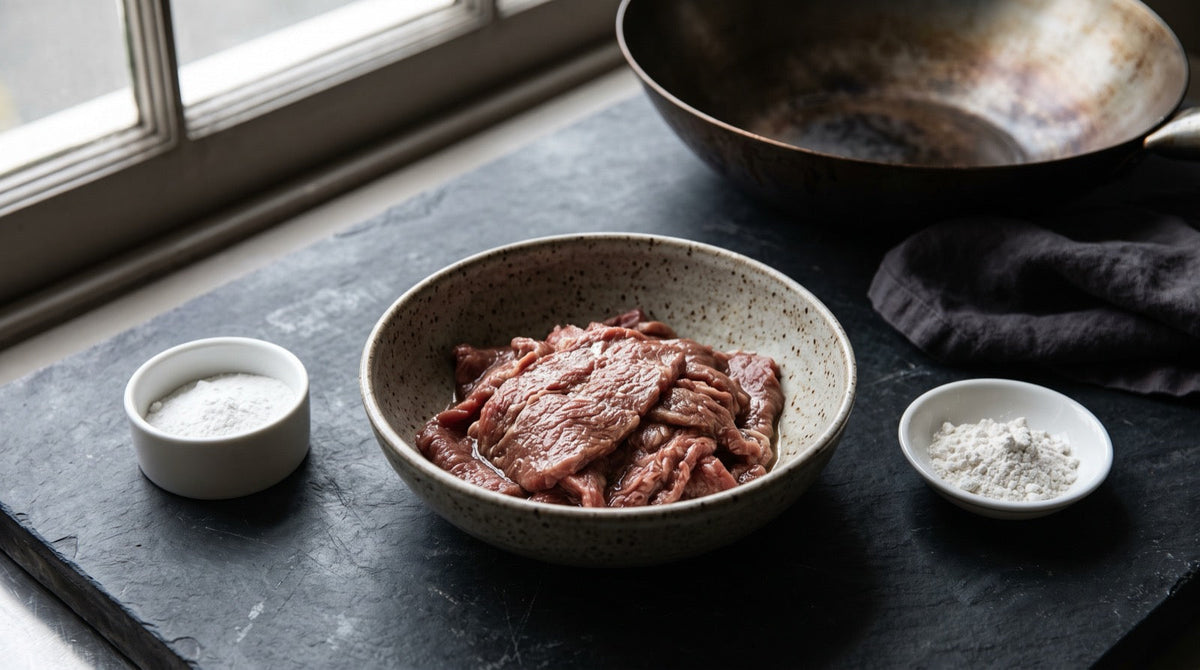
- Bicarb first, on bare meat. ½ tsp per 500g (1 tsp for tough beef). Toss it through with your hands until every piece has seen some. Nothing else in the bowl yet.
- Rest 15–20 minutes. Chicken at the short end, beef at the long end. Longer isn't better — past about half an hour at the high dose the surface starts going soft and floury.
- Rinse — but only if you used the full teaspoon. Cold water, about a minute, then pat properly dry with paper towel. Wet meat steams instead of searing. At the ½ tsp dose, skip this entirely; there isn't enough bicarb left to taste.
- Now the flavour. Soy, Shaoxing, white pepper, a little sesame oil, whatever the dish wants. Mix through and let it get absorbed.
- Cornflour last. 1–2 tsp per 500g, plus a tablespoon of water or one egg white if you want the full glossy version. Massage until the slices look coated and slightly tacky rather than wet.
- Hot pan, don't crowd it. Cook in two batches. A crowded pan drops in temperature, the coat never sets, and you've done all that work to end up with grey stewed meat.
Chef note
The thing nobody tells you is that at home you're usually solving a different problem to the one the restaurant was solving.
We were velveting because we had to run twenty covers through the same wok and every plate had to land identical. You're standing in your kitchen at 6:45pm with a chicken breast and a hungry family, and the version of this that gets used on a Tuesday is the version that doesn't need a set of measuring spoons and a sink.
So the honest advice: if you're cooking a special one, do the full two-step above. It's better, and it's not hard. If it's a weeknight and the whole reason your stir-fry disappoints is that the chicken comes out like a squash ball — the ½ tsp of bicarb alone, no rinse, does most of the heavy lifting. The cornflour is the polish. The bicarb is the fix.
Which one, for what
- Chicken breast, weeknight stir-fry → bicarb (½ tsp/500g), no rinse. Cornflour optional.
- Cheap beef — chuck, blade, budget rump → both, full method, and rinse the bicarb off.
- Anything with a proper sauce (black bean, honey soy, Mongolian) → both, and go the full tablespoon of cornflour so the sauce clings.
- Lamb → both, and slice it properly thin; lamb has its own quirks.
- Pork for a quick fry → bicarb only, short rest, 15 minutes is plenty.
- Prawns → neither, really. They don't need it and bicarb makes the texture oddly bouncy.
If you'd rather not run a chemistry set on a Tuesday
Two powders, two doses, two rest times, a rinse decision and a slicing rule. It works. It's also five more things to get right at the end of a workday, and getting one of them wrong is why most people quit after the soapy attempt.
That's the exact reason we bottled YumYum Meat Velvet. It does the tenderising job and the silky-coat job in a single step, already measured, so there's no weighing, no rinsing and no second bowl.
How to use it: 1–2 tbsp Meat Velvet plus 1–2 tbsp water per 250g of meat. Mix through, rest 30 minutes, straight into a hot pan. That's it. Works on chicken, beef, pork, lamb, prawns and tofu. One bottle is $17 and gets you around ten dinners.
Cooking for the family? The Meat Velvet Three-Pack is $50 and ships free (free AU shipping over $50), which works out cheaper per bottle than buying them one at a time. If you want the seasonings alongside it, the 6 Bundle Mix is $90 for three Meat Velvet and three signature seasonings. 🔥
And if you're weighing up the powder against doing it by hand, we put the two head to head here.
Questions people actually ask
Can I use cornflour instead of baking soda for velveting?
You can, but you won't get tender meat — you'll get coated meat. Cornflour makes the surface silky and helps sauce stick; it has no effect on how tough the meat is. If tenderness is the problem you're trying to solve, you need the bicarb.
Can I use baking soda instead of cornflour?
Yes, and honestly for a weeknight it's the more useful of the two on its own. You'll get tender meat without the glossy coat, and your sauce won't cling as well. ½ tsp per 500g, rest 15–20 minutes, no rinse needed at that dose.
Do I have to rinse the baking soda off?
Only at the higher dose. At 1 tsp per 500g, rinse under cold water for a minute and pat dry. At ½ tsp per 500g there's not enough left to taste, so skip it — the rinse costs you the marinade you just made anyway.
Is baking powder the same as baking soda for this?
No. Baking powder is baking soda already blended with an acid, which means a good chunk of it is chemically spent before it touches your meat. It's much weaker at raising pH. Use plain bicarbonate of soda.
How long can I leave meat in baking soda?
15–20 minutes for thin slices. Past about 30 minutes at the full dose the surface starts going soft and slightly floury, and it doesn't come back. This is one of the few kitchen steps where a timer genuinely beats guessing.
Does velveting work on mince?
Sort of, but it's a different job — mince has enormous surface area, so it needs far less bicarb and a much shorter rest. Treat the doses above as a starting point and halve them.
Written by Vincent Lim — chef, cookbook author, and co-founder of YumYum. Vincent grew up in his family's Chinese restaurants and learned to cook from his father, Danny. He shares the restaurant techniques most home cooks are never told.
Researched and drafted with AI assistance, edited and kitchen-checked by the YumYum team.