
You've had it a hundred times without knowing what it was.
That beef in your local's Mongolian beef that gives way like butter. The chicken in the black bean that's somehow silky when the chicken you cook at home comes out like a squash ball. 🥢
That's velveting. And the reason your version doesn't taste like theirs isn't the wok, the heat, or the sauce. It's a five-minute step that happens before the meat ever sees the pan.
Here's the whole technique — and, more importantly, which version of it each protein actually needs. Because most of what's written about velveting online is answering a different question than the one you're asking.

First: velveting is two techniques, not one
This is the bit that trips everyone up, so let's get it out of the way.
Search "velveting" and you'll get two completely different sets of instructions, both called the same thing. They do different jobs. A proper restaurant velvet uses both, in order.
| What it does | What you use | What it feels like if you skip it | |
|---|---|---|---|
| Step 1 — Tenderise | Raises the surface pH so the muscle proteins can't clench up and squeeze out moisture | Bicarb soda (baking soda) | Chewy. Springy. The squash-ball problem. |
| Step 2 — Coat | Lays down a thin starch jacket that holds moisture in and gives sauce something to cling to | Cornflour, often with water or egg white | Dry and grey. Sauce slides straight off. |
| Step 3 — Blanch | A 40-second pre-cook that sets that jacket before the meat hits the hot wok | Simmering water, or warm oil | Nothing is "velvet" without it. This is the step home cooks skip. |
Tenderising is chemistry. Coating is insurance. The blanch is what turns the two into that specific glossy, slippery texture the word "velvet" is actually describing.
Most pages online teach step 1, call it velveting, and stop. It's not wrong — bicarb alone genuinely fixes tough meat — but it's a third of the technique.
The table you actually came here for
Different proteins need different amounts of help. A chicken thigh is already tender and fatty; a budget rump is neither. Treating them the same is why people get inconsistent results and decide velveting "doesn't really work."
Doses are per 500g of thinly sliced meat.
| Protein | Bicarb? | Cornflour | Rest | Notes |
|---|---|---|---|---|
| Chicken breast | ½ tsp | 1–2 tsp | 20–30 min | The classic problem cut. Bicarb matters here more than people think. |
| Chicken thigh | Optional (½ tsp) | 1–2 tsp | 20 min | Already forgiving. Do it for gloss, not rescue. |
| Beef — rump, porterhouse, sirloin | ½ tsp | 1–2 tsp | 30 min | The everyday stir-fry beef. |
| Beef — chuck, blade, budget stir-fry strips | 1 tsp, then rinse | 1–2 tsp | 30 min | The only one on this list that genuinely needs the full dose. |
| Pork loin / scotch fillet | ½ tsp | 1–2 tsp | 20–30 min | Lean and dries out fast. The coat is doing most of the work. |
| Lamb — backstrap, leg | ½ tsp | 1–2 tsp | 30 min | Slice it properly thin; lamb punishes thick slices. Full lamb method here. |
| Prawns | Skip | 1 tsp | 15 min | Bicarb on prawns goes rubbery and faintly soapy. Don't. |
Two rules that fall out of that table and matter more than the numbers:
Never go above 1 tsp of bicarb per 500g. Above that you're not tenderising, you're cooking dinner in a soapy, faintly metallic coating that no sauce will hide. If that's already happened to you, there's a whole piece on fixing the baking soda taste.
Rinse only at the full teaspoon. At ½ tsp per 500g there isn't enough bicarb left to taste, and rinsing just washes off the seasoning you've built. The internet's "always rinse" advice comes from recipes using twice the bicarb. The dose-and-rinse logic gets unpacked properly here.
The method, start to finish
Assume 500g of meat and a hot pan waiting.
- Slice it 3–4mm, across the grain. Not with it. Find the direction the muscle fibres run and cut at ninety degrees to them. Firm the meat in the freezer for fifteen minutes first and you'll cut twice as thin. This step does more for tenderness than anything else on this list.
- Bicarb goes on bare meat. Straight onto the slices, tossed through with your fingers until every piece has seen some. Nothing else in the bowl yet — bicarb is alkaline, and an acidic marinade sitting alongside it just fizzes and cancels it out.
- Wait 15–20 minutes. In the fridge if it's a warm day.
- Rinse — only if you used the full teaspoon. Cold water, about a minute, then pat properly dry with paper towel. Wet meat steams instead of searing, and steamed meat is grey.
- Now the flavour. Soy, shaoxing, white pepper, a little sesame oil, whatever the dish wants.
- Cornflour last. 1–2 tsp per 500g, plus a tablespoon of water or one egg white if you want the full glossy version. Massage until the slices look coated and slightly tacky rather than wet. Added earlier, it clumps.
- Rest 20–30 minutes. The coat needs to actually set. Rushing this is why the starch sloughs off in the pan.
- Blanch. See below.
- Into the wok, in batches of 250–300g. Crowding the pan drops the temperature and everything you just did is undone in ten seconds.
Water or oil? The step everyone skips
This is the difference between "tender meat" and velvet.
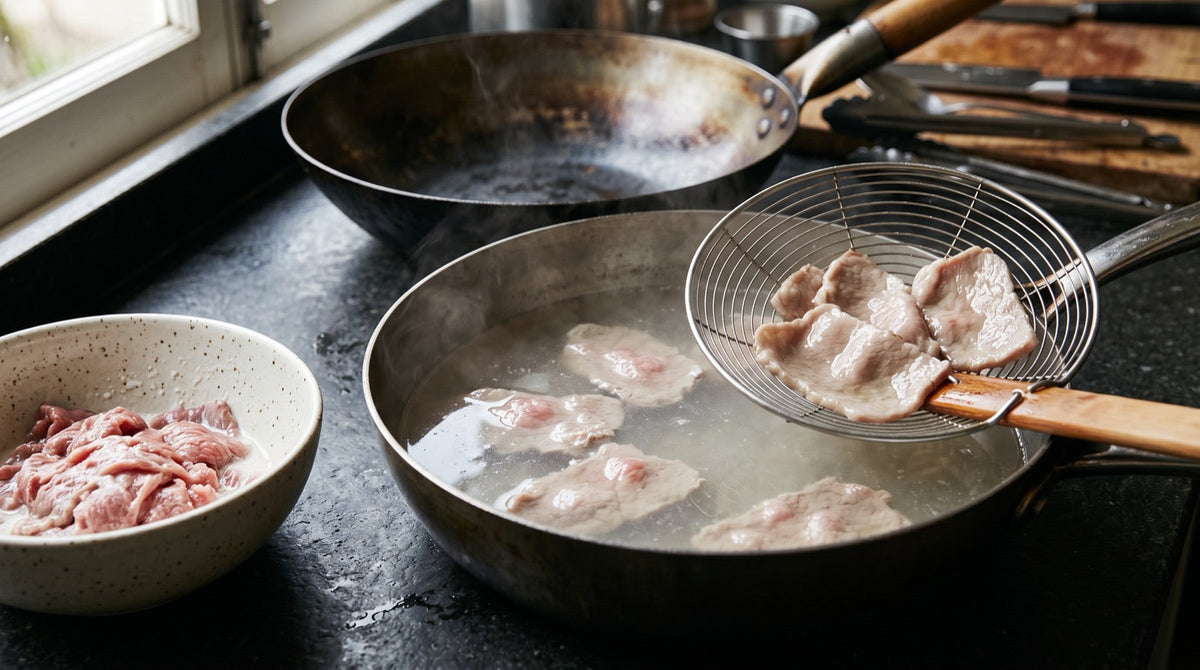
Water-blanch (水汆) — the home cook's version. Bring a pot of water to a bare simmer, not a rolling boil. Add a teaspoon of oil. Slide the meat in, separate the pieces with chopsticks, and pull it out after 40–60 seconds, the moment the outside turns opaque and the inside is still raw. Drain. Then finish it in the wok with your sauce.
Oil-blanch (過油) — the restaurant version. Same thing in oil at around 120–140°C — warm, not frying-hot. Thirty to forty seconds. It gives a richer, slicker result. It also means a wok of oil to deal with on a Tuesday night.
Water works. Use water. The chefs use oil because they've got a pot of it on all day, not because water fails.
The thing to hold onto: the meat comes out of the blanch undercooked on purpose. It finishes in the sauce. Blanch it to done and you've just boiled your stir-fry.
The Australian cornflour trap
Worth thirty seconds of your attention, because no overseas recipe will warn you about it.
In Australia, a box labelled "cornflour" can be one of two entirely different products. Maize cornflour is pure corn starch — that's the one you want. Wheaten cornflour is made from wheat, contains gluten, and behaves differently: it goes gluey rather than silky and it will not give you the same coat.
Check the ingredients panel, not the front of the box. If it says wheat, it's the wrong one for this.
When not to velvet
Velveting is a fix for a specific problem — thin, fast-cooked, lean or tough meat. It is not a universal upgrade, and using it where it doesn't belong is how people conclude it's overrated.
- Mince. There's no long muscle fibre structure to protect, so there's nothing for the bicarb to do. Mince wants fat and a hard sear instead.
- Anything going in a slow cooker or braise. Three hours of low heat does the tenderising for you.
- A steak you're searing whole. You want crust. A starch coat is the enemy of crust.
- Delicate fish. It'll break up in the blanch.
- Meat that's already good and sliced thin. A nice piece of backstrap doesn't need rescuing.
And if your stir-fry is still coming out wrong after all this, the meat may not be the problem — here are the five other things that make chicken tough in a wok.
The chef note
Dad ran Chinese restaurants — Emperors of China, Texas then Australia — and velveting wasn't a technique there, it was just Tuesday. Every protein in the walk-in was already velveted and sitting in trays before service started. Nobody velveted to order. That's the part home cooks never see: in a restaurant this happens hours before you sit down.
He was also relaxed about it in a way the internet isn't. His line was that if you sliced it properly thin and didn't crowd the pan, you were most of the way there before any powder came out.
He wasn't wrong. If you only take one thing from this page, take the 3–4mm slice across the grain. 🔪
The one-step version
Here's the honest summary of everything above: two powders, two doses, a rinse decision, two rest times and a blanch. It works, and it's genuinely worth doing properly for a weekend dish.
It's also five things to get right at the end of a workday, and getting one wrong is why most people try velveting once and never again.
It's also a fair question whether a bottled product beats doing it by hand — we put the two head to head here.
That's the entire reason Meat Velvet exists — the tenderising and the coating in one measured step, no rinse, no chemistry set on the bench.
How to use it: 1–2 tbsp Meat Velvet plus 1–2 tbsp water per 250g of meat. Mix through, rest 30 minutes, straight into a hot pan. Chicken, beef, pork, lamb, prawns, tofu. About ten dinners a bottle.
Cooking for a family, or just tired of running out? The Meat Velvet Three-Pack ($50) ships free — free AU shipping over $50 — and works out cheaper per can. If you want the rest of the range with it, the 6 Bundle Mix pairs three Meat Velvet with three signature seasonings. ✨
It doesn't overpower. It elevates.
Frequently asked questions
What does velveting actually do to meat?
Two things. Bicarb raises the surface pH so the muscle proteins can't bond tightly and squeeze out moisture during cooking, which is what makes meat go chewy. Cornflour then forms a thin starch jacket that holds that moisture in and gives sauce something to grip. The brief blanch sets the jacket before the meat hits high heat.
Can I velvet meat without baking soda?
Yes. Cornflour and a blanch alone will give you a silkier, glossier result and better sauce cling — you just won't get the tenderising. For already-tender cuts like chicken thigh, pork loin or backstrap, that's often all you need. For chuck or budget beef strips, the bicarb is the part doing the work.
How long should meat sit in a velveting marinade?
Twenty to thirty minutes for most things. Long enough for the coat to set, short enough that the bicarb doesn't start affecting texture past the surface. Beef can take the full thirty; prawns are done in fifteen. Overnight is not better — it's worse.
Do I have to rinse the baking soda off?
Only at the higher dose. At 1 tsp per 500g, rinse under cold water for a minute and pat properly dry. At ½ tsp per 500g there isn't enough left to taste, so skip it and keep your marinade.
Can you velvet meat the day before?
You can slice and velvet up to a day ahead and keep it covered in the fridge — that's exactly what restaurants do. What you shouldn't do is leave it in bicarb overnight; do the bicarb step, rinse or rest it, then coat and hold.
Why is my velveted meat still tough?
Nine times out of ten it's the slicing, not the marinade. Too thick, or cut with the grain instead of across it. After that: pan overcrowding, which drops the heat and steams the meat instead of searing it.
Written by Vincent Lim — chef, cookbook author, and co-founder of YumYum. Vincent grew up in his family's Chinese restaurants and learned to cook from his father, Danny. He shares the restaurant techniques most home cooks are never told.
Researched and drafted with AI assistance, edited and kitchen-checked by the YumYum team.