
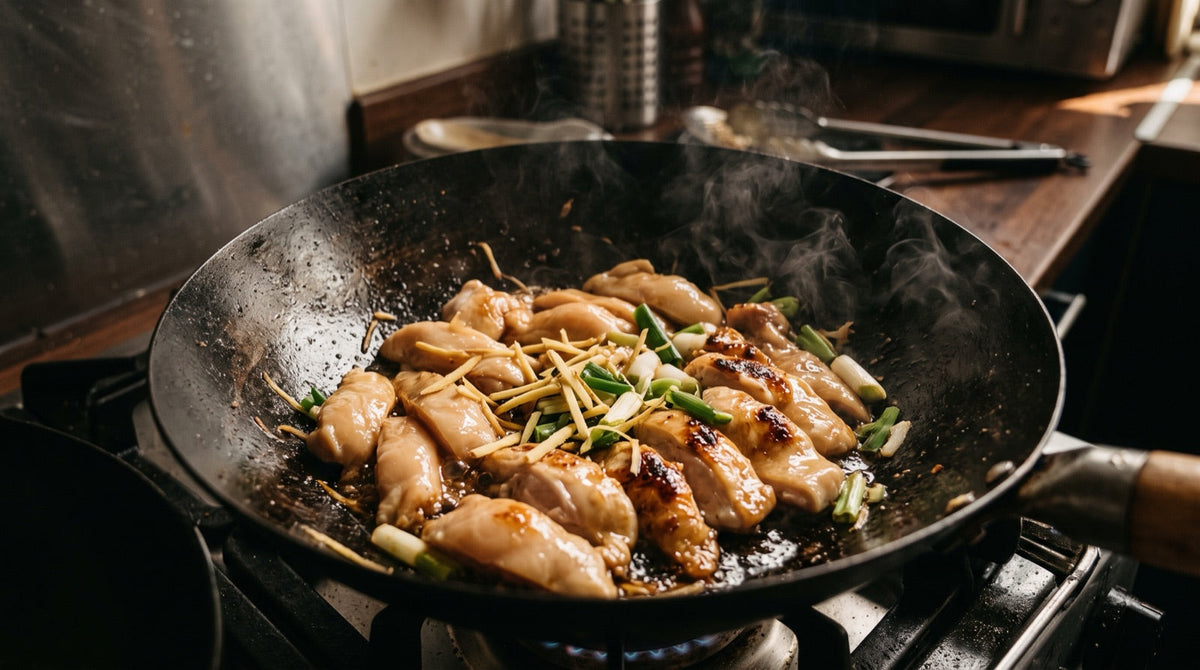
You did everything the recipe said. Bicarb, twenty minutes, into the wok.
And the chicken came out tender, sure. Tender and faintly like soap.
That taste has put more people off velveting than any other single thing, and almost every page telling you how to fix it gives you the same two words: rinse thoroughly. Useful, as far as it goes. It just isn’t the actual problem.

The quick answer
The soapy taste is leftover bicarb sitting on the surface of the meat. Fix it by matching your dose to your method: ¾ tsp of bicarb per 250g of chicken if you’re going to rinse it off, or about ¼ tsp per 250g if you’re not. Keep contact time to 20–30 minutes, rinse under cold water for a full minute, then dry the chicken properly and season it after the rinse.
That’s the whole fix. The rest of this is why each part matters, and what to do if tonight’s chicken already tastes like a bar of Sunlight.
Why it tastes soapy in the first place
Bicarb soda is a base. Bases taste bitter and slightly soapy on the tongue — that’s not a cooking failure, that’s just chemistry doing what it does.
Velveting with bicarb works by raising the pH at the surface of the meat. Push the surface alkaline and the proteins stop gripping each other so hard when they hit heat, so they don’t clench and squeeze the water out. You get chicken that stays soft instead of going stringy.
Here’s the bit that matters: that reaction happens on the surface. It doesn’t consume the bicarb. Whatever you put on and didn’t take off is still there when you eat it.
So the soapy taste isn’t a sign that bicarb is a dodgy ingredient. It’s a sign you left too much of it on the plate.
The mistake nearly every recipe makes
Search “how much baking soda to velvet chicken” and you’ll get numbers that don’t agree with each other at all. One tsp per 226g on one site. Half a tsp per 450g on another. That’s a fourfold spread on the single most important measurement in the technique.
They’re not all wrong. They’re answering different questions without telling you which one.
A rinse dose and a no-rinse dose are different numbers. If you’re going to wash the chicken afterwards, you can afford to be generous, because most of it goes down the sink. If you’re tipping the bowl straight into the wok, that same amount stays on the meat and you taste every grain of it.
Nobody says which one their number is. So a home cook reads a rinse-strength dose, skips the rinse because it sounds fussy, and eats a mouthful of alkali.
Match the dose to the method:
| Method | Bicarb per 250g chicken | Rest time | Rinse? |
|---|---|---|---|
| Rinse method (classic) | ¾ tsp | 20 min | Yes — 60 seconds, cold water |
| No-rinse method | ¼ tsp | 30 min | No |
| Tough breast, cheap cut | ¾–1 tsp | 30 min | Yes, always |
Weigh or measure it. Do not eyeball bicarb out of the box into your palm — a heaped “teaspoon” poured by hand is often closer to two, and two is exactly where the taste starts.
Velveting isn’t one technique. It’s two.
This is the part the internet has quietly mashed together, and untangling it will fix your chicken faster than any tip on this page.
Alkaline tenderising is the bicarb step. Its job is texture. It softens the meat itself and stops it seizing up.
上浆 — the coating step is egg white and cornflour, sometimes with a spoon of oil, and it’s what the word velvet actually refers to. Its job is the surface: that slippery, glossy, satin feel, and a shield that keeps the meat from drying out in a screaming-hot wok.
Restaurants do both. They’re separate steps solving separate problems.
Most home guides do one, call it velveting, and then wonder why the result isn’t quite right. If your chicken is tender but dry, you’re missing the coating. If it’s slippery but tough, you’re missing the tenderise. And if it tastes soapy, you’re doing the tenderise at coating scale.
How to velvet chicken without the taste, step by step
You’ll need: 500g chicken thigh or breast, sliced 3–5mm across the grain · bicarb soda · cornflour · one egg white (optional) · neutral oil · your seasoning.
Step 1: Slice it thin, and across the grain
3–5mm. Thicker than that and you’ll be tempted to leave it in the bicarb longer to compensate, which is where things go wrong.
Across the grain, always. Half of what people call “tough chicken” is chicken cut the long way.
Step 2: Measure the bicarb against your method
¾ tsp per 250g if you’re rinsing. ¼ tsp per 250g if you’re not. For 500g of chicken that’s 1½ tsp or ½ tsp.
Toss it through with a splash of water — about a tablespoon per 250g — so it distributes evenly instead of clumping in three spots. Clumps are the reason one bite tastes fine and the next one doesn’t.
Step 3: Set a timer for 20 minutes
Not an hour. Not “while I do the veg.”
Past about 30 minutes the surface keeps going and the texture turns from tender to mushy and slightly spongy, and no amount of rinsing pulls it back. Twenty minutes is plenty for thin slices.
Step 4: Rinse like you mean it
Cold running water, hands in the bowl, moving the pieces around for a full minute. A quick flash under the tap does almost nothing — the bicarb is stuck to a wet, slightly tacky surface and needs agitation to come off.
The rinse tax nobody mentions: rinsing also washes off everything else you put in that bowl. Your soy, your Shaoxing, your seasoning. Gone.
Which is why so many people end up with chicken that’s beautifully tender and completely bland, then decide velveting isn’t worth it.
Step 5: Dry it properly, then season
Paper towel, press down, keep going until the chicken stops leaving damp patches. Wet chicken steams. Steamed chicken goes grey and never gets that seared edge.
Now season it. This is the step order that fixes the blandness problem: tenderise, rinse, dry, then build your marinade — soy, a little sugar, white pepper, a teaspoon of cornflour to hold it all on.
Step 6: Coat, then sear hot and fast
A teaspoon of cornflour per 250g, plus an egg white if you want the full restaurant gloss, plus a splash of oil so the pieces don’t weld into a raft.
Hottest pan you’ve got. Spread the chicken in one layer and leave it alone for 60–90 seconds before you touch it. Thin slices need about 2–3 minutes total.
What if you skip the bicarb entirely?
You can. Egg white and cornflour on their own will give you a silky, protected surface, and on good-quality chicken thigh that’s genuinely enough.
Be clear about what you’re getting, though. You’re getting the coating, not the tenderise. On a decent thigh, lovely. On a big supermarket breast that’s been sitting in a chiller for four days, it’ll be silky on the outside and still a bit tough in the middle, because nothing has touched the protein itself.
The advice to “just skip the bicarb” is really advice to buy better chicken. Which is fine — it’s just a different sentence to the one people think they’re reading.
Rescue: you’ve already over-done it
Tonight’s chicken is in the bowl and it smells wrong. Not lost yet.
- Rinse again, longer. Two minutes, cold water, keep the pieces moving.
- Add acid. A tablespoon of rice vinegar or the juice of half a lemon in the rinse water neutralises what’s left. You’ll hear a faint fizz — that’s the bicarb reacting, and that’s a good sign.
- Rinse once more to get the vinegar off, then dry thoroughly.
- Season assertively. Salt, white pepper, a good savoury base. Anything faintly alkaline that survived will hide behind proper seasoning far better than behind a plain sauce.
If it’s gone mushy rather than soapy, that one’s terminal. Mince it, and put it in a filling where texture isn’t the point.
Chef note
I grew up in my family’s Chinese restaurants — Emperors of China — and I never once saw anyone pour bicarb out of the box by hand. It lived in a tub with a scoop, and the scoop didn’t change size depending on who was on the wok that day.
That’s the whole difference, honestly. Restaurants get consistent results because the measurement is fixed and the process doesn’t move. Home cooks get soapy chicken because the “teaspoon” is a guess and the twenty minutes turns into fifty because the kids needed something.
My dad, Danny, used to say it about fried rice: “Until you get your fried rice right, you aren’t able to serve customers. It’s the easiest dish to cook, but the hardest to master.” Velveting is the same shape of problem. Four ingredients, no skill barrier, and it lives or dies on numbers you can’t eyeball.
When you’d rather not measure at all
If you’ve read this far and thought I’m not weighing bicarb on a Tuesday, that’s a fair position, and it’s the exact reason we bottled YumYum Meat Velvet.
It’s a measured blend built around a no-rinse dose, with the coating and the seasoning already balanced into it — so you’re not running the tenderise, the coat and the season as three separate steps and hoping the ratios line up.
How to use it: 1–2 tbsp Meat Velvet plus 1–2 tbsp water per 250g of meat. Mix through, rest 30 minutes, then straight into a hot pan. No rinse, no rebuild of your marinade, no sink full of your own soy sauce.
Works the same on beef, pork, lamb, prawns and firm tofu.
Silky Velveted Chicken Stir-Fry
Serves: 3–4 · Prep: 10 min · Rest: 30 min · Cook: 8 min
Ingredients
- 500g chicken thigh, sliced 3–5mm across the grain
- 2–4 tbsp YumYum Meat Velvet
- 2–4 tbsp cold water
- 2 tbsp neutral oil
- 3 spring onions, cut into 4cm lengths
- 2 cloves garlic, sliced
- 1 thumb ginger, julienned
- 1 tbsp light soy sauce
- 1 tsp sugar
- 1 tbsp Shaoxing wine (or dry sherry)
- ½ tsp white pepper
- Steamed rice, to serve
Method
- Put the sliced chicken in a bowl. Add the Meat Velvet and the water, and mix through with your hands until every piece is coated and the liquid has been taken up.
- Rest 30 minutes at room temperature, or up to 2 hours in the fridge. No rinsing.
- Mix the soy, sugar, Shaoxing and white pepper in a small bowl and set it beside the stove.
- Get a wok or heavy frying pan as hot as it will go. Add the oil, swirl, and lay the chicken out in a single layer. Leave it for 90 seconds without touching it.
- Toss, and cook another 60–90 seconds until the pieces are just opaque. Tip it onto a plate — it will finish cooking on residual heat.
- Same pan, splash more oil. Garlic and ginger for 20 seconds, spring onion whites for another 20.
- Chicken back in, sauce down the side of the hot pan so it hisses, toss hard for 30 seconds until everything is glossy.
- Spring onion greens through at the last second. Straight to the table, over rice.
Tip: if your pan isn’t big enough to hold 500g in a single layer, do it in two batches. Crowding is the difference between seared and boiled.
Common questions
Does velveted chicken taste like baking soda?
It shouldn’t. If it does, you used too much bicarb, left it on too long, or didn’t rinse properly. A correctly velveted piece of chicken tastes of chicken — just softer and juicier.
Do you have to rinse chicken after using baking soda?
Only if you used a rinse-strength dose (around ¾ tsp per 250g). At about ¼ tsp per 250g there’s little enough left that you can skip the rinse, which also means you keep the marinade you built.
How long should chicken sit in baking soda?
Twenty to thirty minutes for thin slices. Past an hour the texture goes spongy, and that damage can’t be undone.
Can I velvet chicken without baking soda?
Yes — egg white and cornflour will give you the silky coating. You won’t get the tenderising effect, so start with good-quality thigh rather than a large breast.
What neutralises the taste of baking soda?
Acid. A tablespoon of rice vinegar or lemon juice in the rinse water reacts with what’s left. Rinse once more afterwards so the chicken doesn’t taste sharp.
Get the tender without the guesswork
One bottle of Meat Velvet is $17 and does roughly ten dinners.
Cooking for the family? The Meat Velvet Three-Pack is $50 and ships free (free AU shipping over $50), which works out cheaper per bottle than buying them one at a time. If you want the seasonings alongside it, the 6 Bundle Mix is $90 for three Meat Velvet and three signature seasonings.
Tender meat, no measuring, no rinse. ✨
Keep going: Velveting vs meat tenderiser powder: which actually works for stir-fry? · How to tenderise lamb for stir-fry, Xinjiang cumin lamb-style · Why your fried rice tastes flat, and the one scoop that fixes it
Written by Vincent Lim — chef, cookbook author, and co-founder of YumYum. Vincent grew up in his family’s Chinese restaurants and learned to cook from his father, Danny. He shares the restaurant techniques most home cooks are never told.
Researched and drafted with AI assistance, edited and kitchen-checked by the YumYum team.