
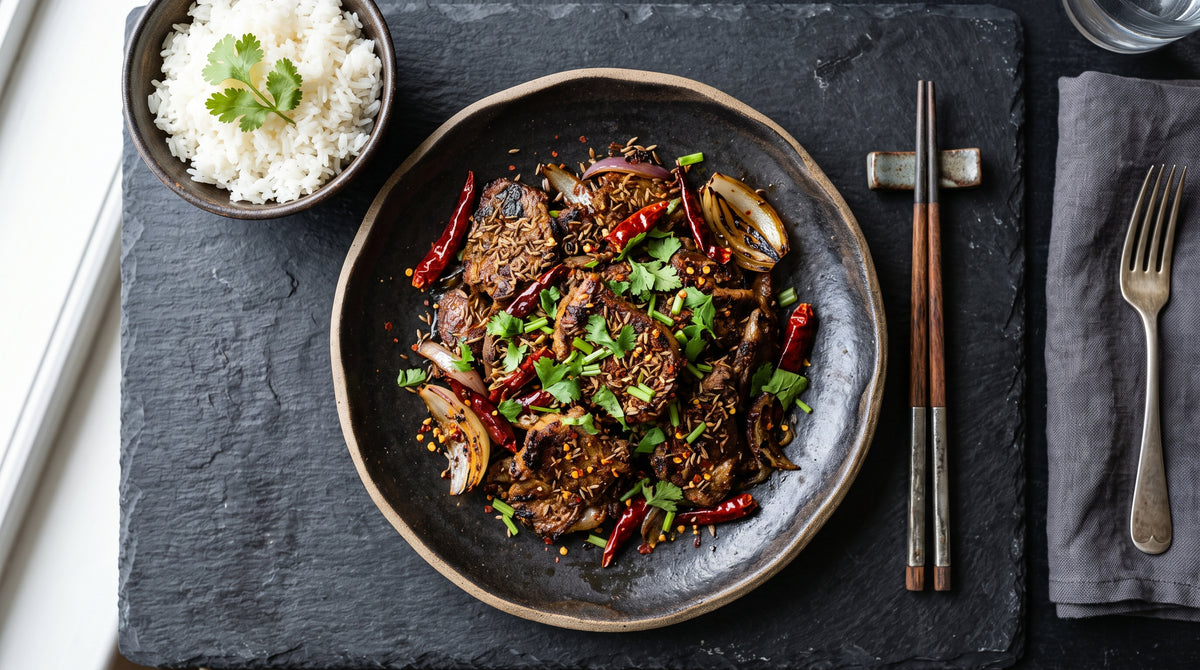
Bitten into a lamb stir-fry that fought back? Grey, chewy strips that squeak against your teeth — while the takeaway down the road serves lamb that pulls apart like it's had a day at the spa.
That gap isn't the lamb. It's a step you're skipping.
Here's the short version: to tenderise lamb for stir-fry, slice it thin against the grain, then velvet it — coat it in a light bicarb-based mix, rest it 20–30 minutes, and sear it hot and fast. Do that and even a cheap cut goes tender enough to cut with a fork. Below is exactly how, plus a Xinjiang-style cumin lamb recipe to prove it.

Why does lamb go tough and chewy in a stir-fry?
Two reasons, and they gang up on you.
First, lamb has more connective tissue and firmer muscle fibre than chicken — especially the cheaper cuts most of us grab. Blast that over high heat with nothing done to it and the proteins seize, squeeze out their moisture, and set hard. That's the squeak.
Second, home stoves run cooler than a restaurant wok burner. So your lamb sits in the pan longer, stewing in its own juices instead of searing. Longer time on the heat = tougher meat. You've basically slow-cooked it the wrong way, for the wrong length of time.
The takeaway kitchen gets around both with one move you were never shown.
The chef's fix: velveting
Velveting is the restaurant technique for turning ordinary meat silky. My dad, Danny, ran Chinese kitchens from Texas to Australia — the family restaurants were called Emperors of China — and this was standard prep on every station, every service. Nobody sent out a chewy stir-fry. They couldn't afford to.
What velveting does, in plain words: a touch of alkaline (bicarb / baking soda) nudges up the pH on the surface of the meat. That stops the proteins bonding as tightly when they hit heat, so the lamb holds its water instead of wringing it out. The result is that soft, saucy, melt-in-your-mouth bite you can't quite reproduce at home — until now.
You can do it two ways. One's fiddly. One isn't.
Option 1: Straight bicarb (the messy way)
The internet's standard answer. Toss your sliced lamb in about ¾–1 tsp of baking soda per 500g, leave it 15–20 minutes, then rinse it thoroughly under cold water and pat bone-dry before it goes near the wok.
It works. But there are two traps, and I've watched both ruin dinners:
- Too much, or too long, and you get that metallic, soapy aftertaste. Bicarb is not subtle. The line between “tender” and “tastes like the box it came in” is narrow, and nobody tells you where it is.
- The rinse is not optional. Skip it and the soapiness bakes right in. So now you've got a wet, slippery pile of lamb you have to dry again before searing — or it steams instead of browns, and you're back to grey and chewy.
Fine for a Sunday you've got time to babysit. Annoying on a Tuesday.
Option 2: A balanced velveting blend (the way we actually cook now)
This is the honest reason we bottled YumYum Meat Velvet in the first place. It's the world's first ready-to-use velveting blend — the bicarb already balanced with salt, white pepper and a little starch, so it does the tenderising and seasons the meat in one step. It's also MSG-free, if that matters to you.
Two things it fixes about the raw-bicarb method:
- No guessing on the dose. The bicarb is already balanced, so you skip the metallic-taste tightrope.
- No rinsing. The blend is built to stay on the meat, so the lamb goes straight from the bowl to the wok. One step, not three.
The ratio we tested and locked: 1–2 tbsp Meat Velvet + 1–2 tbsp water per 250g of meat. Mix it through, rest 30 minutes, then cook. For thin stir-fry slices, 20–30 minutes is plenty.
(If you want the full head-to-head on this, we put velveting up against supermarket meat tenderiser powder in this comparison — short version: the enzyme powders turn the surface to mush and stop there.)
The two steps everyone skips before the velveting even starts
Velveting does the heavy lifting. But two knife-and-cut basics decide whether it lands.
1. Buy the right cut. For stir-fry lamb you want lamb leg or rump — good flavour, lean enough for quick cooking, tender enough to reward you. Backstrap works beautifully if you're feeling flush. Skip shoulder and chops for this; they're built for the slow lane.
2. Slice thin, against the grain. Look at the lines running through the meat — that's the grain. Cut across them, not with them, into slices about 3–5mm thick. Against-the-grain means shorter muscle fibres, which means less to chew through. Partially freeze the lamb for 20 minutes first and it slices like butter. This one's free, and it does half the work.
Recipe: Xinjiang-style cumin lamb stir-fry
Now let's cook the dish that shows off tender lamb better than anything — smoky, cumin-heavy, a little fiery. This is the Uyghur classic from China's north-west, built for a hot wok and 20 minutes.
Serves: 4 · Prep: 15 min (+30 min velveting) · Cook: 10 min
Ingredients
- 500g lamb leg or rump, sliced 3–5mm thick against the grain
- 2 tbsp YumYum Meat Velvet + 2 tbsp water (for velveting)
- 2 tbsp neutral oil (peanut or vegetable)
- 1 large brown onion, cut into thick wedges
- 4 garlic cloves, sliced
- thumb of ginger, julienned
- 1½ tbsp whole cumin seeds
- 1 tsp ground cumin
- 1–2 tsp dried chilli flakes (to your heat)
- 1 tsp Sichuan peppercorns, lightly crushed (optional, but worth it)
- 1 tbsp light soy sauce
- 1 tsp sugar
- splash of Shaoxing wine (or dry sherry)
- 2 spring onions, cut into batons
- handful of coriander, roughly chopped
Method
- Velvet the lamb. In a bowl, mix the sliced lamb with 2 tbsp Meat Velvet and 2 tbsp water until every piece is coated. Rest 30 minutes at room temp (or up to a few hours in the fridge). No rinsing.
- Toast the cumin. Dry-fry the cumin seeds and Sichuan peppercorns in your wok over medium heat for about 60 seconds, until fragrant. Tip out and set aside. This wakes them up — don't skip it.
- Get the wok screaming hot. Add 1 tbsp oil. When it's shimmering, sear the lamb in two batches — crowd the pan and it steams. About 60–90 seconds a batch, just until browned at the edges. Remove and set aside.
- Fry the aromatics. Add the last tbsp oil, then the onion wedges. Stir-fry 1 minute, then add garlic, ginger and chilli flakes for another 30 seconds.
- Bring it together. Lamb back in. Add soy, sugar and Shaoxing, then most of the toasted cumin and pepper. Toss hard over max heat for 60 seconds — you want it glossy, not saucy.
- Finish. Off the heat, fold through the spring onions, coriander and the rest of the cumin. Serve straight away with steamed rice.

Chef note: the lamb should look barely browned outside and still blushing inside when you pull it in step 3 — it keeps cooking when it goes back in. Overcook it here and no amount of velveting saves you. Trust the wok, work fast, get it on the plate.
Common questions
What's the best cut of lamb for stir-fry?
Lamb leg or rump. Both are lean enough to cook fast without drying, with enough flavour to carry a bold spice mix. Backstrap is the premium choice if the budget stretches. Leave shoulder, forequarter and chops for braises and roasts — they need low, slow heat.
How long should you tenderise lamb before stir-frying?
For thin stir-fry slices, 20–30 minutes is enough with a velveting blend. With raw baking soda, 15–20 minutes then a thorough rinse. Longer isn't better — too long with bicarb pushes the meat toward a soapy, mushy texture.
Does baking soda make lamb taste soapy?
It can. Too much bicarb, or leaving it on too long without rinsing, gives that metallic, soapy aftertaste. That's exactly why we balance the bicarb with salt, pepper and starch in Meat Velvet — you get the tenderising without the tightrope, and there's no rinse step to get wrong.
Can you velvet lamb the same way as beef or chicken?
Yes. The technique is identical across chicken, beef, pork and lamb — same ratio, same rest time. Lamb just rewards it more, because the cuts most of us stir-fry are a touch tougher to begin with.
Get silky lamb every time
Chewy lamb is a solved problem. Slice thin against the grain, velvet it, sear it hot — that's the whole game.
If you'd rather not play chemist with a box of bicarb, Meat Velvet does the tenderising and the seasoning in one scoop — chicken, beef, pork, lamb, even prawns and tofu. 🔥
Cooking for the family (or just planning ahead)? The Three-Pack Meat Velvet is $50 and ships free (free AU shipping over $50) — works out cheaper per can than grabbing one at a time, and one can quietly disappears once you taste the difference. Want the seasonings too? The 6 Bundle Mix pairs three Meat Velvet with three signature seasonings.
While the lamb's resting, here's more of the good stuff:
- Velveting vs Meat Tenderiser Powder: Which Actually Works?
- Why Your Fried Rice Tastes Flat (and the One Scoop That Fixes It)
Written by Vincent Lim — chef, cookbook author, and co-founder of YumYum. Vincent grew up in his family's Chinese restaurants and learned to cook from his father, Danny. He shares the restaurant techniques most home cooks are never told.
Researched and drafted with AI assistance, edited and kitchen-checked by the YumYum team.