
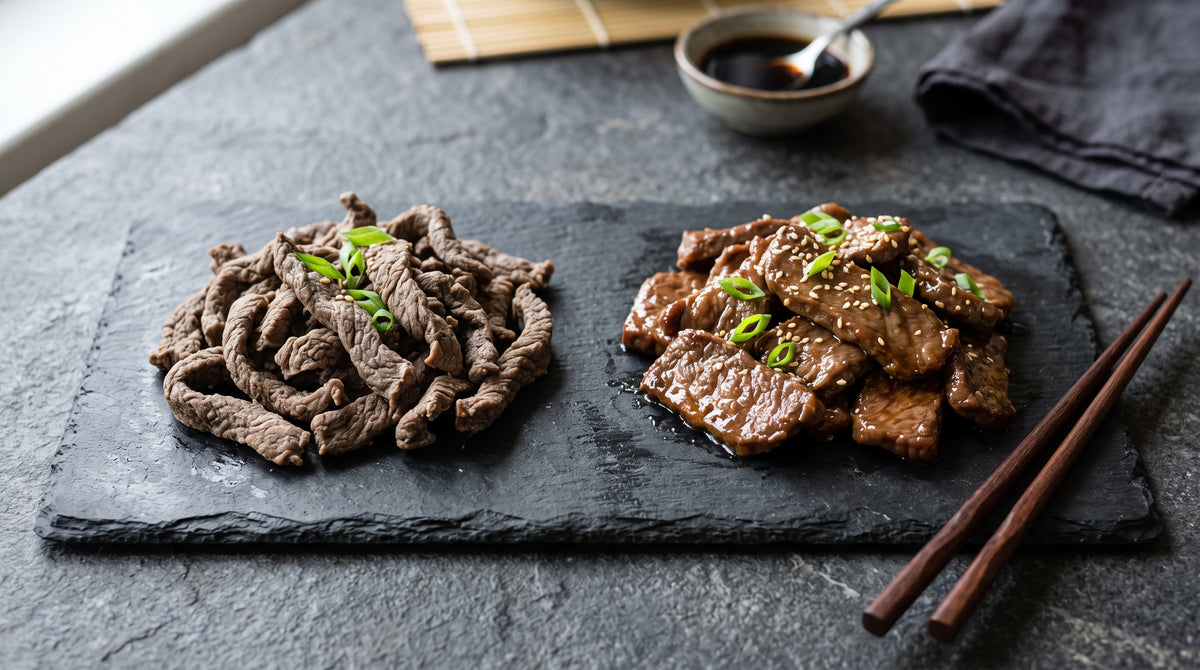
Grab a tub of meat tenderiser powder off the shelf, sprinkle it on your stir-fry beef, and you'd expect tender meat. Half the time you get something worse than what you started with — grey, weirdly soft on the outside, still chewy in the middle. A bit gritty.
Here's the short answer, because you came here to buy something and get on with dinner.
For a thick steak you're grilling, an enzyme meat tenderiser powder is fine. For thin-sliced stir-fry meat, it's the wrong tool — and velveting is what you actually want. Velveting is the method every Chinese restaurant uses to get that silky, melt-in-your-mouth chicken and beef. It doesn't chew the meat apart the way enzyme powders do. It protects it.
I grew up on the wok line in my family's restaurants. We velveted every protein, every service, for years. We never once reached for a tub of tenderiser powder. Let me show you why.

Quick verdict: which one for stir-fry?
- Enzyme tenderiser powder (papain/bromelain) → good for thick cuts, grilling, tough steak. Wrong for thin stir-fry slices — over-tenderises the surface and leaves a mushy, sometimes gritty texture.
- Velveting → the restaurant method for stir-fry. Keeps meat silky and juicy without breaking it down to mush. This is the one you want for chicken, beef, pork or lamb going into a hot wok.
If you only take one thing away: the reason your home stir-fry meat never matches the takeaway isn't a seasoning problem. It's a texture problem, and velveting is the fix.
What meat tenderiser powder actually is (and why it fights your stir-fry)
Most supermarket “meat tenderiser powder” is an enzyme tenderiser. The active ingredient is usually papain (from papaya) or bromelain (from pineapple). These enzymes literally digest the protein — they cut the muscle fibres from the inside.
That works a treat on a thick, tough cut. A big blade steak, a cheap roast, something you're cooking low or grilling hot. The enzyme has a thick piece of meat to work through, and cooking eventually kills the enzyme's action.
Now picture stir-fry meat. You've sliced it 3–4mm thin so it cooks in ninety seconds. The enzyme has almost no meat to work through and way too much surface area. It races through the outside of every slice before you've even lit the wok. That's where the mush comes from.
And here's the bit the packet doesn't tell you: the enzyme keeps working until it hits heat. Leave papain-dusted meat sitting in the fridge for a couple of hours “to be safe,” and the outside turns to paste. People blame themselves. It's the tool.
A few real problems with enzyme powder on stir-fry cuts:
- Mushy surface, chewy centre. Thin slices over-tenderise on the outside before the inside changes at all.
- A faint gritty or “off” texture. Over-digested protein doesn't sear clean — it goes grey and soft instead of catching colour.
- No flavour, no juiciness. Enzyme powder tenderises. It doesn't help the meat hold moisture in a screaming-hot wok, which is half the battle in a stir-fry.
What velveting does differently
Velveting is a Chinese restaurant technique. Instead of digesting the meat, it does two jobs at once: it slightly raises the pH of the surface so the muscle fibres relax and hold water, and it wraps each piece in a thin starch coat that seals in juice and shields the meat from the brutal heat of the wok.
The result is the texture you know from good takeaway — beef that's tender but still has bite, chicken that's silky and never rubbery, everything glossy and coated in sauce instead of grey and dry.
The classic home version uses a pinch of bicarb soda (bicarbonate of soda) and a little cornflour, mixed with water, worked into the meat, then rested. The trouble is dose. Too much bicarb and you get a soapy, metallic taste and — yep — mushy meat again. Too little and nothing happens. Get it wrong on the bicarb and you've made the exact problem you were trying to avoid.
That dialled-in ratio is the whole game. And it's exactly why we ended up bottling ours.
The honest comparison
| Enzyme tenderiser powder | Velveting | |
|---|---|---|
| How it works | Papain/bromelain digest the protein | Relaxes fibres + starch coat locks in moisture |
| Best for | Thick cuts, steak, grilling | Thin stir-fry slices, wok cooking |
| On thin stir-fry meat | Over-tenderises → mushy/gritty | Silky, tender, still has bite |
| Holds moisture in a hot wok? | No | Yes — that's the point |
| Timing risk | Keeps working → easy to overdo | Forgiving 30-min rest |
| What restaurants use | Rarely, and not for stir-fry | This one |
Nobody's saying enzyme powder is useless. If you've got a tough bit of chuck steak destined for the grill, go for it. But you searched for a tenderiser powder to fix your stir-fry — and for that job, velveting wins every time. It's not close.
How to velvet meat for stir-fry (the restaurant way, at home)
You can absolutely do this with bicarb and cornflour if you want to measure carefully. Or you use a pre-balanced velveting blend so you can't get the ratio wrong. Either way, the method is the same.
You'll need (serves 4 as part of a stir-fry):
- 500g meat, thinly sliced against the grain (chicken thigh, beef rump, pork, or lamb all work)
- 2–4 tbsp velveting blend (or a careful pinch of bicarb + 1 tbsp cornflour), scaled to the meat
- 2–4 tbsp water
- Your wok, hot as it'll go
Method:
- Slice thin and against the grain. 3–4mm. This matters as much as anything you do next — cutting across the fibres shortens them so the meat is tender before you've done a thing.
- Mix the velvet through. For our Meat Velvet, that's 1–2 tbsp blend + 1–2 tbsp water per 250g of meat. Massage it in until the meat feels tacky and has drunk up the liquid.
- Rest 30 minutes. Room temp is fine while you prep the rest of dinner. Thin slices (1–3mm) only need about 20 minutes; thicker pieces (up to 2cm) like an hour. This is the forgiving bit — unlike enzyme powder, a velvet rest won't wreck the meat if you leave it a little long.
- Get the wok screaming. Velveted meat needs high heat to sear fast. A cool pan steams it and you lose the point.
- Flash-fry in batches, then toss with sauce. Don't crowd the wok. The meat comes out silky, holds its juice, and grips the sauce.
That's it. Same technique on chicken, beef, pork, lamb, even prawns or tofu. No fork-piercing, no guessing, no mush.
Chef note
My dad, Danny Lim, ran Chinese restaurants from Texas to Australia — the family called them Emperors of China, and my brother and I grew up doing our homework at the tables. Dad had one rule about serving customers: get the basics perfect before you get fancy. Velveting was one of those basics. Every wok cook on the line knew the ratio in their hands, not off a packet.
When we bottled Meat Velvet, that was the whole idea — take the exact velveting balance we used in the restaurant and put it in a jar so you don't have to gamble on how much bicarb is “a pinch.” It's the world's first bottled velveting blend, it's MSG-free, and it does in one step what the pros do by feel. One scoop, water, thirty minutes. That's the move restaurants don't tell you about. 🔥
FAQ
Does meat tenderiser powder work for stir-fry?
Enzyme tenderiser powder (papain or bromelain) works on thick, tough cuts but tends to over-tenderise thin stir-fry slices, leaving them mushy or gritty. For stir-fry, velveting gives a silkier, juicier result and is what Chinese restaurants actually use.
Is velveting better than meat tenderiser powder?
For stir-fry, yes. Velveting protects thin slices and helps them hold moisture in a hot wok, while enzyme powder keeps digesting the protein until it hits heat, which is easy to overdo on thin meat.
Why is my stir-fry meat mushy?
Usually too much enzyme tenderiser or too much bicarb soda, or leaving either on the meat too long. Both keep breaking down the surface. A balanced velveting blend and a 30-minute rest avoids it.
Can I velvet chicken, beef and pork the same way?
Yes. The same velveting method works on chicken, beef, pork, lamb, prawns and tofu — slice thin, mix the velvet through, rest, then flash-fry in a hot wok.
Get silky stir-fry meat every time
Stop fighting your stir-fry with the wrong powder. Meat Velvet ($17) is the restaurant velveting step in a jar — silky, tender meat in under 20 minutes of hands-on, no ratio guesswork.
Cooking for the family (or just want to stop running out)? The Meat Velvet Three-Pack is $50 and ships free (free AU shipping over $50) — cheaper per jar than buying singles. Want the seasonings too? The 6 Bundle Mix pairs three Meat Velvet with three signature seasonings.
More on getting restaurant results at home:
- Why your fried rice tastes flat (and the one scoop that fixes it)
- Vincent's step-by-step velveting beef guide (dimsimlim.com)
Written by Vincent Lim — chef, cookbook author, and co-founder of YumYum. Vincent grew up in his family's Chinese restaurants and learned to cook from his father, Danny. He shares the restaurant techniques most home cooks are never told.
Researched and drafted with AI assistance, edited and kitchen-checked by the YumYum team.