
If you've ever had plain poached chicken at a Chinese restaurant and wondered why it tasted better than anything you make at home — it wasn't the chicken. It was the little dish next to it. 🌿
Soy scallion sauce is spring onions, hot oil and soy. That's it. Five minutes, one pan, no cooking skill required. And once there's a jar of it in your fridge, plain rice becomes dinner, leftover chicken becomes a meal, and a fried egg on toast starts tasting like something you'd pay for.
Here's the exact ratio, the one temperature that decides whether it's fragrant or bitter, and the honest answer on how long it keeps.
First: which “soy scallion sauce” do you actually want?
Search this and you'll get three different sauces wearing the same name. They're not interchangeable, and picking the wrong one is why home versions disappoint.
| What it is | What it's for | Time |
|---|---|---|
| Soy scallion sauce (this one) | A spoonable condiment — over rice, noodles, chicken, eggs, dumplings | 5 min |
| Scallion oil (葱油) | A cooking/finishing oil. Onions are fried out and discarded | 30–40 min |
| Soy dressing | Soy, vinegar, sugar shaken cold. Sharp, thin, no aroma | 2 min |
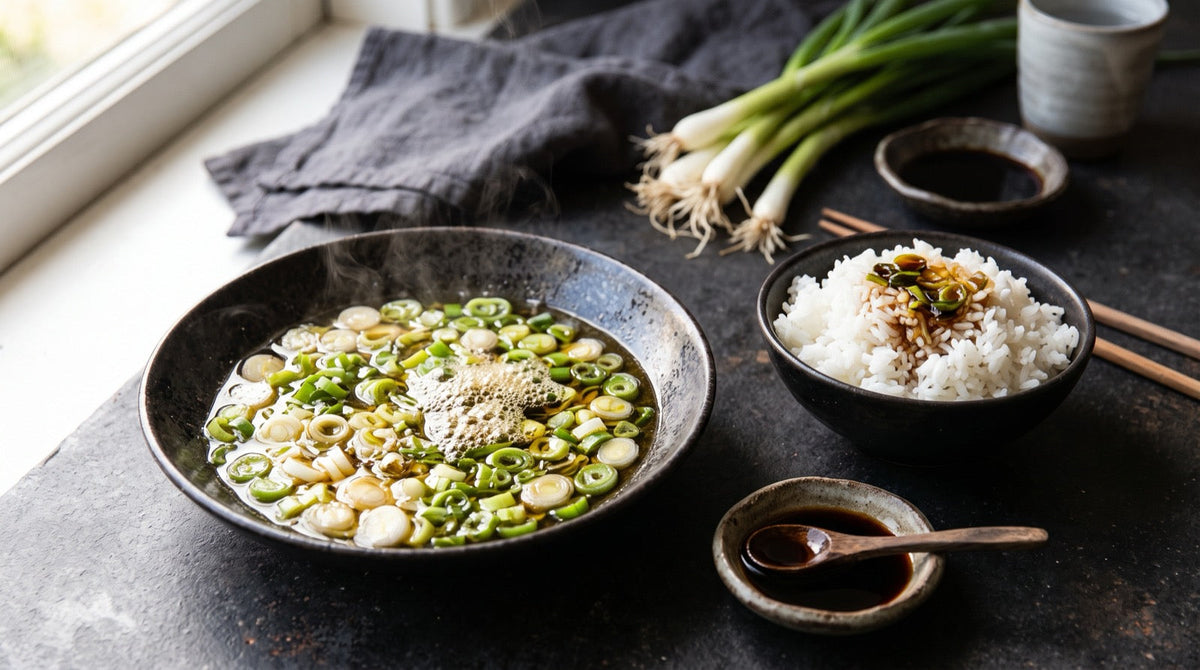
The one you want — the one that tastes like the restaurant — is the first. Raw spring onions, shocked with hot oil so they bloom instead of fry, then loosened with soy. You keep the onions. That's the entire point of it.
The recipe
Serves: makes about 200ml (roughly 8 serves) · Prep: 2 min · Cook: 3 min · Total: 5 min
Ingredients
- 1 bunch spring onions (about 6), very finely sliced — whites and greens kept separate
- 1 tbsp YumYum Shanghai Nights (Soy & Scallion) — about one serve
- ½ cup (125ml) neutral oil — rice bran, sunflower or peanut
- 2 tbsp light soy sauce
- 2 tsp Chinese black vinegar (rice vinegar is fine)
- 1 tsp caster sugar
- 1 tsp sesame oil
Yes, spring onions. In Australia that's what “scallions” are — the long green ones in the bunch at the greengrocer, not shallots and not eschalots. Same thing, different passport.
Method
- Slice thin, and mean it. 2–3mm rounds. Thick pieces stay squeaky and raw in the middle. Put the white parts in a heatproof bowl (metal or ceramic — not a plastic container), and set the green parts aside.
- Add the dry seasoning to the whites. Sprinkle the Shanghai Nights straight over the raw onion whites in the bowl. It goes in before the oil, so the hot oil blooms it — that's where the savoury depth comes from.
- Heat the oil to 160–180°C. About 3 minutes over medium heat. No thermometer? Drop one slice of onion white in. It should sizzle steadily and float within about 2 seconds. Silence means too cold. Violent crackling and instant browning means too hot — pull it off the heat for 30 seconds.
- Pour it over. Straight onto the whites. It'll roar for a few seconds, then settle. Stir once. The smell that comes off the bowl at this moment is the entire reason to make it.
- Now the greens. Stir them through after the oil has calmed (about 30 seconds). They only need the residual heat — hit them with full-temperature oil and they go khaki and stewed.
- Finish. Stir in the soy, vinegar, sugar and sesame oil. Taste. Let it sit 10 minutes before you eat it; the flavour rounds out noticeably in that first quarter hour.
The temperature is the whole recipe
Every other variable here is forgiving. This one isn't.
- Under ~140°C: nothing blooms. You get oily raw onion. It tastes like salad dressing that went wrong.
- 160–180°C: the sweet spot. The alliums release their aroma into the oil without browning. Fragrant, sweet, restaurant.
- Over ~200°C: bitter in about ten seconds, and you cannot fix it. Bin it and start again — you're out one bunch of spring onions, not a dinner.
If you've made this before and it tasted harsh or acrid, that was the temperature. Not the soy, not the onions.
What to actually put it on
The reason it earns a permanent shelf in the fridge:
- Plain steamed rice — a spoonful, stirred through. This is the one that surprises people.
- Noodles — 2 tbsp per portion, hot noodles straight from the water, tossed. Dinner in the time the noodles took.
- Poached or roast chicken — the classic pairing. Also excellent on cold leftover chook.
- Fried eggs — over the top, on toast. Try it once and it becomes a habit.
- Steamed or pan-fried fish — spooned over at the table, never cooked into it.
- Dumplings — as a dipping sauce, thinned with an extra splash of vinegar.
- Roast or steamed vegetables — broccoli, beans, pumpkin, cauliflower. Works on all of them.
- Grilled steak or lamb — a Chinese-restaurant answer to chimichurri.
There's no meat in it, so it does the same job on a plate of vegetables and tofu as it does on chicken. If that's your kitchen, we've written more on building savoury depth without meat.
Three mistakes that ruin it
Chopping the onions too far ahead. Sliced spring onion sitting around for an hour goes sulphurous and sharp. Slice, then heat the oil — in that order.
Skipping the vinegar. It reads as an optional extra. It isn't. Without it the sauce is flat and oily on the tongue; the acid is what makes you want the next mouthful. This is the same problem behind why so much home cooking tastes bland, and it shows up in about half of it.
Making it in a plastic container. 180°C oil into a takeaway tub is how you warp the tub and, worse, end up wearing the oil. Metal or ceramic bowl, on a stable bench, and stand back as you pour.
How long does it keep? The honest answer
You'll see anywhere from one week to three months online. Here's the version I'd give you in my own kitchen:
Airtight container, in the fridge, use within 5 days. Not on the bench — in the fridge, always.
That's raw allium sitting in oil. Chilled and used within the week it's completely fine, and the flavour actually improves by day two. Left at room temperature it's the kind of thing food-safety people write papers about, and there's no upside to risking it when the sauce takes five minutes to make fresh. The oil will go semi-solid and cloudy in the fridge — that's normal. Ten minutes on the bench and it loosens right back up.
Only ever spoon it out with a clean spoon. Double-dipping is what actually kills a jar of this.
🥢 Chef's note
Dad — Danny Lim — kept a container of something close to this on the pass at Emperors of China, and it never lasted a service. Not because it was on the menu; because it went on staff meal, on the steamed fish that came back a bit plain, on rice at 3pm between sittings. He had one rule about it that I still follow: the greens go in last, off the heat. He'd say if you can see the green go dull, you've already lost it. Twenty years on the wok line and that's the note he bothered to repeat. 🔥
Where the seasoning comes in
You can make this sauce with just soy and onions and it'll be good. The reason I add a tablespoon of Shanghai Nights to the whites before the oil hits is that it gives the sauce the savoury base a five-minute recipe can't build on its own — the deep, rounded soy-and-scallion note a restaurant gets from a stockpot it's had going since the morning.
It doesn't overpower the spring onions. It gives them something to sit on. That's the whole idea behind the fifth taste — and it's the same lever behind why restaurant fried rice tastes different to yours.
👉 Grab a can of Shanghai Nights — Soy & Scallion ($17) and make this tonight.
Cooking for the family? The Four-Pack of YUM ($60) ships free (free AU shipping over $50), works out cheaper per can, and gets you all four blends — so the next four dinners are already sorted. ✨
Common questions
Is soy scallion sauce the same as scallion oil?
No. Scallion oil is slow-fried for 30–40 minutes and the onions are strained out and discarded — you keep the oil. Soy scallion sauce is a 5-minute condiment where the onions stay in and get eaten.
Can I use spring onions instead of scallions?
They're the same vegetable. In Australia they're sold as spring onions; in the US they're scallions. Don't substitute brown onion or eschalots — different flavour entirely.
Why did my scallion sauce turn bitter?
The oil was too hot. Over about 200°C the alliums scorch within seconds and the bitterness is permanent. Aim for 160–180°C — a slice of onion white should sizzle and float in roughly 2 seconds.
How long does soy scallion sauce last?
Airtight in the fridge, use it within 5 days, and never store it at room temperature. It thickens and clouds when cold, which is normal.
Is it spicy?
Not at all. If you want heat, stir a teaspoon of chilli flakes into the bowl with the onion whites so the hot oil blooms them too.
Written by Vincent Lim — chef, cookbook author, and co-founder of YumYum. Vincent grew up in his family's Chinese restaurants and learned to cook from his father, Danny. He shares the restaurant techniques most home cooks are never told.
Researched and drafted with AI assistance, edited and kitchen-checked by the YumYum team.