
You bought the shaker. It's sitting in the cupboard next to the salt. And now you're standing over a wok with absolutely no idea whether to use a pinch or a spoonful. 🔥
Here's the short version, then the chart.
How much MSG should you use?
Use about ½ teaspoon (roughly 2g) of MSG per four serves — the same amount for a 500g stir-fry, a tray of roast veg, or 1.5L of soup. Add it with your salt, early in cooking. It's heat-stable, so it won't break down. More is not better: past roughly 1g per serve, the flavour stops improving and starts to flatten.
That's the answer. Now the part nobody tells you.
The chef's ratio chart
Restaurant kitchens don't measure this. We season by feel, taste, adjust, taste again. But "season by feel" is useless advice when you've never used the stuff, so here's the feel translated into numbers you can actually follow. All quantities are per four serves, in Australian units.
| Dish | MSG | Notes |
|---|---|---|
| Stir-fry (500g protein + veg) | ½ tsp (2g) | Goes in with the sauce, not the marinade |
| Fried rice (4 cups cooked rice) | ½–¾ tsp (2–3g) | Rice is bland by design, it can carry more |
| Soup or broth (1.5L) | ¾–1 tsp (3–4g) | Liquid dilutes it; taste at the 15-minute mark |
| Dry rub or marinade (500g meat) | ½ tsp (2g) | Rub in with the salt, rest 20 min minimum |
| Roast vegetables (1kg raw) | ½ tsp (2g) | Toss through the oil, not sprinkled on after |
| Mince dishes — bolognese, mapo, san choy bau (500g) | ½ tsp (2g) | Add when you brown, not at the end |
| Scrambled or fried eggs (4 eggs) | a pinch, ⅛ tsp (0.5g) | Eggs are already glutamate-rich, go light |
| Gravy or pan sauce (500ml) | ¼–½ tsp (1–2g) | Half at the start, taste, then decide |
| Dressing or dipping sauce (100ml) | ⅛–¼ tsp (0.5–1g) | It needs to dissolve — whisk into the liquid first |
Two things to notice. Eggs get a tenth of what soup gets. And the dishes that take the most are the blandest base ingredients — rice, potatoes, plain broth. That's the whole principle in one table: MSG amplifies what's already there. Give it nothing to work with and it gives you nothing back.
When to add MSG (and why "add it early" is only half right)
Every guide says add it early. That's true but incomplete.
MSG is heat-stable. It doesn't scorch the way garlic powder does at 200°C, and it doesn't cook off. So early is safe, and early is better for anything with liquid — a braise, a soup, a sauce — because it needs to dissolve to do anything at all. Undissolved crystals sitting on the surface of a dry dish are just crunchy.
But there's a second window most home cooks never use: the finishing pinch.
On the line at my dad's restaurants, seasoning went into the wok in one motion, mid-toss, and that was that. Twelve dishes deep into a Friday service you don't get a second pass. At home you do. Cook the dish, taste it off the heat, and if it reads flat rather than under-salted, a pinch stirred through at that moment is the fastest fix in your kitchen. Under-salted and flat are different problems and they have different answers, which brings us to the mistake.
The mistake nearly everyone makes: MSG without enough salt
This is why people try MSG once and conclude it's overhyped.
Glutamate and sodium work together. MSG is only about 12% sodium by weight — table salt is around 39%. So when you swap a spoon of salt for a spoon of MSG, you've cut the sodium in that spoonful by roughly two-thirds, and your dish is now genuinely under-salted. What you taste is a strange hollow savouriness. Loud but empty. You blame the MSG.
Season with salt to the point where the dish tastes correct. Then add MSG. Not instead of. Alongside.
Where this gets useful is sodium reduction: swapping half your salt for MSG cuts the total sodium in a dish by around 30% while the food still tastes seasoned, because the glutamate covers the savoury gap the missing salt left behind. That's a real, worthwhile trade. Total replacement isn't.
If you want the longer version of what glutamate actually is and why the label calls it 621, we've written that one up separately: what flavour enhancer 621 actually means on an Australian label.
The lever that lets you use less: pair it with mushrooms or tomato
Here's the bit missing from every page ranking for this term.
Glutamate isn't the only umami compound. There's a second family — nucleotides, mostly inosinate and guanylate — that on their own taste of very little. Put them together with glutamate and the two don't add up. They multiply. Researchers who've measured it put the jump as high as eightfold.
The practical version: dried shiitake, tomato paste, anchovy, bonito, cured pork and aged parmesan are nucleotide sources. Any dish containing one of those needs noticeably less MSG to hit the same depth.
This is not a modern trick. It's why a Chinese braise starts with soaked dried shiitake and a splash of the soaking liquid. It's why the Italians build a sauce on tomato paste and parmesan rind. Two cuisines that never spoke to each other landed on the same chemistry, centuries before anyone named it.
So if your dish already has tomato paste or mushrooms in it, halve the chart. And if you want to build depth without any meat at all, the vegan umami boosters guide runs through the full pantry list.
The ceiling: how much MSG is too much?
Roughly 1g per serve is where most palates stop improving. Push past it and the dish doesn't get more savoury. It gets worse, in a specific and recognisable way.
Learn these signs, because the mistake is invisible while you're making it:
- A lingering coating on the tongue that doesn't fade between bites. Normal seasoning clears. Too much MSG doesn't.
- A faint metallic or soapy edge, usually at the back of the palate.
- The dish tastes loud but blurry — you can tell it's savoury, but you can no longer pick out the individual ingredients. Everything has merged into one flat note.
- Odd, persistent mouth-watering after you've stopped eating.
Number three is the important one. Over-seasoning with salt makes food taste salty, which is obvious. Over-seasoning with MSG makes food taste generic, which is much harder to diagnose and much easier to keep doing.
If you've overshot, you can't remove it. Dilute with more of the base — more stock, more rice, more vegetables — or accept it and go lighter next time. Acid helps a little. A squeeze of lemon or a splash of vinegar cuts through the flatness and buys the dish back some definition.
What MSG can't do
An honest list, because the internet is full of people who'll tell you it's magic.
It can't rescue bad ingredients. Tired vegetables, freezer-burnt meat, a stock made from nothing — MSG amplifies what's there, and if what's there is mediocre, you now have louder mediocre. Dad had a line about this that applied to everything, not just the dish he was talking about: "Until you get your fried rice right, you aren't able to serve customers. It's the easiest dish to cook, but the hardest to master." Seasoning is the last 10%. It isn't the first 90.
It does almost nothing for sweet food. Cakes, custards, pastry. There's no savoury foundation to amplify. Skip it.
It's redundant in dishes already loaded with umami. A sauce built on soy, miso and aged cheese is already saturated with glutamate. Adding more pushes you straight past the ceiling.
It won't fix acidity or balance. If a dish is missing brightness, it needs acid. If it's cloying, it needs acid. MSG can't substitute for either. We wrote a whole diagnostic on this — why your cooking tastes bland and what to check first — because "add MSG" is genuinely the wrong answer about half the time.
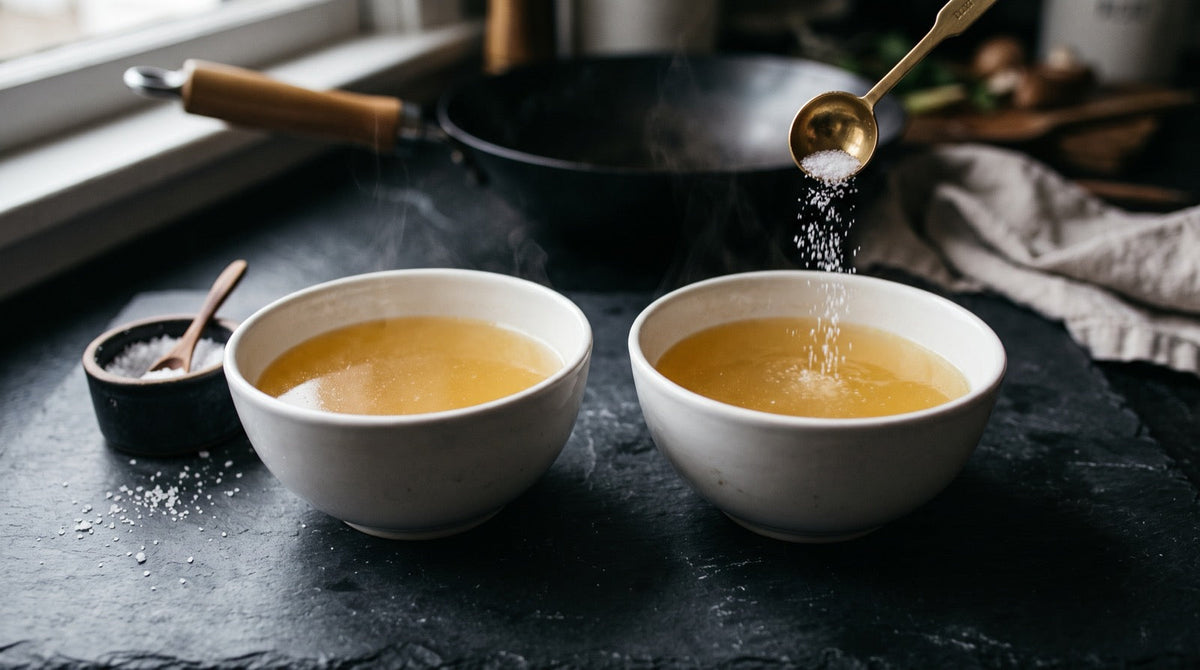
The two-bowl test (do this before you cook anything else)
Twenty minutes, and you'll understand the dose better than any article can teach you.
- Make 500ml of plain chicken or vegetable stock. Nothing else in it.
- Split it into two bowls, 250ml each.
- Salt both identically until they taste properly seasoned. Same salt in both. This is the step people skip and it ruins the test.
- Add ¼ tsp MSG to bowl B only. Stir until dissolved.
- Taste A, then B, then A again.
What you're looking for isn't "more flavour". It's length — how long the taste stays after you swallow. Bowl A drops off almost immediately. Bowl B keeps going for several seconds and makes your mouth water. That sensation is the whole point of the ingredient, and once you've felt it deliberately in a controlled bowl of stock, you'll recognise it in every restaurant dish you've ever eaten and wondered about.
Then, if you want the other half of the lesson: add another ¾ tsp to bowl B and taste it again. That's the ceiling. Now you know what the far side feels like, and you'll never accidentally cook it.
Chef's note
I grew up in my dad's kitchens — Emperors of China, Texas and then Australia — and MSG was never a debate there. It was a tub next to the salt, used the same way you'd use white pepper: constantly, in small amounts, without ceremony. What I didn't understand until much later, standing on my own wok line, is that the skill was never whether to use it. It was restraint. Every young cook I've trained oversalts and over-MSGs in their first month, because when a dish is missing something the instinct is to add more of whatever's nearest. The good ones learn to stop a beat earlier than feels right. That's it. That's the technique.
FAQ
Can you use MSG instead of salt? No, but you can use it to cut salt. MSG is about 12% sodium against table salt's 39%, so replacing all your salt leaves the dish under-seasoned and hollow. Replace roughly half and you'll cut the dish's total sodium by around 30% while it still tastes properly seasoned.
Does MSG burn or break down when you cook it? No. It's heat-stable at normal cooking temperatures, so you can add it to a marinade, a dry rub, a wok at full heat, or a stock that simmers for hours. It needs moisture to dissolve, though — on a completely dry dish it just sits there.
How much MSG per serving is safe? Flavour caps out well before anything else does. Around 1g per serve is where the taste stops improving, and most people naturally use less than that because more simply doesn't taste better. If you're interested in the health side of the question rather than the cooking side, we covered it properly in the truth about MSG and headaches.
What foods should you not put MSG on? Sweet dishes, anything already heavy on soy, miso, parmesan or fish sauce, and delicate things where the point is a single clean flavour — a good piece of sashimi, a simple steamed fish. MSG is a background instrument. In those dishes there's no background.
Where the Red Can fits
You can buy bare MSG crystals at any Asian grocer, and there's nothing wrong with them. But dosing pure glutamate is fiddly, and it's the reason most people give up on it — you're managing the salt separately, guessing at the ratio, and the two only work together.
Our YumYum Umami Seasoning, the Red Can ($17) is the MSG-forward one in our range, built and balanced so a scoop lands where it should without you doing arithmetic over the wok. One shaker, one motion, the way it worked on the line. It doesn't overpower. It elevates. ✨
(Worth saying plainly: the Red Can is the only one of ours built around MSG. Meat Velvet, Shanghai Nights and Emperor's Dust have no added MSG at all.)
Cooking for the family? A single can sits under our $50 free-shipping line, so it costs you postage. The Three-Pack ($50) ships free and works out cheaper per can — or the Four-Pack of YUM ($60) gets you the whole range, which is what most people end up with anyway. Free AU shipping over $50. 🌿
New to the whole idea? Start with the foundation piece: umami, the fifth taste, and why restaurants don't talk about it.
Written by Vincent Lim — chef, cookbook author, and co-founder of YumYum. Vincent grew up in his family's Chinese restaurants and learned to cook from his father, Danny. He shares the restaurant techniques most home cooks are never told.
Researched and drafted with AI assistance, edited and kitchen-checked by the YumYum team.