
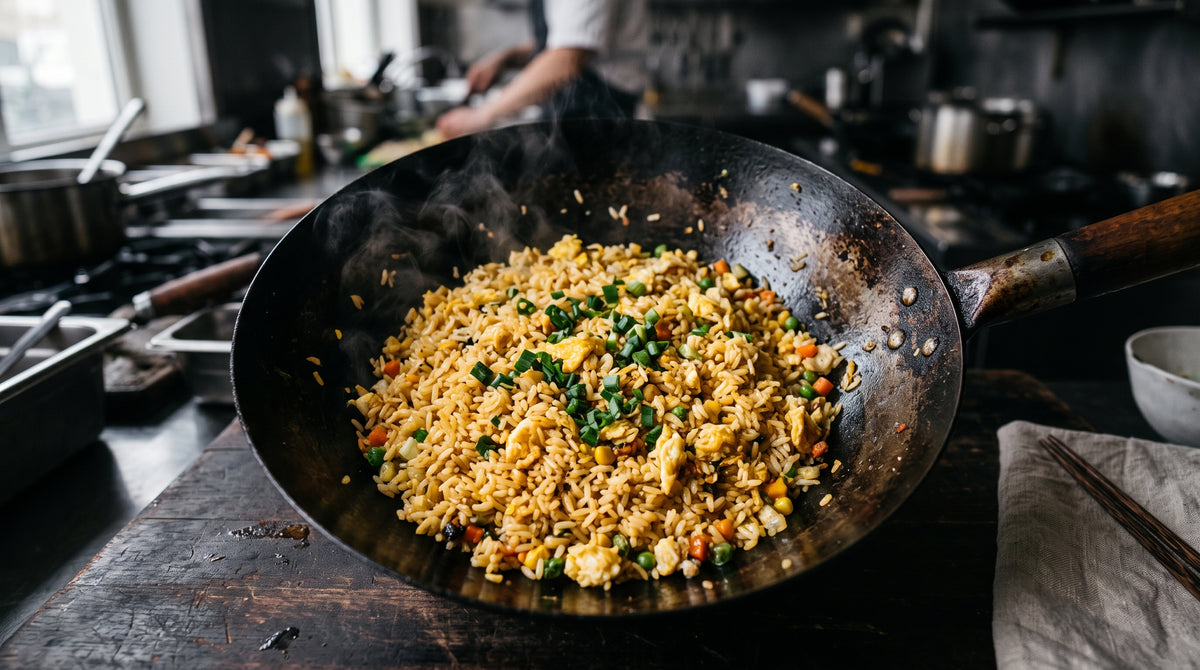
You followed the recipe. Day-old rice, hot pan, splash of soy. And it still came out tasting like… beige.
Meanwhile the fried rice from the shop down the road tastes alive. Savoury, deep, moreish. You go back for a second forkful before you've swallowed the first.
So why does restaurant fried rice taste better than yours? 🍚
I grew up in the answer. Let me walk you through it, then hand you the shortcut.
First, the honest bit: it's not really the rice
Every article online tells you the same three things. Use day-old rice. Get your pan screaming hot. Don't drown it in soy.
All true. All worth doing. I'll cover them properly below.
But here's what nobody who hasn't stood behind a restaurant wok will tell you: you can nail all three and your fried rice will still taste flat. Because the thing that actually separates takeaway from home cooking isn't technique.
It's umami depth. The savoury backbone restaurants build into every single dish on purpose.
That's the gap. And it's a much easier fix than buying a jet-engine burner for your kitchen.
The four real reasons (that you can actually control)
1. Day-old rice, genuinely dried out
Fresh rice is full of water. Chuck it in the wok and it steams instead of frying, so you get soft, clumpy, sticky grains instead of separate, slightly chewy ones.
Cook your rice the day before, spread it on a tray, and leave it uncovered in the fridge overnight. No day-old rice? Spread fresh rice thin on a tray and give it 30–40 minutes in the fridge. It won't be perfect, but it'll fry, not stew.
Jasmine or long-grain works best. Rinse it before cooking so it's not gluey.
2. High heat and a pan you don't overcrowd
Restaurants cook on burners that put out several times the heat of your Woolies-bought stovetop. That fierce heat is where wok hei comes from, the smoky “breath of the wok” you can smell across a food court.
You won't fully match it at home. But you can get closer:
- Get the pan properly hot before anything goes in. Hotter than feels sensible.
- Cook in batches. Pile a home wok full of cold rice and cold veg and the temperature crashes. Now you're boiling, not frying.
- Use a wide, heavy pan if you don't have a wok. More surface contact, more browning.
3. Cook the components separately
Watch a line cook and you'll notice they don't tip everything in at once. Egg gets scrambled and pulled out. Protein gets seared and set aside. Aromatics go in on their own.
Everything comes back together at the end for one final, fast toss. That way nothing overcooks, nothing weeps water into the rice, and every element keeps its own texture.
At home we get impatient and one-pan everything. That's how the veg goes soggy and the rice goes grey.
4. The big one: they build umami on purpose
Here's the part the internet skips.
A restaurant kitchen isn't seasoning your fried rice with just salt. There's soy, there's the savouriness that's soaked into a wok that's cooked a thousand meals, there's often a savoury flavour booster going in that you'll never see. Layer on layer of savouriness. That's umami, the fifth taste, and it's the reason a mouthful of takeaway rice tastes full while yours tastes thin.
Home cooks add salt and wonder why it's still missing something. Salt makes food salty. It doesn't make it deep. Umami is what makes it deep.
That's the whole secret in one line: restaurants build every dish around umami, and most home cooks never season for it at all.
The chef note: my dad wouldn't let me serve fried rice
My father, Danny Lim, ran Chinese restaurants his whole life, from Texas all the way to Australia. Ours was called Emperors of China. My brother and I did our homework at the tables after school while the woks roared behind us.
Dad had a rule. I wasn't allowed to cook fried rice for a paying customer until he decided I'd got it right. That took years. I'd hand him a plate, he'd taste it, shake his head, and hand it back.
His line stuck with me forever:
“Until you get your fried rice right, you aren't able to serve customers. It's the easiest dish to cook, but the hardest to master.”
He was right. Anyone can fry rice. Almost nobody makes it taste like that. The difference was never a fancy ingredient or a secret step. It was depth — that savoury backbone he could taste in a heartbeat and I couldn't, until years of plates finally taught me.
That depth has a name: umami. And these days, there's a shortcut to it. Which brings me to the scoop.
The one scoop that fixes it 🔥
The missing ingredient was never a technique. It's umami — that savoury depth — and the fastest way to build it into your rice at home is our YumYum Umami Seasoning, the Red Can.
It's the shortcut to the exact thing your fried rice has been missing: the deep, savoury, moreish backbone that makes takeaway taste like takeaway. One scoop, straight over the rice near the end of cooking.
It doesn't overpower your dish. It elevates it. You taste more soy, more egg, more spring onion — the whole thing just tastes fuller, rounder, more like the shop's.
Restaurant-style fried rice with the Red Can
Serves 2–3. Ready in about 15 minutes.
You'll need:
- 3 cups day-old cooked jasmine rice
- 2 eggs, beaten
- 2 spring onions, sliced (whites and greens separated)
- 2 cloves garlic, finely chopped
- 1 cup mixed veg (peas, diced carrot, corn)
- 2 tbsp neutral oil
- 1 tbsp light soy sauce
- 1 to 2 tsp YumYum Umami Seasoning (the Red Can) — 1 tsp for this batch, up to 1 tbsp if you're scaling up
- Optional: cooked prawns, char siu, or leftover roast chook
Method:
- Get your wok or widest pan very hot. Add 1 tbsp oil.
- Pour in the egg, let it set for a second, scramble it into loose curds, then tip it out onto a plate.
- Add the remaining oil. Fry the garlic and spring onion whites for 20 seconds until they smell amazing. Add the veg and any protein, toss for a minute.
- Add the rice. Spread it out and leave it for 30 seconds before tossing, so it catches some heat and doesn't clump. Break up any lumps with the back of your spoon.
- Drizzle the soy down the side of the hot pan (not on top) so it sizzles and caramelises. Toss through.
- Sprinkle over the YumYum Umami and the egg. Toss hard for 30 seconds so every grain gets coated.
- Finish with the spring onion greens. Taste. Add a pinch more Red Can if it needs it.

That's it. Same rice, same veg you always use. The only new variable is the umami, and it's the one that was missing.
Want the shortcut to that restaurant-level umami? Grab the Red Can here. One shaker, about $17, and roughly 40 dinners' worth. ✨
FAQ
How much umami seasoning do I put in fried rice?
Start with 1 teaspoon for a two-to-three person batch and taste before adding more. For a big family-sized wok, work up to 1 tablespoon. Because it's concentrated, add it near the end and adjust rather than dumping it in at the start. You want it to elevate the dish, not shout over it.
What else can I use YumYum Umami on?
It's not a fried-rice-only trick. Anywhere you'd reach for salt and think “it still needs something” — eggs, roast veg, noodles, soups, grilled meat, even hot chips — reach for the Red Can instead. Start with a light hand and taste as you go; a little brings a lot of savoury depth.
Can I make restaurant fried rice without a wok or a super-hot stove?
You can get most of the way there. Use your widest, heaviest pan, get it as hot as your stove allows, cook in small batches so the pan doesn't cool down, and use dried-out day-old rice. You won't get full wok hei, but with proper umami seasoning the flavour gap all but disappears, which is the part most people were actually missing.
Keep the depth on tap (free shipping over $50)
Cook fried rice like this once and the Red Can empties fast — it's the same shake you'll want on eggs, noodles, roast veg and soups. The Three-Pack of YumYum Umami is $50 with free AU shipping — three cans, so every dinner from here has the savoury backbone built in. New to it? Start with the single Red Can (about $17).
Keep reading: Velveting vs Meat Tenderiser Powder (why takeaway meat is silky, never chewy) · What Is Flavour Enhancer 621? (the umami number on your labels, explained).
Written by Vincent Lim — chef, cookbook author, and co-founder of YumYum. Vincent grew up in his family's Chinese restaurants and learned to cook from his father, Danny. He shares the restaurant techniques most home cooks are never told.
Researched and drafted with AI assistance, edited and kitchen-checked by the YumYum team.