
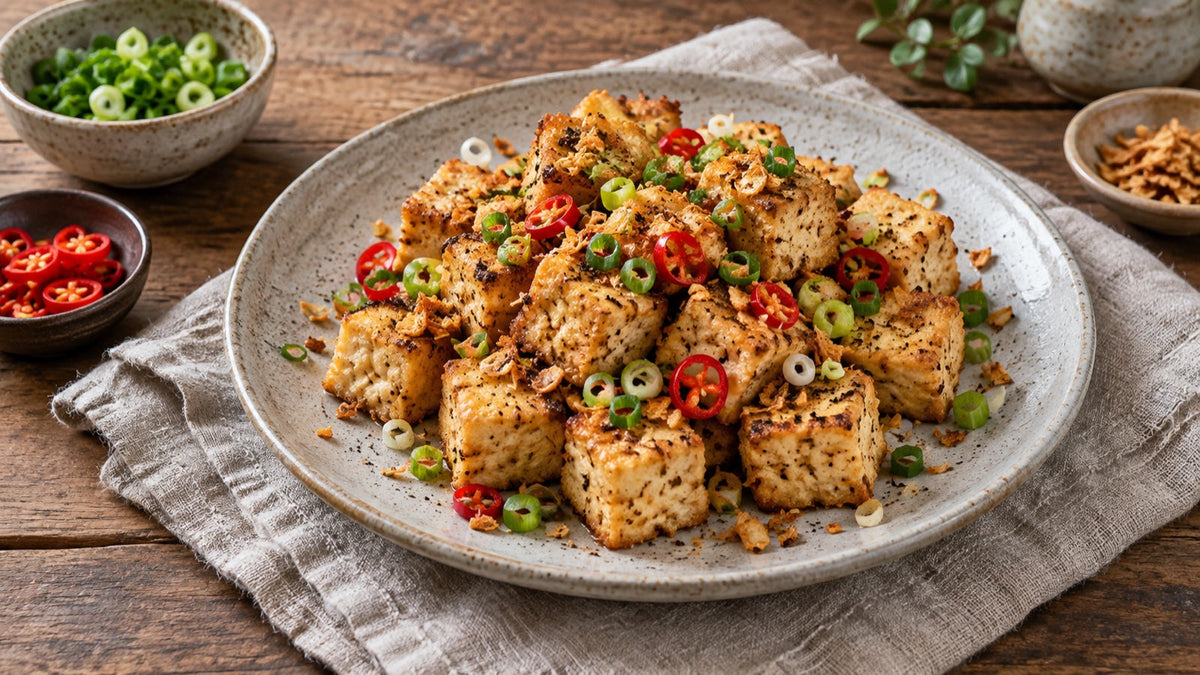
Your tofu came out of the pan golden. Looked perfect.
Two minutes later it's in the wok with the garlic and chilli, and the whole lot has gone soft and a bit sad.
That's not a frying problem. It's what happened after the frying, and it's the step nobody writes down.
Here's the takeaway-shop version: firm tofu, salted and air-dried instead of pressed, dredged twice in cornflour, fried until the shell is properly hard, then tossed off the heat with aromatics that have already been dried out in the wok. Ready in about 30 minutes. Vegan, and genuinely crispy for longer than the walk to the table. 🔥
Stop pressing your tofu
Every salt and pepper tofu recipe on the internet opens with "press your tofu for 30 minutes." I'd skip it.
Pressing squeezes water out of the middle of the block. That's useful when you want chewy, dense tofu for a braise. For salt and pepper you want the opposite: armour on the outside, and an inside that's still soft enough to be worth eating. Press it and you get a crunchy shell around a rubbery core.
The water that ruins your crust isn't the water in the middle. It's the film sitting on the cut faces when they hit the oil.
So do this instead:
- Cut the tofu first.
- Toss the cubes with ½ teaspoon of fine salt.
- Sit them on a wire rack for 15 minutes.
The salt pulls surface moisture out and seasons the tofu itself, which matters more than you'd think — a plain cube with seasoned coating tastes like two separate things. Fifteen minutes on a rack and the faces go visibly matte. Pat them once with paper towel and they're ready.
You'll notice this is faster than pressing, too.
The double dredge (this is the crunch)
One pass through cornflour gives you a thin, papery shell that shatters the moment it meets sauce or steam. Takeaway shops don't get that texture from better cornflour. They get it from coating twice.
Toss the tofu in cornflour. Wait two minutes. The coating will look damp and slightly pasty where it's pulled moisture off the tofu — that's exactly right. Now toss it through the cornflour again.
The second layer grabs onto the damp first layer and fries into something craggy and thick. It survives the wok toss. It survives sitting on the plate while you plate up the rice.
Two notes on the cornflour itself. Australian "cornflour" is often wheaten cornflour, not maize — check the box if that matters to you or anyone you're feeding. And if you've got potato starch, it fries a shade crispier, though it's stickier to work with and the cubes want to clump. I use cornflour. (I go into the wheaten-cornflour thing properly in the salt and pepper chicken recipe, if you want the longer version.)
Why vegan salt and pepper tastes flat — and the actual fix
Here's the part the recipe blogs skip.
Salt and pepper chicken works partly because chicken brings its own savour to the party. Skin, fat, the browned bits stuck to the wok. Tofu brings none of that. It is, deliciously, a blank page.
So when you season tofu exactly the way you'd season the chicken version, you get a dish that's crispy, salty, peppery and somehow still missing something. People usually respond by adding more salt, which makes it salty and still missing something.
What's missing is savoury depth — umami, the fifth taste, the thing that makes food taste finished rather than merely seasoned. It's why a mushroom tastes meatier than a cucumber. Tofu has very little of it, and no amount of salt will invent it.
That's the whole reason a scoop of YumYum Umami Seasoning goes into the finishing mix here rather than the coating. It doesn't overpower the tofu. It gives the tofu something to be. The Red Can is vegan-friendly, so the dish stays vegan end to end.
If you want the longer explanation of savoury depth in plant cooking, I've written that up separately: how to add umami without meat.
Ingredients
Serves 4 as a side, or 2 as a main. Prep 20 min, cook 10 min.
The tofu
- 500g firm tofu (not silken, not soft — it'll disintegrate)
- ½ tsp fine salt
- 6 tbsp cornflour
- Neutral oil for shallow frying (rice bran, sunflower, canola), about 2cm deep
The aromatics
- 4 spring onions, whites cut into 3cm lengths, greens sliced
- 3 garlic cloves, finely chopped
- 1 long red chilli, sliced (2 if you like it hot)
- ½ brown onion, sliced thick
- ½ red capsicum, cut into squares (optional, but it's what the shops use)
The finishing seasoning
- 1 tsp YumYum Umami Seasoning
- ½ tsp ground white pepper
- ¼ tsp fine salt
Mix the three finishing ingredients in a small bowl before you start cooking. Once the wok is going you will not have time.
Method
- Cut and salt. Slice the tofu into 3cm cubes. Toss with ½ tsp salt, spread on a wire rack, leave 15 minutes. Pat dry.
- Dredge twice. Toss the cubes in cornflour until coated. Wait 2 minutes for the coating to go damp. Toss in the cornflour a second time. Shake off the loose excess.
- Heat the oil to 180°C. No thermometer? Drop in a pinch of cornflour — it should fizz straight away and float, not sink and sulk.
- Fry in two batches, 4–5 minutes each, turning once the underside has set. Crowding the pan drops the oil temperature and steams the coating. Pull the tofu out when it's pale gold and hard to the tongs, not just coloured. Drain on a rack, not paper towel.
- Dry the aromatics. Pour off all but a tablespoon of oil. Get the wok hot, then stir-fry the onion, capsicum, garlic, chilli and spring onion whites for 60–90 seconds until the garlic smells sweet and the moisture has cooked off. This is the step that saves your crust.
- Toss and finish. Kill the heat. Return the tofu, add the spring onion greens, scatter over the finishing seasoning and toss for 15 seconds. Off the heat, so nothing steams and the seasoning doesn't scorch.
- Serve immediately. With rice, or on its own with a beer. ✨
Air fryer version
200°C, 14–16 minutes, shaking the basket twice. Spray the coated cubes generously with oil first, otherwise the cornflour stays chalky and white. You'll get about 80% of the crunch. Do the aromatics and the final toss in a frying pan exactly as above — that part doesn't change, and it's the part that matters.
Chef's note
I spent years on the wok line in my family's restaurants, and the vegetarian orders were the ones that taught me the most.
A wok that's been cooking meat all night is coated in fond and rendered fat. Everything you throw in it afterwards tastes better for free. When a vegetarian order came in, the wok got scrubbed down, and suddenly all that free flavour was gone. Nothing to hide behind. You couldn't fudge it with technique — the seasoning had to carry the entire dish on its own.
Which is why I get a bit annoyed when tofu dishes are treated as the afterthought on a menu. Cooked properly, salt and pepper tofu is better than the chicken. The shell goes crunchier. The inside goes custardy in a way meat can't. It just asks you to season it like you mean it.
Dad never let anything leave the pass under-seasoned, vegetarian or not. That standard is the whole recipe, really.
Common questions
Do you have to press tofu for salt and pepper tofu?
No. Salt the cut cubes and rest them on a wire rack for 15 minutes instead. The salt draws out the surface moisture that stops a crust forming, and it seasons the tofu itself. Pressing removes internal water and makes the middle dense, which is the opposite of what this dish wants.
Why isn't my salt and pepper tofu crispy?
Usually one of three things: the oil was under 180°C, the pan was crowded, or the aromatics went into the wok wet. That last one catches most people. Fry the garlic, chilli and onion until their moisture has cooked off before the tofu goes back in, and toss everything off the heat.
Can I make salt and pepper tofu ahead?
Fry the tofu up to 2 hours ahead and leave it on a rack at room temperature. Re-crisp for 60 seconds in a hot dry pan, then do the aromatics and the toss. Don't refrigerate it — condensation will undo the shell.
What is Chinese salt and pepper seasoning?
At its simplest, salt and white pepper. What separates the takeaway version from the home version is savoury depth underneath the salt, which is why restaurants use a seasoned salt blend rather than the plain stuff. Grinding your white pepper fresh makes a bigger difference here than most people expect — pre-ground loses its top notes within months.
Is this recipe vegan?
Yes. Tofu, cornflour, oil, vegetables and seasoning, with no animal products anywhere. The Red Can is vegan-friendly too.
What to season it with
The white pepper you can get anywhere. The savoury depth is the bit worth buying properly.
YumYum Umami Seasoning — the Red Can — is $17 and does the job in this dish with a single teaspoon. It's the same can I reach for on fried rice, roast vegetables and anything that tastes almost-right but not quite.
Cooking for the family? The Three-Pack is $50 and ships free (free AU shipping over $50), which works out cheaper per can than buying singles. If you want the full range instead, the Four-Pack of YUM is $60 and it's our best seller for a reason.
More in this series: how to make Chinese food taste like takeaway is the full playbook, and if this went well you'll want five-spice roast vegetables next. 🌿
Written by Vincent Lim — chef, cookbook author, and co-founder of YumYum. Vincent grew up in his family's Chinese restaurants and learned to cook from his father, Danny. He shares the restaurant techniques most home cooks are never told.
Researched and drafted with AI assistance, edited and kitchen-checked by the YumYum team.