
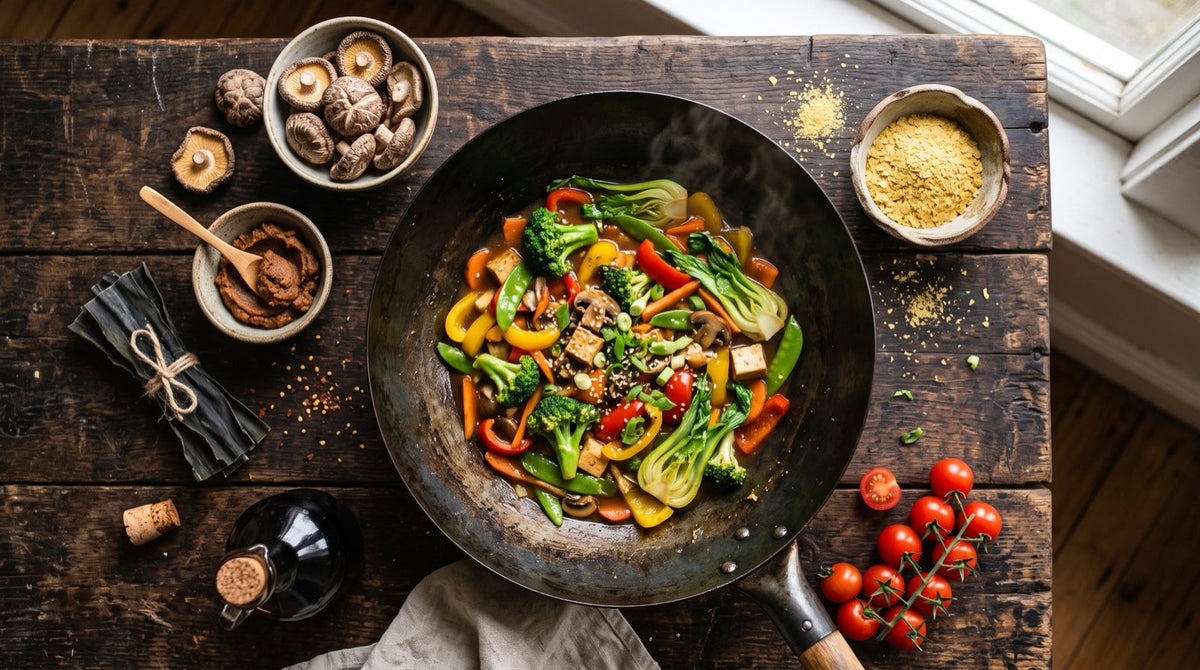
You made the veggie stir-fry. You did everything the recipe said. And it still tastes… thin. Like the picture of a meal instead of the meal. ✨
That missing thing has a name: umami — the deep, savoury, mouth-filling taste that meat and bones usually bring to a dish. Here’s the good news from someone who grew up in Chinese restaurant kitchens: you don’t need the meat. Chinese cooks have been building serious umami into vegetable dishes for centuries, because the depth was never just the pork — it’s glutamate, and plants are full of it.
The problem with most “vegan umami” lists is they hand you the shopping list and skip the method. Mushrooms in the pantry don’t flavour anything. It’s how much, and when, and how you stack them. So here’s the working version — doses, timing, and the one layering rule that changes everything.
Quick answer: 8 vegan umami boosters that actually work
- Dried shiitake mushrooms — soak, slice, and use the soaking water
- Tomato paste — fried off in oil, not stirred in raw
- Miso paste — a spoon in dressings, sauces, soups
- Soy sauce — light for salt, dark for depth
- Kombu (dried kelp) — the 20-minute vegan “stock bone”
- Nutritional yeast — the savoury dust for finishing
- Browned onions & roasted veg — technique, not an ingredient
- YumYum Umami (the Red Can) — one scoop, instant depth, vegan-friendly
Any two of those, layered right, will out-flavour a dish that leans on one. Now the detail — because the doses are where it goes wrong.
1. Dried shiitake mushrooms — the vegan stock bone
Fresh mushrooms are fine. Dried shiitake are a different weapon entirely — drying concentrates the glutamate, which is why they’re the backbone of vegetarian cooking across China and Japan.
The move: soak 4–5 dried shiitake in a cup of hot water for 30 minutes. Slice the caps into your stir-fry or braise — and do not tip out the soaking water. That brown liquid is free umami stock. Splash it in where a recipe calls for water or stock.
In my family’s restaurant kitchens the vegetable dishes couldn’t lean on pork bones, and this was the first answer: dried mushrooms and their soaking liquid doing the job the bones do everywhere else.
2. Tomato paste — but you have to cook it out
Tomatoes are one of the most glutamate-rich things in your kitchen, and paste is tomatoes with the water removed. But stirred in raw it just tastes tinny.
The move: fry 1 tbsp of tomato paste in your oil for 60–90 seconds before the liquid goes in, until it darkens a shade and smells sweet. That’s the difference between “tomatoey” and “deep”. Works in noodle sauces, braises, even fried rice at the margins.
3. Miso — the fermented depth-charge
Fermentation frees up glutamate, which is why the fermented aisle is where vegans should do their flavour shopping. Miso is the easiest entry: white miso is mild and a bit sweet, red/dark miso is a foghorn.
The move: 1–2 tsp whisked into a dressing, a marinade, a soup base, or a glaze for roast eggplant. Add it late and don’t boil it hard — you’ll keep more of the aroma.
4. Soy sauce — use two, not one
Every list says “add soy sauce”. The restaurant version: use light soy for saltiness and seasoning, dark soy for colour and rounded depth, and stop treating one bottle as both.
The move: season with light soy during cooking, then a teaspoon of dark soy at the end for that glossy, takeaway-brown finish. (If your greens taste flat with soy alone, the problem is usually salt balance — umami reads loudest with enough salt behind it, which is exactly why chip-shop chips taste the way they do.)
5. Kombu — 20 minutes to vegan stock
Kombu (dried kelp) is the K in the original umami discovery — Japanese dashi. One postcard-sized piece steeped in barely-simmering water for 20 minutes gives you a clean, savoury stock that makes vegetable soups and noodle broths taste finished.
The move: don’t boil it hard (goes slimy and bitter — same energy as scorched five spice). Steep, pull it out, build your soup on the liquid.
6. Nutritional yeast — the finishing dust
Cheesy, savoury, shelf-stable. It’s not subtle, and that’s fine.
The move: a tablespoon through popcorn, roast potatoes, pasta, or scrambled tofu. Treat it like parmesan: a finishing seasoning, not a base.
7. Browning — the booster that isn’t an ingredient
Here’s what the ingredient lists never tell you: half of umami is technique. A pale onion and a properly browned onion are different ingredients. Roasted tomatoes beat raw. Charred cabbage beats steamed. High heat and patience generate savoury depth from the vegetables you already have.
The move: stop crowding the pan, stop stirring so often, and let things actually colour. If your veg dish tastes flat, this is the first fix before you buy anything.
8. The Red Can — one scoop when you want it done
Everything above is real and it all works. It also asks you to keep six ingredients stocked and layer them right on a Tuesday night.
This is exactly why we make YumYum Umami — the Red Can. One scoop over stir-fried veg, fried rice, roast potatoes, tofu, soup — and the savoury depth arrives, without a shred of meat in sight. It’s vegan-friendly and gluten-free, and it doesn’t overpower what you’re cooking. It amplifies what’s already there.
What’s actually in it? That’s the bit people love to guess at. A chef family’s blend we keep close to our chest — try it and have your own theory. 😉
The move: ½–1 tsp per serve, added near the end of cooking, taste, adjust. Start smaller than you think.
The layering rule (why your dish still tastes flat)
The real restaurant secret isn’t any single ingredient on this list. It’s that umami stacks. Glutamate sources reinforce each other, so two moderate boosters beat one heavy one — every time.
Flat veggie fried rice? Shiitake and a scoop of the Red Can. Thin noodle soup? Kombu stock and miso. One-note pasta? Browned onions and tomato paste. If a dish tastes flat, don’t double the booster you already used — add a second, different one, and check the salt.
That’s the whole method. Shopping list + doses + stacking. You’re done being the person whose vegan food needs apologising for.
Keep the depth on tap
If the Red Can earns its spot on your bench (it will), singles are $17 — but a single sits under the $50 free-shipping line, so the smart buy is the Three-Pack at $50, which ships free and works out cheaper per can. Want the full kit? The Four-Pack of YUM ($60) adds the rest of the range to the bench. 🔥
Keep reading: Why Your Fried Rice Tastes Flat (the one scoop that fixes it) · What Is Flavour Enhancer 621? (the umami number on labels, explained) · The Best MSG-Free Chinese Seasonings (chef-tested).
Written by Vincent Lim — chef, cookbook author, and co-founder of YumYum. Vincent grew up in his family’s Chinese restaurants and learned to cook from his father, Danny. He shares the restaurant techniques most home cooks are never told.
Researched and drafted with AI assistance, edited and kitchen-checked by the YumYum team.