
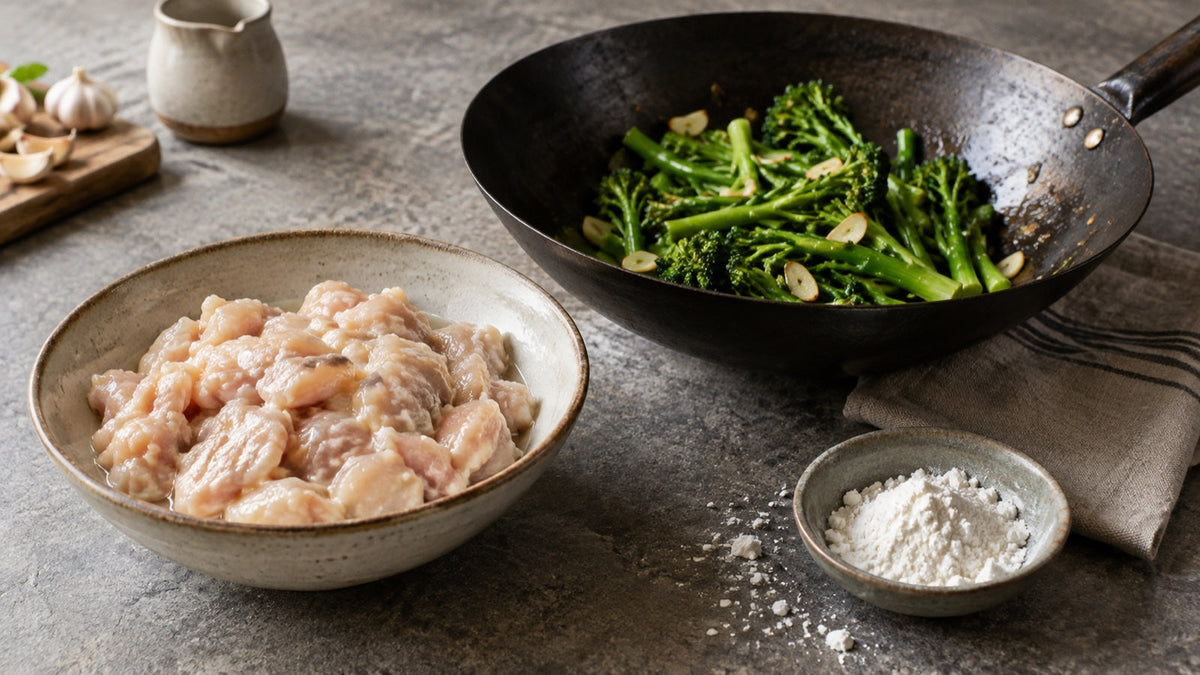
You've had the chicken in a good stir-fry. It's slippery. It gives way. It doesn't shred into dry strings when you bite it. 🍗
Then you make one at home and the chicken is fine, but it's chicken — a bit tight, a bit dry at the edges, sitting in the sauce rather than being part of it.
The gap is one step, done before the wok is even hot. Restaurants call it velveting, and the reason yours hasn't worked yet is almost certainly that you picked the wrong version of it.

How to velvet chicken, short version
Slice the chicken thin across the grain. Toss it with bicarb at 0.3% of its weight (a scant ¼ teaspoon per 250 g), a splash of water, and a little soy. Rest 20–30 minutes in the fridge. Add 1–2 teaspoons of cornflour per 250 g and a teaspoon of oil, then straight into a very hot pan. No rinsing.
That's the whole technique. Everything below is why each part is there, and which bits change depending on what you're cooking.
There are three velveting methods, and they're not interchangeable
This is the thing page one never says out loud. "Velveting" describes three genuinely different processes, and picking the wrong one is why the technique gets a reputation for being fiddly.
| Method | What you do | Best for | Honest verdict at home |
|---|---|---|---|
| Oil-blanching (走油 zǒu yóu) | Coat in egg white and starch, then poach in 120°C oil for ~30 seconds before stir-frying | Restaurant service, banquet dishes | Skip it. A litre of oil and a thermometer for a Tuesday dinner |
| Water-blanching (水滑 shuǐ huá) | Coat, then poach in barely-simmering water for 60 seconds, drain, then stir-fry | Fried rice, saucy dishes, big batches | Genuinely useful. Underrated at home |
| Direct marinade | Coat and go straight into the hot pan, no pre-cook | Weeknight stir-fry | The one you want 90% of the time |
For a stir-fry, use the direct marinade. It's the fastest, it browns properly, and the coating sets in the pan instead of in a pot of oil you then have to deal with.
Save the water-blanch for fried rice. More on that below, because it matters more than it sounds.
Do I need egg white?
No — and for a home stove I'd argue against it.
Egg white is the traditional restaurant coating, and it works beautifully in the context it was designed for: a gentle 120°C oil bath where the egg and starch set into a smooth shell around each piece. That's what oil-blanching is for.
Drop that same egg white into a screaming-hot home wok and it doesn't form a shell. It sets instantly and unevenly, then shears off the meat as you toss, and you end up picking pale stringy bits out of your stir-fry. Which is exactly what a lot of people describe when they say velveting "didn't work" for them.
Cornflour and a little water do the same job in a hot pan, without the audition.
Breast or thigh? They need different handling
Nearly every velveting guide gives you one set of instructions for "chicken". Breast and thigh are not the same problem.
Breast is the one that actually needs this. It's lean, it has almost no connective tissue, and it goes from juicy to chalky in about forty seconds of overcooking. Velveting buys you a margin you otherwise don't have. Australian supermarket breast fillets also tend to be thick through the middle, so butterfly the fat end before slicing or your pieces will be twice as thick at one end as the other and cook at two different rates.
Thigh barely needs tenderising — the fat and collagen do that themselves. Velvet it anyway, but for the coating, not the bicarb. Halve the bicarb, or leave it out entirely and go with just cornflour, water and soy. Thigh that's been dosed like breast comes out soft in a slightly unpleasant, mushy way.
If you're new to this, start with thigh. It's much harder to get wrong, and you'll see the coating do its work without the bicarb being a variable.
Slice it properly, because nothing downstream fixes a bad cut
Chill the chicken for 15 minutes in the freezer first. Firm meat slices cleanly; room-temperature chicken slides under the knife and tears.
Then cut across the grain — look for the direction the muscle fibres run and cut at ninety degrees to them. On breast the grain runs the length of the fillet, so slice crossways into strips about 5 mm thick. On thigh the grain wanders, so cut in whatever direction gives you short fibres rather than long ones.
Five millimetres is the number. Thicker and the outside overcooks before the centre is done. Thinner and it curls into ribbons in the wok.
Here's a small thing that's actually true: this is the one part of the process where you can beat a restaurant. A prep cook slicing forty kilos of chicken before lunch service is fast and consistent, but nobody is butterflying individual fillets. You're doing 400 grams in a bowl. Take the extra two minutes.
The method (by weight, not by spoon)
For 500 g of sliced chicken:
- Bicarb: 1.5 g — about ⅓ of a level teaspoon. That's 0.3% of the meat's weight, the leave-on dose. Sprinkle it over and toss until you can't see it.
- 1 tablespoon of water. Not optional. Toss until the chicken absorbs it and the surface goes slightly tacky.
- 1 tablespoon of light soy sauce, and a splash of Shaoxing wine if you have it.
- Rest 20–30 minutes in the fridge. Not overnight.
- 2–4 teaspoons of cornflour, added at the end, tossed to a thin even film.
- 1 teaspoon of neutral oil, tossed last. This stops the pieces welding into a single lump in the pan.
- Into a properly hot pan, spread in one layer, and then leave it alone for 60–90 seconds before you touch it.
Scale up or down from there — the doses are the same percentages at any weight. The full chart from 250 g to 1 kg, including the different dose you need if you're rinsing, is in how much bicarb soda to tenderise meat.
Should I rinse the bicarb off?
Not at this dose. The rinse is a workaround for over-dosing, and it costs you: you wash the soy and the seasoning down the sink along with the bicarb, then have to dry the chicken completely before it can take a coating.
Rinse only if you've used the 1% treatment dose. At 0.3% the bicarb is deliberately low enough to cook with, which is the entire point of using the leave-on number.
How long should chicken marinate?
Twenty to thirty minutes. The pH shift that makes bicarb work is mostly finished inside fifteen.
Past about two hours the surface starts breaking down into something soft and pale, and that's the "slimy" complaint you'll see in recipe comments. Longer is not better. This is a step with a peak, not a slope.
Velveting chicken for fried rice is a different job
Every guide mentions fried rice. None of them tell you to change anything, and you have to, for two reasons.
Dice, don't slice. Fried rice wants 1 cm cubes that sit at the same scale as the rice and the peas. Strips clump and hang together, and you end up with a bowl of rice with a nest of chicken in one corner.
Water-blanch it — and get it dry. This is the change that matters. A wet marinade going into a fried rice pan releases liquid, the rice steams instead of frying, and you get the soft, slightly gluey result that makes people think their rice was too fresh. Coat the diced chicken as above, poach it in barely-simmering water for 60 seconds until it's just opaque, drain it well, then let it sit on a plate while you fry the rice. Fold it through at the end.
The chicken is already cooked, so it's only in the pan for the final thirty seconds — which is why restaurant fried rice has chicken that's tender rather than leathery, in a dish that spends four minutes over a burner hot enough to blister the pan.
If your fried rice has a bigger problem than the chicken, that's a different fix, and we've written it up in why restaurant fried rice tastes better than yours.
Why yours came out chalky (and the other three failures)
Chalky or powdery. This is the one in the title, and it's raw starch. Cornflour has to hydrate before it can turn into the glossy gel that makes velveting feel silky — it needs water and it needs heat. Dust dry cornflour onto dry chicken and drop it into a dry pan and the granules never gelatinise. What you're tasting is uncooked starch. The fix is the tablespoon of water in step 2, which is exactly the step people skip because it looks pointless.
Soapy or metallic. Too much bicarb, or a rinse-off dose left on. Drop to 0.3%, or rinse properly. Worth knowing that a US recipe calling for a tablespoon means 3 teaspoons, while your Australian tablespoon holds 4 — a third more bicarb, at a quantity where a third is the whole margin. There's a full account of that mistake in velveting chicken without the baking soda taste.
Slimy or mushy. Rested too long. See above — 30 minutes, not 3 hours.
The coating slid off in the pan. Either the pan wasn't hot enough, or you stirred too early. Chicken hitting a properly hot surface sticks for a moment and then releases itself once the coating has set. Nudge it before that and you tear the coating off. Give it 60 seconds before the first stir. If it's still gripping, it isn't ready. And a pan that's merely warm will give you tough, tight chicken no matter how well you velveted it — the full list of reasons stir-fry chicken goes rubbery covers the rest.
Chef's note
I grew up thinking velveting was a skill. It isn't. It's a schedule.
In my dad's kitchens — Emperors of China, where I learned most of this — nobody velveted chicken to order. It was a prep job. One person, one enormous tub, every kilo of chicken for the night done in the same twenty minutes before service, sitting in the coolroom in portioned trays. When a docket came in, the wok chef reached for chicken that had already been sitting in its coating for four hours.
That's the actual reason it's so consistent in a restaurant and so hit-and-miss at home. It's not that they're better at the technique. It's that the technique had already happened, at leisure, by someone whose whole job for that hour was getting it right.
You can borrow the schedule. Velvet the chicken when you get home from the shops, not when you're standing over a hot pan with the vegetables already cut and the rice going cold. It's the same twenty minutes either way — but one of them isn't twenty minutes you're standing there waiting for.
Common questions
What does velveting chicken actually do?
Two separate things at once. The bicarb raises the surface pH so the muscle fibres hold onto moisture instead of contracting and squeezing it out, and the starch coating forms a thin gel that shields the meat from direct heat. Tenderness comes from the first, that slippery restaurant texture from the second. Skip either and you only get half the effect.
Can you velvet frozen chicken?
Thaw it fully first, then pat it dry. Frozen chicken releases water as it thaws, and if it does that in the marinade you've diluted your dose and made a puddle. One upside: partially thawed chicken slices beautifully, so take it out, let it get to the firm-but-sliceable stage, cut it, then finish thawing before you season.
Do I have to use bicarb soda at all?
No, especially not for thigh. Cornflour, water and soy alone will still give you the silky coating and a noticeably better result than nothing. You lose the tenderising, which matters most on breast and hardly at all on thigh.
How far ahead can I velvet chicken?
Coat it with the bicarb, water and soy, and it's happiest cooked within about two hours. Add the cornflour and oil right before it goes in the pan, not hours ahead — the coating goes claggy sitting in the fridge and won't spread evenly. If you're prepping earlier in the day, hold the starch until the last minute.
Does this work for beef and pork too?
Yes, and it's the same idea with different numbers, since beef and pork have more connective tissue to deal with than chicken does. The full protein-by-protein breakdown is in how to velvet meat at home.
When you'd rather not measure a third of a teaspoon
Everything above works. It also asks you to weigh out 1.5 grams of bicarb on a Wednesday night.
That's genuinely the failure point for most people — not the concept, the arithmetic. A third of a teaspoon is a rounded guess with a teaspoon, and being "a bit heavy-handed" at that scale means being 50% over.
YumYum Meat Velvet is this whole step, pre-balanced — the tenderising, the coating and the seasoning already in the right proportion to each other, so your dose becomes 1–2 tablespoons plus 1–2 tablespoons of water per 250 g of chicken, rested 30 minutes. A tablespoon you can measure, instead of a fraction of a teaspoon you're estimating. Same technique, same timings, and it seasons the chicken while it works — because tender and bland is only half the job. It doesn't overpower. It elevates. ✨
Cooking for a household? A single can is $17, and both the Three-Pack of Meat Velvet at $50 and the Four-Pack of YUM at $60 ship free (free AU shipping over $50) and work out cheaper per can.
Written by Vincent Lim — chef, cookbook author, and co-founder of YumYum. Vincent grew up in his family's Chinese restaurants and learned to cook from his father, Danny. He shares the restaurant techniques most home cooks are never told.
Researched and drafted with AI assistance, edited and kitchen-checked by the YumYum team.