
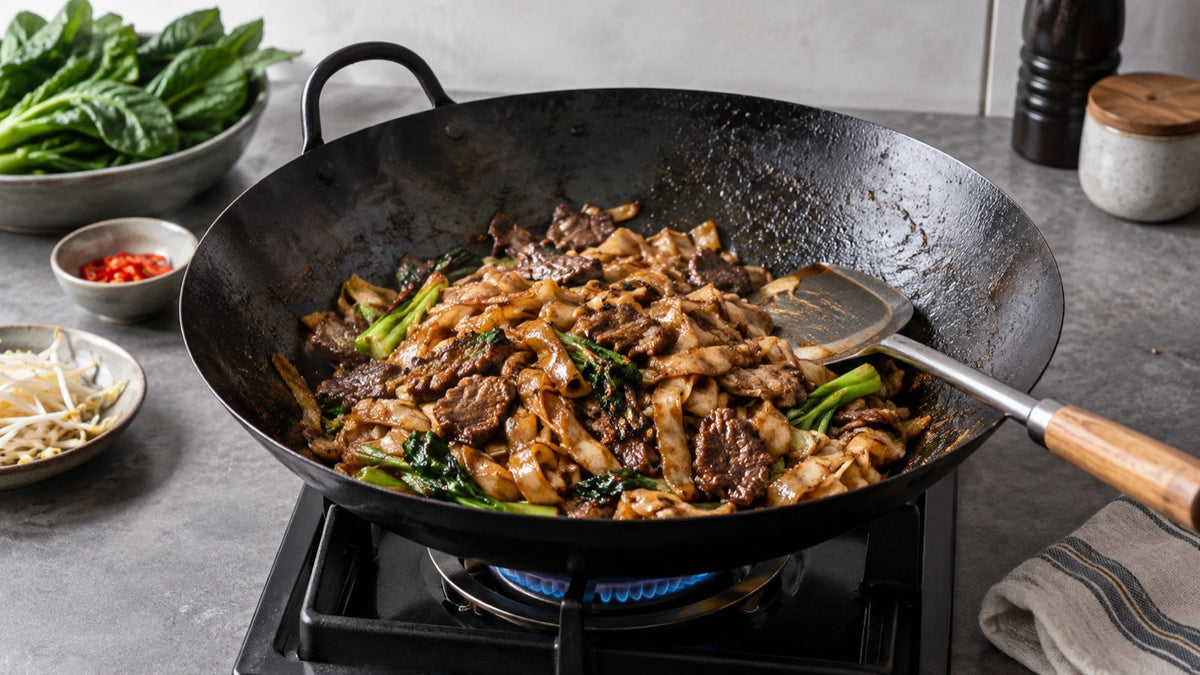
You've tasted it. That smoky, savoury, slightly-charred thing that happens to noodles at a good Chinese restaurant and never happens in your kitchen.
Then you go home, buy a wok, and produce a pan of grey wet stir-fry.
Here's the honest version of why, and what actually fixes it.
The short answer
You can't match a restaurant jet burner at home. You can get most of the way there. Cook in 200g batches, dry your ingredients properly, preheat the wok until it smokes, leave it on the heat instead of tossing it, and pour your soy down the hot side of the wok rather than over the food.
Those five things will do more for you than any burner upgrade.
What wok hei actually is
Wok hei translates as the breath of the wok. It's the smoky, faintly sweet, savoury edge that food picks up when it's cooked fast over very dry, very high heat.
It isn't one flavour. It's three things stacked, and this matters because two of the three are fully available to you at home.
One: the seasoned wok itself. A carbon steel wok that's been used builds up a layer of polymerised oil. That patina gives food a grilled, caramelised note. Free. Yours after about a month of cooking.
Two: caramelised sauce. When soy sauce hits bare hot steel instead of landing on food, it sizzles and browns in about two seconds. Raw soy tastes salty and sharp. Seared soy tastes roasted. J. Kenji López-Alt calls this perimeter searing, and it's the single most underrated move in home stir-frying.
Three: burning oil vapour. At restaurant temperatures, oil aerosolises off the food, catches the flame above the burner, and rains combustion products back down. López-Alt identifies this as the main flavour component of true wok hei.
Number three needs an open flame and a burner putting out several times what your stove does. A domestic gas hob runs somewhere around 12,000 to 18,000 BTU. A Chinese restaurant wok range is in another category entirely.
So: you get two out of three. Anyone who tells you a $40 wok and a blowtorch will give you all three is selling something.
Two out of three is still a completely different dinner from what you're making now.
Your stove is not your main problem
I've watched hundreds of home cooks blame their kitchen. Nearly always, the stove is the second problem.
The first is water.
Think about what's actually in your wok. Chicken straight from the fridge, still damp. Capsicum you rinsed a minute ago. Bean sprouts with water clinging to them. Half a cup of sauce poured in early.
All of that has to boil off before the pan can get back above the temperature where browning happens. Until it does, you aren't stir-frying. You're boiling food in a metal bowl.
That's the grey wet stir-fry. It's not a heat output problem. It's a moisture problem wearing a heat output problem's clothes.
And the second problem is that you put it all in at once.
Step 1: The wok
Carbon steel, 2 to 3mm thick. Adam Liaw's advice here is the right advice: carbon steel beats thin cast iron and aluminium, and a long handle beats two loop handles for home cooking because you can actually move the thing.
Flat bottom, not round. This is non-negotiable on electric, ceramic or induction. A round-bottomed wok sitting on a flat element touches it in a circle the size of a coaster, and you will be cooking on a coaster.
Skip the non-stick wok. Non-stick coatings aren't rated for the temperatures you need and they never build a patina.
What goes wrong: people buy a beautiful round-bottom wok for an electric cooktop because that's what the restaurant uses. Restaurants have a ring-shaped burner well designed for it. You don't.
Step 2: Dry everything
This is the step that decides your dinner, and almost every article skips past it in one line.
- Pat meat dry with paper towel. Properly dry, not damp.
- Wash vegetables at least 20 minutes ahead and let them drain. Spin your greens if you have a salad spinner.
- Bean sprouts and leafy greens go in last, never at the start.
- Mix your sauce in a small bowl and keep it out of the wok until the end.
If you velvet your meat first, shake off the excess liquid before it hits the oil. Velveted chicken still needs to sear. (If tough, rubbery chicken is your actual complaint, that's a different fix and I've written about why your chicken goes tough in a stir-fry separately.)
Step 3: Preheat until it smokes
Dry wok. No oil. Highest setting.
Wait until you see a wisp of smoke lift off the surface. On gas that's about 90 seconds. On a ceramic or coil electric cooktop it can be three to four minutes, because the element has to heat, then the wok has to take heat off the element.
Then add your oil, swirl it up the sides, and go the moment it shimmers.
Use an oil that can take it. Peanut, rice bran, or grapeseed. Olive oil will smoke bitter and ruin the dish.
What goes wrong: almost everyone adds oil to a cold wok and heats them together. You end up with oil that's been slowly cooking for four minutes, and a wok that was never hot enough to sear.
Step 4: Cook in 200g batches
Two hundred grams. Per batch. That's roughly one chicken thigh, or two handfuls of vegetables.
Overcrowding drops the wok temperature below the point where browning happens, and once it drops, a home burner cannot claw it back. A restaurant burner can. Yours can't. This is the one place where the BTU gap genuinely bites you, and batching is the workaround.
Cook the protein. Tip it onto a plate. Cook the vegetables. Tip them onto the plate. Combine everything at the end for 30 seconds with the sauce.
Dinner for four means four or five short rounds in the wok. It feels wrong. It's about six minutes of extra work and it's the difference.
Step 5: Stop tossing
Here's the one that surprises people, and it's the opposite of what the videos teach you.
Restaurant chefs toss constantly because their burner is so violent that food sitting still would carbonise in seconds. Tossing is damage control.
At home you have the reverse problem. You need contact time on hot steel to get any browning at all. Every toss lifts the food off the heat and lets the wok cool in the draught.
So: spread the food out, leave it for 20 to 30 seconds, then stir. Leave it again. Stir. You want to hear a hard continuous sizzle. If it goes quiet, something's wrong and it's usually water.
Step 6: Pour the soy down the side
If you only change one habit, change this one.
Don't pour soy sauce onto the food in the middle of the wok. Pour it in a thin stream around the upper edge, where the steel is bare and hottest, so it hisses and caramelises on the way down.
You'll smell the difference immediately. That roasted, slightly sweet note that appears in the two seconds after the soy hits steel is a real chunk of what you've been calling wok hei.
Same goes for the Shaoxing wine.
Step 7: Finish off the heat
Kill the heat, then splash in your Shaoxing and give it one last toss. The volatile aromatics lift straight off rather than boiling away.
Serve immediately. Wok hei has a shelf life of about 90 seconds. This is genuinely why takeaway tastes better at the shop than it does in your car.
If you're on electric or ceramic
The lag is your enemy. The element takes forever to heat and then holds that heat stubbornly.
- Preheat for three to four minutes, not one.
- Leave the wok flat on the element the entire time. Don't lift it. Every lift is 30 seconds of lost heat.
- Because you can't toss, stir with a wooden spatula and push food up the walls of the wok instead.
- Turn the element on to preheat before you start your prep, not after.
If you're on induction
Induction is better for this than most people expect, and better than an old electric coil by a wide margin.
- You need a flat-bottomed, heavy-gauge carbon steel wok that the hob will actually recognise.
- Use the boost setting. A 3,700W-plus hob puts real heat into the base.
- Heat is only delivered to the flat contact patch, so the walls stay cooler than on gas. Keep everything down in the base rather than pushing it up the sides.
- Batch even more strictly. Induction recovers fast, but only if you haven't buried the base under 500g of cold food.
Does the blowtorch trick work?
You'll see this one everywhere: sear your stir-fry with a butane torch to fake the flame.
I've tried it. It puts a scorched note on the food, and a butane note along with it. It tastes like a torch, because it is one.
If you want a real flame and you own a gas barbecue with a side burner, that'll get you closer than any kitchen gadget. Otherwise, put the effort into drying and batching. You'll get more back.
The practice dish: wok hei soy noodles
Two serves. Every step above, in one short dish. Make it twice this week and the technique sticks.
Ingredients
- 400g fresh thick egg or hokkien noodles, loosened and patted dry
- 200g chicken thigh, sliced thin (optional)
- 2 tbsp peanut or rice bran oil
- 2 garlic cloves, sliced
- 3 spring onions, cut into 5cm lengths, whites and greens kept separate
- 1 large handful bean sprouts
- 1½ tbsp light soy sauce
- 2 tsp dark soy sauce
- 1 tbsp Shaoxing wine
- 1 tsp YumYum Umami Seasoning
- White pepper
Method
- Separate the noodles with your hands and spread them on a tray to dry out for 10 minutes. Pat the chicken dry. Mix the two soys in a small bowl. Have everything within arm's reach of the stove, because once you start there's no time to go looking.
- Heat the dry wok on the highest setting until you see a wisp of smoke. 90 seconds on gas, 3 to 4 minutes on electric.
- Add 1 tbsp oil and swirl. Add the chicken in a single layer. Leave it 30 seconds without touching it, then stir for another 60. Tip it onto a plate.
- Add the last tablespoon of oil. Garlic and spring onion whites, 15 seconds.
- Noodles in. Spread them out and leave them 30 seconds. You want a few of them to catch and brown. Stir, spread, leave again, twice more.
- Pour the soy mix in a thin stream around the top edge of the wok. Listen for the hiss. Toss through for 20 seconds.
- Chicken back in. Bean sprouts and spring onion greens in. Sprinkle over the umami seasoning and a few grinds of white pepper. Toss 30 seconds.
- Kill the heat. Splash in the Shaoxing. One final toss, then onto plates straight away.
Cook time is about 8 minutes once the wok is hot. Don't walk away from it.
Chef note
My dad, Danny Lim, ran Chinese restaurants for most of his life, from Texas to Australia, and he had a rule about the wok line that took me years to appreciate.
He said: "Until you get your fried rice right, you aren't able to serve customers. It's the easiest dish to cook, but the hardest to master."
What he meant was that fried rice hides nothing. No sauce to cover a soggy result, no marinade to rescue tough meat. Get it wrong and the plate tells on you instantly.
Wok hei works the same way. It doesn't come from a secret ingredient. It comes from a dry wok, a small batch, and the patience to leave food alone for 30 seconds when every instinct says stir. The chefs you're trying to copy aren't doing something you can't. They're doing something simple, ten thousand times.
If fried rice is where you want to test it, here's why restaurant fried rice tastes better than yours.
Where seasoning fits (and where it doesn't)
Wok hei and savoury depth are two different axes, and people mix them up constantly.
Wok hei gives you aroma and char. It doesn't give you depth. You can nail every step above and still end up with a stir-fry that smells incredible and tastes slightly hollow, because nothing in the pan is carrying savouriness.
That's where the Red Can does its job. A teaspoon over noodles for two, or a tablespoon in a family-sized wok, added near the end so it doesn't scorch. It doesn't overpower. It elevates. ✨
If you're not sure what to season your protein with before it hits the wok, this is my honest answer on stir-fry chicken.
Cooking for the family? The Three-Pack for $50 ships free across Australia, and the Four-Pack of YUM at $60 gets you one of each so you've got the right can for whatever's going in the wok. Both clear the free-shipping line, which a single can doesn't. 🔥
Wok hei is one piece of a bigger puzzle. The rest of it is in how to make Chinese food taste like takeaway.
Questions people ask
Can you get wok hei on an electric stove?
Partly, yes. You'll get the browning and the caramelised-soy layer, which is most of the flavour. You won't get the burning-oil-vapour layer, which needs an open flame. Use a flat-bottomed carbon steel wok, preheat three to four minutes, and never lift the wok off the element.
Why does my stir-fry go watery?
Wet ingredients and too much food in the wok at once. Water has to boil off before anything can brown, and a home burner can't recover the lost temperature. Dry everything, cook in 200g batches, and add sauce at the end.
Do I need a special wok burner?
No. A wok burner helps, but batching and drying will close more of the gap than a burner upgrade will. Fix your technique first and then decide whether you still want one.
What oil is best for wok hei?
Peanut, rice bran or grapeseed. You need a smoke point above roughly 220°C. Olive oil and butter will burn bitter before the wok is hot enough.
How long does wok hei last?
Around 90 seconds. It's an aroma, and it leaves. Serve straight from the wok onto the plate.
Written by Vincent Lim — chef, cookbook author, and co-founder of YumYum. Vincent grew up in his family's Chinese restaurants and learned to cook from his father, Danny. He shares the restaurant techniques most home cooks are never told.
Researched and drafted with AI assistance, edited and kitchen-checked by the YumYum team.