
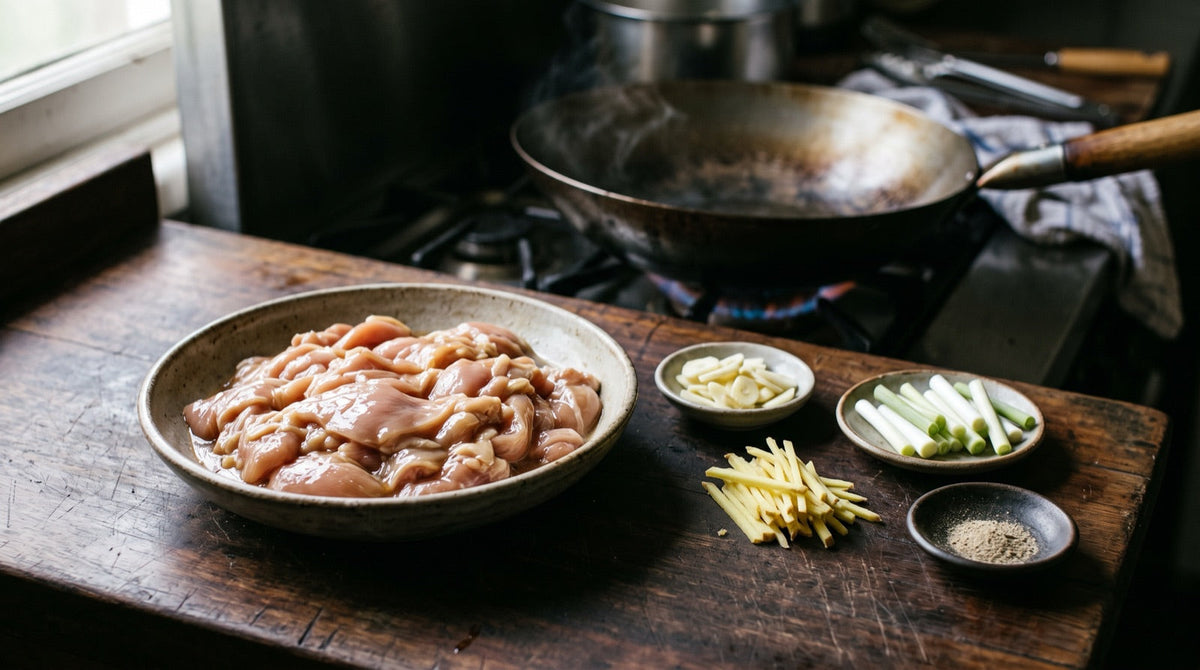
You've got chicken, a hot pan, and twenty minutes.
So you reach for the spice rack. Garlic powder, a bit of paprika, maybe some cumin, a good shake of whatever says "stir fry" on it. Onto the chicken it goes.
And it comes out tasting… dusty. Slightly bitter. Nothing like the takeaway. 🍗
Here's the honest answer, and it's not the one page one of Google gives you.
What seasoning do you put on chicken for a stir-fry?
Salt, white pepper and a savoury soy-based seasoning — mixed into the chicken with cornflour and a splash of water, 15 minutes before it hits the pan. Ground spices like garlic powder, cumin and paprika don't go on the meat at all: they scorch in a hot wok. Garlic and ginger go in the oil, and the sauce goes on last.
The three-layer rule (this is the whole answer)
Stir-fry seasoning isn't a jar. It's three jobs, done at three different moments.
| Layer | What goes in it | When | What it's actually for |
|---|---|---|---|
| 1. On the meat | Salt or light soy, white pepper, a pinch of sugar, cornflour, water — or one savoury seasoning that covers all of it | 15–30 min before cooking | Seasons the chicken through, and keeps it juicy |
| 2. In the oil | Fresh garlic, ginger, spring onion whites, dried chilli | First 30 seconds of cooking | Perfume. This is the smell that makes people walk into the kitchen |
| 3. In the sauce | Soy, sugar, stock or water, a cornflour slurry, sesame oil | Last 60 seconds | The gloss and the final hit of savoury |
Get those three in the right order and you don't need a "stir-fry seasoning" at all. Get them wrong and no blend on earth saves it.
The bit nobody wants to tell you: there's no such thing as "stir-fry seasoning"
Not in a Chinese kitchen, anyway.
The jar-of-blend thing is a Western invention — a good idea for a slow-roasted chook, a bad idea for a wok. Almost every page that ranks for this question will hand you a recipe for a dry mix and tell you to rub it on the chicken.
Do that and you get two problems.
Ground spice burns. Powder is dust. Enormous surface area, no water in it, nothing to protect it. A stir-fry pan runs well north of 200°C and that dust scorches in seconds — that's the bitterness. A clove of garlic has water inside it, so it has a buffer. Garlic powder doesn't.
Dry powder can't season the inside. It sits on the surface, then the sauce washes half of it into the pan. You end up with a chicken piece that's aggressive on the outside and bland in the middle. Which is exactly what most people describe when they say their stir-fry "tastes like nothing".
The fix isn't a better blend. It's putting the seasoning somewhere it can actually work: in a wet marinade, mixed through.
Layer 1: what actually goes on the chicken
This is where 80% of the flavour is won, and it takes ninety seconds of work.
Slice the chicken 3–4mm thick, then mix through:
| For this much chicken | Light soy | Cornflour | Water | Sugar | Neutral oil | Rest |
|---|---|---|---|---|---|---|
| 250g | 2 tsp | 1½ tsp | 1 tbsp | ¼ tsp | 2 tsp | 15 min |
| 500g | 1 tbsp | 1 tbsp | 2 tbsp | ½ tsp | 1 tbsp | 15–30 min |
| 750g | 1½ tbsp | 1½ tbsp | 3 tbsp | ¾ tsp | 1½ tbsp | 30 min |
Add ¼ tsp white pepper per 500g. Not black — white pepper is the flavour you can't place in takeaway food, and it's the single most under-used thing in an Australian spice rack.
Two things to understand about that list:
- The water isn't a mistake. You mix it in until the chicken drinks it and turns tacky. That's moisture you're putting into the meat before it ever meets heat, and it's why restaurant chicken stays juicy.
- The cornflour is doing double duty. It holds the marinade against the meat, and later it grabs the sauce so it clings instead of pooling in the bottom of the pan.
If you want the deeper version of that step — the one that gets you properly silky, takeaway-grade chicken — that's velveting, and it's a different lever again.
And if your chicken has been coming out tough rather than bland, seasoning isn't your problem at all. That's a texture failure, and it has its own five fixes.
Layer 2: the oil, and the 30-second rule
Aromatics go into hot oil, and they get seconds, not minutes.
- Garlic, sliced: 20–30 seconds. It should smell sweet, not toasty. Toasty is already too far.
- Ginger, julienned: 30–45 seconds — it's tougher, it can take a bit more.
- Spring onion whites, in 4cm batons: 30 seconds alongside the garlic. The greens go in at the very end, off the heat.
- Dried chilli: 15 seconds, and pull the pan off the heat if it darkens.
That's the perfume layer. It's not seasoning in the salt sense — it's the smell, and the smell is most of what people mean when they say a dish tastes "like the restaurant".
The mistake: dumping garlic into a cold pan with the oil and letting it come up to temperature together. By the time the pan is hot enough for the chicken, the garlic is brown and bitter, and that bitterness goes through everything.
Layer 3: the sauce, where the flavour lands
The chicken is seasoned. The oil is perfumed. Now you finish it.
A stir-fry sauce for 500g of chicken is roughly:
- 1 tbsp light soy (salt + savoury)
- 1 tsp dark soy (colour, barely any salt)
- 1 tsp sugar
- 1 tbsp Shaoxing wine, or dry sherry
- 100ml chicken stock or water
- 2 tsp cornflour, slaked in a bit of cold water first
Mix it in a cup before you start cooking. Once the wok is going you have about ninety seconds of thinking time, and measuring soy sauce is not what you want to be doing with it.
It goes in for the last 60 seconds, comes to a boil, thickens, and coats. That's it.
Want a sauce that does more work than that with fewer moving parts? The 5-minute soy scallion sauce is the one we make most at home.
So what should you actually buy?
Honest answer first: four things and you're covered — light soy, white pepper, cornflour, and a bit of sugar. That's a real Chinese stir-fry marinade. Nothing else required.
The reason people still want one seasoning is that the four-item version means measuring four things, every time, on a Tuesday night when the kids are already asking what's for dinner.
That's the job YumYum Shanghai Nights ($17) does. It's our soy-and-scallion blend, and it's built for exactly layer 1 — the savoury, oniony, slightly sweet backbone that a stir-fry marinade is supposed to have, in one spoon instead of four jars.
Dose: 2 tsp (about 7g) per 500g of chicken, mixed through with the cornflour and water. Pull the light soy back to 2 tsp if you're using both, or skip it entirely — the blend is already carrying the savoury side. (It contains soy, worth knowing if you're cooking for someone who can't have it.)
It doesn't overpower the chicken. It elevates it — which is the whole point of a seasoning, and the reason we don't make one that shouts. Curious about the science of why that savoury depth works the way it does? That's umami, the fifth taste.
If you want one can that does everything rather than one that does stir-fry, the Umami Red Can is the all-rounder — and if your food has been tasting flat generally, not just in the wok, start here instead.
The recipe: Shanghai Scallion Chicken Stir-Fry (15 minutes)
Everything above, in one dish. Serves 4 with rice.
Prep: 10 min + 15 min resting · Cook: 8 min
Ingredients
The chicken
- 500g chicken thigh fillets, sliced 3–4mm
- 2 tsp YumYum Shanghai Nights
- 1 tbsp cornflour
- 2 tbsp water
- ½ tsp caster sugar
- 1 tbsp neutral oil
The wok
- 2 tbsp neutral oil
- 3 cloves garlic, sliced
- 2cm ginger, julienned
- 1 bunch spring onions — whites in 4cm batons, greens sliced for the end
- 1 bunch choy sum, cut in thirds (or 200g green beans)
The sauce (mix in a cup before you start)
- 1 tbsp light soy
- 1 tsp dark soy
- 1 tsp sugar
- 1 tbsp Shaoxing wine
- 100ml chicken stock or water
- 2 tsp cornflour
Method
- Marinate. Mix the Shanghai Nights, cornflour, water, sugar and oil through the sliced chicken until every piece is tacky and the water has disappeared into the meat. Rest 15 minutes on the bench. ✨
- Mix the sauce in a cup. Prep every vegetable. Line them up next to the stove. From here you don't have time to chop anything.
- Heat the wok until a drop of water skitters and vanishes. Add 1 tbsp oil.
- Sear half the chicken — 250g, not the lot — in one layer, 60–90 seconds, moving it once. Pull it out while it's just barely opaque. Repeat with the second batch. Set both aside.
- Aromatics. Last tablespoon of oil, then garlic, ginger and spring onion whites. 30 seconds. Count it.
- Greens in, with a tablespoon of water to steam them. 60–90 seconds, until the stems are bright and still have snap.
- Chicken back in, then the sauce. Stir until it boils and turns glossy — about 45 seconds.
- Off the heat. Spring onion greens through. Straight to the table.
Tip: if the sauce goes claggy, a splash of water loosens it. If it stays thin, it never came to a proper boil — cornflour needs the boil to set.
Chef's note
In our family's restaurants the marinade bowl was set up before service and it never changed: soy, white pepper, a pinch of sugar, cornflour, water. Chicken went through it all day.
There was no jar labelled "stir-fry seasoning" anywhere in that kitchen. Dad wasn't hiding a blend from anyone — the flavour came from the order things went into the wok, and from the fact the chicken had been sitting in that bowl since the morning.
That's the part that doesn't make it onto recipe cards. Everyone photographs the wok. Nobody photographs the bowl. 🔥
— Vincent
FAQ
Can I use garlic powder in a chicken stir-fry?
Yes, but not on the meat. Stir it into the sauce instead, where it dissolves and can't scorch. On the surface of chicken in a 200°C pan it burns before the chicken is cooked, and that's the bitter note people can't identify afterwards.
Should I season chicken before or after stir-frying?
Both, in different ways. Salt-side seasoning goes on before, mixed through with cornflour and water so it penetrates. The sauce goes on in the last minute. Seasoning only at the end gives you a salty coating around a bland piece of chicken.
How much seasoning per 500g of chicken?
About 1 tbsp of light soy, or 2 tsp of a savoury soy-based blend, plus 1 tbsp cornflour, 2 tbsp water, ½ tsp sugar and ¼ tsp white pepper. Scale it linearly — the ratio doesn't change with quantity.
Do I need Chinese five spice for a stir-fry?
Usually not. Five spice is a roasting and braising spice — big, warm, sweet — and in a fast stir-fry it tends to bulldoze everything else. If you want it, add a small pinch to the sauce rather than to the meat.
Why does my stir-fry taste bland even though I seasoned it?
Nine times out of ten the seasoning never got into the chicken — it went on dry, sat on the surface, and washed off into the pan. The wet marinade in layer 1 fixes it. The other common cause is a pan that wasn't hot enough, so everything steamed instead of searing.
Give your chicken the good stuff
Stop rubbing dust on your chicken. Put the flavour where it can actually get in. 🌿
Shanghai Nights — soy and scallion, chef-made, one spoon instead of four jars. $17.
Cooking for the family? The Four-Pack of YUM ($60) is our best-seller — one of each flavour, ships free (free AU shipping over $50), and works out cheaper per can than buying them one at a time.
Written by Vincent Lim — chef, cookbook author, and co-founder of YumYum. Vincent grew up in his family's Chinese restaurants and learned to cook from his father, Danny. He shares the restaurant techniques most home cooks are never told.
Researched and drafted with AI assistance, edited and kitchen-checked by the YumYum team.