
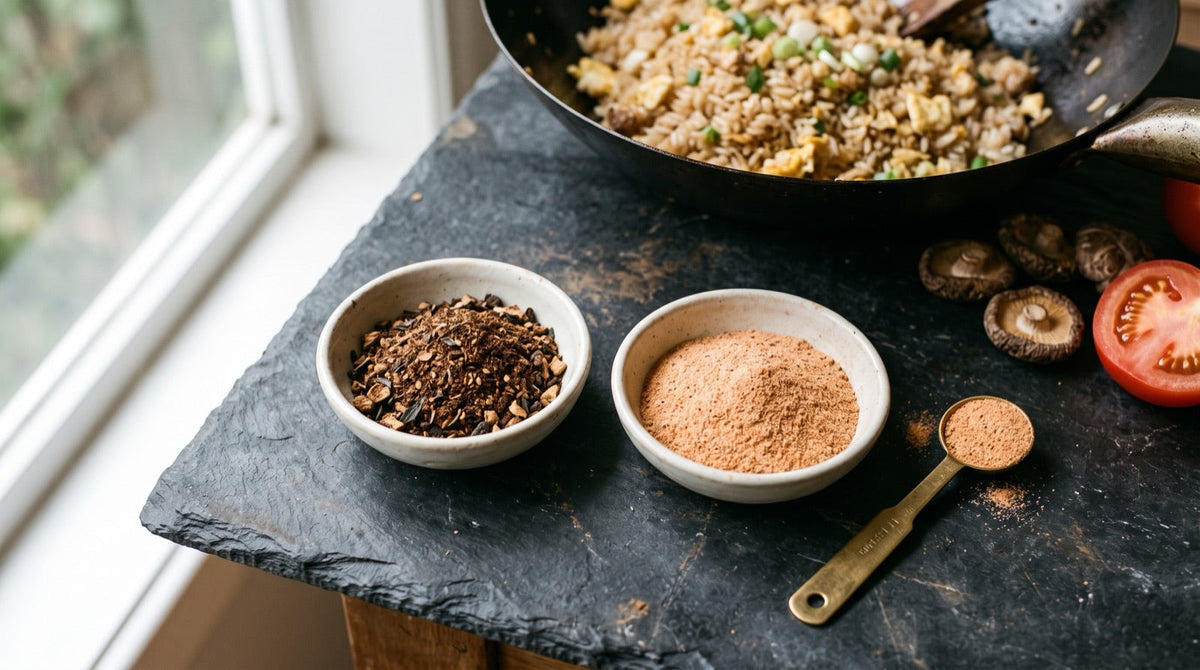
It's on every second jar in the spice aisle now. Umami.
Nobody tells you what's actually in the jar, what it does to your food, or whether your cooking is missing anything without one. 🌿
So here's the straight version from someone who cooks for a living.
The short answer: umami seasoning is a savoury flavour booster — a dry shortcut to the deep, mouth-watering, moreish quality that normally takes a pot of bones, a fermented sauce or a long-simmered stock to build. Some jars add their own flavour. Others add almost none and just amplify what's already in the pan. Which one you've got changes everything about how you use it, and most labels won't tell you which you're holding.
Let's fix that.
What umami actually is (30 seconds, then we move on)
Umami is the fifth taste, alongside sweet, salty, sour and bitter. It's the savoury one — the reason parmesan rinds, anchovies, soy sauce, bacon, tomato paste, dried mushrooms and a long-simmered stock all taste deep rather than just salty.
Your tongue reads it through glutamate, which occurs naturally in all of those foods. It's not exotic and it's not new. Your grandmother built it with a slow-cooked stock; a Japanese kitchen builds it with dashi; my dad built it in a stockpot that never came off the back burner.
An umami seasoning is that depth, dried and put in a jar so you can add it in three seconds instead of three hours.
If you want the full explanation of the taste itself — the science, the synergy, why restaurants lean on it — that's the deep dive: Umami: The Fifth Taste.
This piece is about the jar.
The bit nobody tells you: there are two kinds
This is the whole game, and I've never seen a shop explain it.
"Umami seasoning" is used as a label for two products that behave completely differently in a pan.
| Type 1 — the flavour blend | Type 2 — the amplifier | |
|---|---|---|
| What's in it | Dried mushroom, tomato, seaweed, onion, garlic, sometimes yeast extract — real ingredients, ground | Concentrated savoury compounds, usually with a salt carrier |
| What it tastes like on its own | Like something. Mushroomy, tomatoey, toasty | Almost nothing — then your mouth waters a few seconds later |
| What it does to a dish | Adds a flavour of its own on top of yours | Multiplies the flavour that's already there |
| Best on | Roast veg, risotto, dry rubs, anything you want to taste earthy | Fried rice, stir-fries, soups, mince, sauces, chicken — anywhere the dish should still taste like itself |
| Fails when | The dish shouldn't taste of mushrooms. Now it does | You expected it to add a flavour. It won't. That's not its job |
How to tell which one you own in ten seconds: tip about a quarter teaspoon into your palm and taste it dry. If it tastes like a cup of mushroom soup, it's a blend. If it tastes of very little and then makes your mouth water — that watery, want-another-bite feeling at the back of your jaw — it's an amplifier.
Neither is better. They're different tools. A blend on roast pumpkin is glorious. A blend in a delicate steamed fish is a disaster.
Our Red Can sits in the second camp. It doesn't taste of anything in particular on its own, which throws people the first time. Then they put it through a fried rice and the rice tastes more like fried rice. That's the point of it — it doesn't overpower, it elevates.
"Isn't umami seasoning just MSG?"
Fair question, and here's the honest answer: glutamate is what your tongue reads as umami, whether it arrives via a parmesan rind, a splash of fish sauce, a ripe tomato, or a shaker.
But "umami seasoning" is not one recipe. Plenty of blends on the shelf get there entirely through mushrooms and seaweed. Ours is a whole range and only one of the four cans is built around MSG at all — the other three are MSG-free, which surprises most people who assume it's all the same stuff.
That's as far as I'll take it here, because it's a genuinely big topic and it has its own piece: What Is Flavour Enhancer 621? explains the number on the label properly, without the panic.
Do you actually need one? The honest test
Here's where most articles would tell you yes. I'm going to give you both lists.
It earns its place when…
- Your cooking is "fine, but flat." Technically correct, tastes like nothing. This is the single most common reason people find us.
- You cook a lot of chicken breast, pork loin or lean mince. Low-fat proteins carry very little savoury depth of their own.
- You cook without meat. Vegetables and legumes are low in the compounds that build savouriness, which is why vegetarian food so often tastes thin. It's the whole reason How to Add Umami Without Meat exists.
- You use stock cubes or water where a restaurant would use real stock. That's exactly the gap it fills.
- Your fried rice never tastes like the takeaway's. Fixed here — and yes, this is the one.
- You're cooking on a weeknight with 20 minutes. No time to build depth the slow way. That's what the jar is for.
It will do absolutely nothing when…
I'd rather you keep your money than buy a jar that can't fix your problem.
- Your food is under-salted. Umami is not salt and won't stand in for it. Salt first, taste, then decide if it needs depth. Two different levers.
- Your pan is wet and your food is grey. No browning, no flavour. Nothing in a jar fixes a crowded pan or a lid left on.
- The dish is missing acid. If it's rich and cloying, it needs vinegar or lime, not more savoury.
- Your ground spices are three years old. Dead spices make dull food. Replace them.
- You're over-seasoning already. Soy, oyster sauce, fish sauce, parmesan and stock powder are all bringing plenty. Adding more just makes it salty.
If you're not sure which of those is your problem, work through Why Does My Food Taste Bland? first. Diagnose, then buy.
How to actually use it (real doses, real timing)
Assuming you've got an amplifier-type seasoning, here's what works.
Start at ½ teaspoon per two serves. That's it. Almost everyone's first mistake is going in heavy because "it doesn't taste like much" — then the dish reads salty and they blame the jar.
Salt first, umami second. Season the dish the way you normally would, taste it, and only then add. If you add both blind you can't tell which lever did what.
Timing, by dish:
- Stir-fry: in with the sauce, last 30 seconds. Not on raw meat — it'll draw moisture out and you'll steam instead of sear.
- Soups, braises, curries: 1 teaspoon per litre, added early so it has time to spread through.
- Mince dishes (bolognese, mapo, san choy bau): straight in with the mince once it's browned.
- Roast veg: toss it through the oil before it hits the tray, not after.
- Dry rub: mix it with your salt first, then rub. Keeps the distribution even.
- Eggs and fried rice: with the rice, off the heat, tossed through at the end.
The multiplier trick: savoury compounds don't add up, they multiply. Put an umami seasoning into a dish that already contains dried shiitake, bacon, anchovy, tomato paste or a good stock, and the jump is far bigger than the same spoon in a plain dish. It's why a spoonful in a bolognese is transformative and a spoonful on plain steamed rice is barely noticeable.
And halve it if the recipe already has soy, oyster or fish sauce. They've done half the job.
Chef's note
Dad — Danny Lim, who ran our family's Emperors of China restaurants and taught me everything I know on a wok line — had a rule he'd repeat to anyone who'd listen:
"Until you get your fried rice right, you aren't able to serve customers. It's the easiest dish to cook, but the hardest to master."
He wasn't talking about a seasoning. He was talking about attention — heat, timing, tasting as you go.
That's my honest position on the whole category. A jar of umami seasoning is not a substitute for a hot pan and tasting your food. It's the lever that gets a good home cook from "that was nice" to "how did you do that?" — and it does that in about three seconds, which is the only reason a busy kitchen bothers with it at all. ✨
Get the technique right first. Then let the jar do the last ten percent.
Frequently asked questions
Is umami seasoning the same as MSG?
Not necessarily. MSG is one source of glutamate, the compound your tongue reads as umami — but plenty of umami seasonings get there through mushrooms, seaweed, tomato or fermented ingredients instead. Check the pack. Across our own four cans, only the Umami Red Can is built around MSG; the other three are MSG-free.
Is umami seasoning vegan?
Depends entirely on the jar — some contain fish, shellfish or dairy-derived ingredients, so read the label. YumYum's range is vegan-friendly (no animal products), though not certified vegan. For allergens, always check the pack itself.
Do I still need salt if I use an umami seasoning?
Yes. They do different jobs. Salt makes food taste seasoned; umami makes it taste finished. Season with salt as you normally would, taste it, then decide whether it needs depth on top.
Will it make my food taste Chinese?
No — and this is the biggest misconception. Umami is a taste, not a cuisine. The same spoon works in a bolognese, a shepherd's pie, scrambled eggs, a tomato soup or a roast chicken. It makes food taste more like itself, whatever "itself" happens to be.
Can I just make my own?
Yes, and it's worth trying: blitz dried shiitake, a little dried seaweed and a pinch of salt in a spice grinder. You'll get a Type 1 flavour blend — earthy and lovely on roast veg, too assertive for delicate dishes. What you can't easily make at home is the neutral amplifier type, which is why those come in a jar.
How much should I use?
Half a teaspoon per two serves to start, and taste before you add more. If the dish already has soy, oyster or fish sauce in it, halve that again.
Try it on one dish
If you want to know whether an umami seasoning does anything for your cooking, don't take my word for it — run the test. Cook your usual fried rice twice this week. Second time, half a teaspoon of the YumYum Umami Red Can tossed through at the end. That's the whole experiment. 🔥
Cooking for the family? The Three-Pack ($50) ships free (free AU shipping over $50) and works out cheaper per can — or the Four-Pack of YUM ($60) if you want the whole range, which is the one most people end up on.
Written by Vincent Lim — chef, cookbook author, and co-founder of YumYum. Vincent grew up in his family's Chinese restaurants and learned to cook from his father, Danny. He shares the restaurant techniques most home cooks are never told.
Researched and drafted with AI assistance, edited and kitchen-checked by the YumYum team.