
You flipped the packet over. Read the ingredients. And there it was, tucked near the end: flavour enhancer (621).
Your brain did the thing everyone's brain does. A number. In my food. That can't be good.
Here's the short version, from someone who's cooked with the stuff for thirty years: flavour enhancer 621 is MSG — monosodium glutamate. It's the ingredient that makes savoury food taste more like itself. Not a chemical smuggled into your dinner. The single most misunderstood thing in your pantry.
Let me walk you through what that number actually means, whether you should worry about it (spoiler: you already eat it every day), and why the restaurants you love have never once apologised for using it.
What does flavour enhancer 621 mean on a food label?
Flavour enhancer 621 is the code number for monosodium glutamate, the sodium salt of glutamic acid. It's used to deepen the savoury, meaty, moreish taste in food — the taste the Japanese named umami, the fifth taste alongside sweet, sour, salty and bitter.
The number comes from the International Numbering System (INS), the same system that turns “ascorbic acid” into 300 (that's just vitamin C) and “citric acid” into 330 (the tang in your lemon). Food Standards Australia New Zealand requires manufacturers to declare a flavour enhancer by its class name plus either its name or its number. So on an Aussie label you'll see it written one of two ways:
- Flavour enhancer (MSG)
- Flavour enhancer (621)
Same thing. One just sounds scarier because it's a digit instead of a word. That's the whole trick your brain fell for.
So 621 is just... MSG?
Yep. And MSG isn't some lab-born invention that snuck into the food supply in the 80s.
Glutamate — the “umami” part of MSG — is one of the most common things in a kitchen. It's naturally loaded in parmesan, ripe tomatoes, mushrooms, soy sauce, anchovies, seaweed, Vegemite, even human breast milk. When you slow-roast a tomato and it goes sweet and deep and savoury, that's glutamate concentrating. When aged parmesan makes a bowl of pasta taste finished, same molecule.
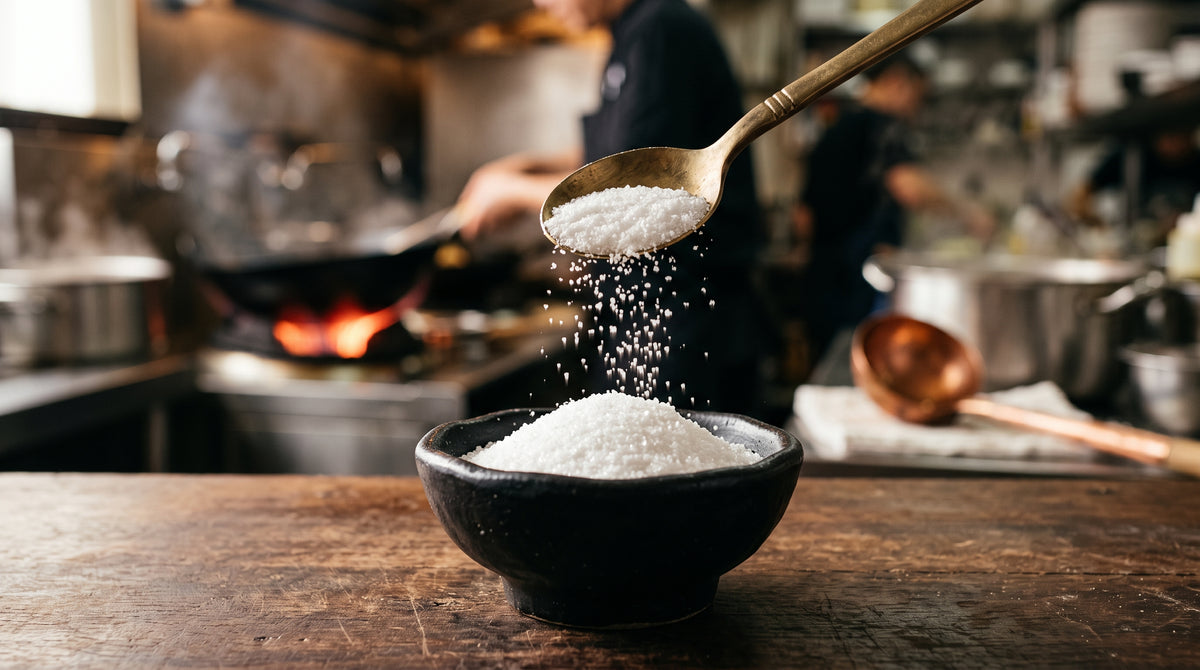
MSG is that exact compound, isolated and dried into a clean crystal so a cook can add umami on purpose instead of hoping a tomato pulls its weight. A Japanese chemist named Kikunae Ikeda worked it out in 1908 from kombu seaweed stock — he was chasing the reason his wife's dashi tasted so good. That's the origin story. Seaweed soup, not a test tube.
Your tongue can't tell the difference between the glutamate in a mushroom and the glutamate in that little “(621)”. Because there isn't one. It's the same amino acid.
Is flavour enhancer 621 safe?
For the general population, yes — and this isn't YumYum's opinion, it's the position of every serious body that's looked at it.
FSANZ, the Joint FAO/WHO Expert Committee on Food Additives (JECFA), and the US Food and Drug Administration have all reviewed MSG. Their conclusion lands in the same place: it's safe at the levels people actually eat. The FDA classes it “generally recognised as safe” — the same bracket as salt and vinegar.
The fear traces back to one 1968 letter to a medical journal, where a doctor described feeling off after Chinese food and floated MSG as the culprit. The press ran with it, coined “Chinese Restaurant Syndrome,” and the panic outlived the science by fifty years. When researchers actually ran the double-blind trials — MSG capsules versus dummy capsules, nobody knowing which was which — the reliable reactions vanished.
The honest bit, because we don't do fear-mongering or cheerleading: a small number of people report sensitivity to large doses of glutamate taken on an empty stomach, and some people with asthma feel they react to it. If that's you, trust your body and check with your GP or a dietitian. But for the overwhelming majority, 621 is doing nothing more sinister than making dinner taste better.
One thing almost nobody mentions: MSG carries about a third of the sodium of table salt. A pinch of it can hit the savoury note you'd otherwise chase with three pinches of salt. For anyone watching their salt, that's not a bug. That's a reason to keep it around.
Why is it in restaurant and takeaway food?
Because it works, and because chefs figured out the fifth taste long before it had a name in the West.
Here's a detail that catches people out: restaurants and takeaways don't have to list 621 at all. The labelling law covers packaged food. Food made and served on the spot doesn't need an ingredient panel — though if you ask the staff whether they use it, they should tell you straight. So the number that spooks you on a supermarket jar is often already in the fried rice you happily order every Friday. It just never had to introduce itself.
My dad ran Chinese restaurants his whole life — from Texas to Australia, a place the family called Emperors of China. My brother and I grew up doing our homework at the back tables while the wok line roared out front. Danny — our old man — kept a tub of what the number on your label calls “621” right next to the salt. He never called it a chemical. He called it the reason people drove across town for his food.
He had a rule about it, actually. He'd say the seasoning doesn't add a flavour that wasn't there. It amplifies the flavour the dish already had. A flat stir-fry doesn't need more soy or more sugar. It needs the umami turned up so everything else finally sings. That's the whole job of 621.
The chef note
The mistake I see home cooks make isn't using MSG. It's dumping it in like salt and expecting fireworks.
Umami is a rounding tool, not a hammer. On the wok line I'll add a teaspoon of umami seasoning to a dish that serves two to four, right when the aromatics hit the oil, then taste before I reach for anything else. Nine times out of ten the dish didn't need more salt or more sauce. It needed depth — and that pinch is what delivers it.
Dad wouldn't let me serve fried rice to a paying customer for years. His line stuck with me: “Until you get your fried rice right, you aren't able to serve customers. It's the easiest dish to cook, but the hardest to master.” Getting it right was never about a secret sauce. It was learning when a dish is flat and knowing the one thing that fixes it.
So should you avoid 621?
Only if you also plan to give up parmesan, tomatoes, mushrooms, soy sauce and every takeaway you've ever loved — because that's where glutamate already lives.
Flavour enhancer 621 is umami with a barcode. The number on the label is the same fifth taste that makes restaurant food taste like restaurant food. Now that you know what it is, the only real question left is whether you want that depth on tap in your own kitchen.
That's exactly what our Umami “Red Can” is built for — the umami hit Danny kept next to his salt, bottled so you can turn a flat dish into a restaurant one with a single scoop. It doesn't overpower. It elevates.
Cooking for the family? A single can sits under the $50 free-shipping line, so bridge it: the Three-Pack ($50) ships free and works out cheaper per can, or grab the best-selling Four-Pack of YUM ($60) to cover umami, tender meat and the signature flavours in one go. 🔥
More from the YumYum kitchen:
- Why Your Fried Rice Tastes Flat (and the One Scoop That Fixes It) — umami in the dish Danny made us master first.
- Velveting vs Meat Tenderiser Powder: Which Actually Works for Stir-Fry? — the other restaurant trick nobody tells home cooks about.
Written by Vincent Lim — chef, cookbook author, and co-founder of YumYum. Vincent grew up in his family's Chinese restaurants and learned to cook from his father, Danny. He shares the restaurant techniques most home cooks are never told.
Researched and drafted with AI assistance, edited and kitchen-checked by the YumYum team.