
Your bolognese is fine. Your gravy is fine. Everything's fine.
That's the problem. 😅
There's a gap between "fine" and the version you'd order again, and almost every time I taste a home cook's food, the gap isn't salt or heat or technique. It's depth. And the fix is usually sitting in the fridge door behind the mustard.
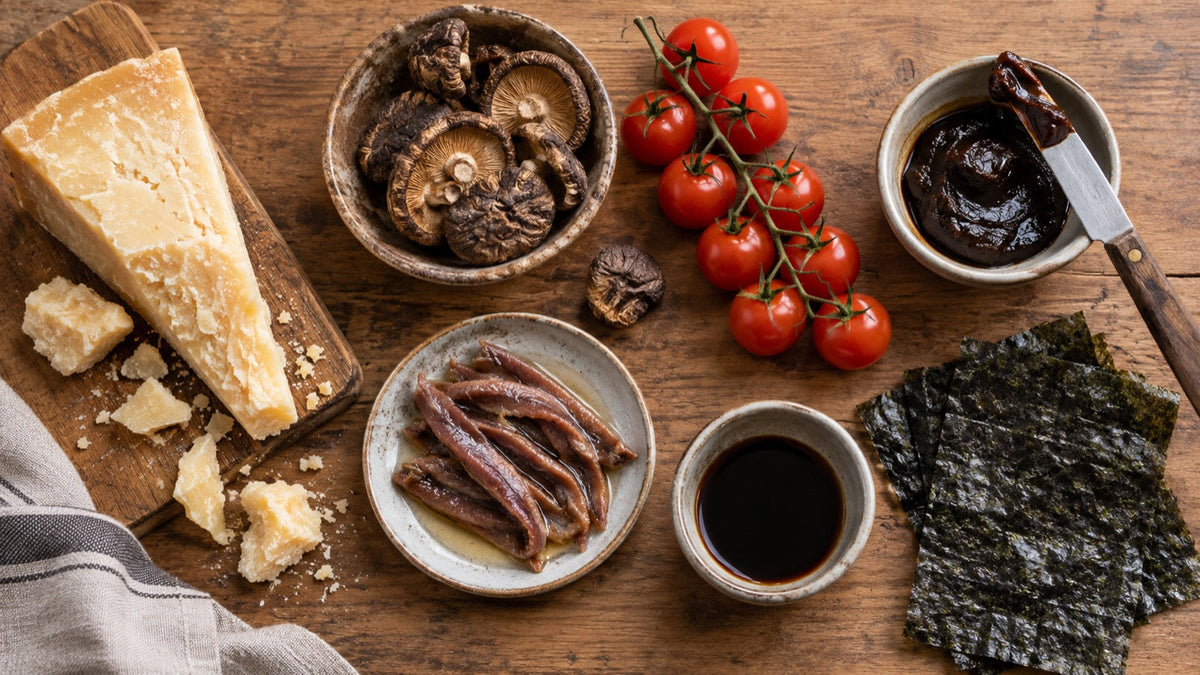
The best umami bomb ingredients are already in most Australian kitchens: Vegemite, parmesan, tomato paste, soy sauce, oyster sauce, dried shiitake, anchovies and the humble stock cube's better cousin — a proper umami seasoning. Each one carries concentrated glutamate, the compound your tongue reads as savoury depth. A teaspoon changes a whole pot.
I've spent my life on a wok line and in my dad's restaurant kitchens, and this is the single cheapest upgrade available to a home cook. No new equipment. No shopping trip.
The everyday umami bombs, ranked by how often I actually reach for them
Glutamate figures below are free-glutamate content per 100g, from the Umami Information Center's published tables — they're the reason these particular foods punch so far above their weight.
| Ingredient | Free glutamate | Put it in | Dose to start with |
|---|---|---|---|
| Kombu (dried kelp) | 2,290–3,380 mg | Stock, braises, poaching liquid | One 10cm strip per litre |
| Soy sauce | 400–1,700 mg | Almost anything savoury | 1 tbsp |
| Parmigiano Reggiano | 1,200–1,680 mg | Ragù, soup, roast veg, popcorn | 20g grated, or the whole rind |
| Dried shiitake | 1,060 mg (+150 mg guanylate) | Stock, mince dishes, gravy | 2 mushrooms, soaked |
| Fish sauce | ~950 mg | Braises, marinades, dressings | 2 tsp |
| Dried tomatoes | 650–1,140 mg | Pasta, stews, sandwiches | 3–4 pieces, chopped fine |
| Anchovies | 630 mg | Lamb, tomato sauce, dressings | 2 fillets, melted in oil |
| Fresh tomato / tomato paste | 150–250 mg fresh, far higher when concentrated | Every red sauce you make | 1 tbsp paste, fried first |
| Vegemite | Yeast extract — glutamate is the whole point of it | Gravy, stew, mince, roast pan sauce | 1 tsp, no more |
Vegemite is the one that gets a laugh and then converts people. It's yeast extract — concentrated savoury depth in a jar — and Adam Liaw has been quietly telling Australians to put a spoonful in their stews for years. He's right. A teaspoon in a beef stew or a vegetarian gravy does what an hour of extra simmering does.
The catch: at two teaspoons it stops being depth and starts being Vegemite. Ask me how I know.
The rule that turns one ingredient into a bomb: pair two, don't double one
Here's the part the American listicles skip, and it's the whole game.
Glutamate is one umami compound. There are two others — inosinate (in meat, fish, bonito, cured ham) and guanylate (in dried mushrooms). On their own each one tastes savoury. Put a glutamate ingredient and an inosinate or guanylate ingredient in the same pot and the perceived umami doesn't add up. It multiplies. Chefs usually quote the jump at seven or eight times; the research bodies are more careful and just call it synergy without a number. Either way you can taste it in about four seconds.
This is why the classics are classics:
- Kombu + bonito = dashi. Glutamate meets inosinate. The entire Japanese pantry rests on it.
- Tomato + parmesan = every ragù ever made.
- Dried shiitake + pork mince = why your local's mapo tofu tastes like that.
- Soy sauce + anchovy in a lamb braise. Sounds mad. Try it once.
So when a dish tastes thin, don't add more of what's already in it. Add the other kind. If your vegetarian stew is heavy on tomato (glutamate), it's dried mushrooms (guanylate) it wants — not more tomato paste.
That single reframe fixes more bland cooking than any recipe I could give you. If bland is your recurring problem, we wrote a whole diagnostic on it.
How to actually use them (the doses I'd give you in a kitchen)
Tomato paste — fry it, don't stir it in. A tablespoon into hot oil, 60–90 seconds until it darkens from red to brick and smells sweet instead of tinny. Raw tomato paste stirred into a sauce at the end tastes like a tin. Fried first, it tastes like it simmered all afternoon.
Parmesan rinds — stop throwing them out. Keep them in a bag in the freezer. One rind into any soup, stew or pot of beans, fished out at the end. Free depth from something you were binning.
Dried shiitake — the soaking water is the ingredient. Two mushrooms, 20 minutes in hot water. Chop the mushrooms in, and pour the soaking liquid in too, leaving the last centimetre behind because grit settles. Most people tip that water down the sink. That water is worth more than the mushrooms.
Anchovies — melt them, don't chop them. Two fillets into warm oil with garlic, pressed with a spoon until they dissolve. Nobody will identify fish. They'll just ask what you did differently.
Vegemite — 1 teaspoon, dissolved in the liquid, never the fat. Stir it into stock or the wine before it goes in the pot, not into the browning meat where it'll catch and turn bitter.
Soy sauce on things that aren't Asian. A tablespoon in a beef stew, a mushroom soup, even a bolognese. It doesn't make the dish taste Chinese at that dose. It makes it taste finished.
Where the Red Can fits (and why I keep one next to the salt)
Everything above is an ingredient with a job. It brings depth and it brings its own flavour, its own colour, its own liquid. Vegemite tastes like Vegemite. Fish sauce announces itself in a light dish. Parmesan is not going in a stir-fry.
Sometimes you want the depth without the passenger.
That's the job YumYum Umami Seasoning — the Red Can does. One teaspoon per serve, straight into the pan or over the top at the end, in dishes where a spoon of Vegemite or a splash of fish sauce would be wrong. Scrambled eggs. Roast potatoes. Fried rice. A tray of vegetables that has to feed people who claim they don't like vegetables.
It doesn't overpower. It elevates what's already there. ✨
And it's vegan-friendly, which matters when the mushroom-and-tomato route has already been exhausted and there's no anchovy option on the table. (If that's your situation permanently, the no-meat umami playbook is here.)
Four ways an umami bomb goes wrong
Depth and salt are not the same thing, and most umami failures are actually salt failures.
- You salted first, then added the bomb. Nearly every ingredient on that list is salty. Add the umami, then taste, then salt. Reverse that order and you'll get a dish that's aggressive on the front of the tongue and still hollow underneath.
- You used three at once. Soy plus Vegemite plus stock powder plus parmesan reads as "stock cube", not as cooking. Two is a pairing. Four is a muddle.
- You added it at the end. Tomato paste, Vegemite and shiitake all need time and heat to stop tasting like themselves. Early in the pot. Finishing seasoning is a different job.
- You went by volume instead of by weight of food. A teaspoon of anything is a lot in a two-serve pan sauce and nothing in a 3kg braise. Scale it, taste it, adjust.
Chef's note 🔥
My dad, Danny Lim, ran Chinese restaurants — the Emperors of China — from Texas to Australia, and he had one line he repeated until it lodged permanently: "Until you get your fried rice right, you aren't able to serve customers. It's the easiest dish to cook, but the hardest to master."
The reason fried rice is the test is that it hides nothing. No sauce, no braise, no long simmer to cover for you. Rice, egg, a bit of protein, high heat. Every restaurant fried rice you've loved and couldn't reproduce at home was doing something on that list — usually more than one thing, usually paired on purpose.
At home I keep it to two: one glutamate source, one guanylate or inosinate source. That's a wok's worth of depth in about eight seconds of work.
The move
Grab the Red Can and start with one teaspoon on your next tray of roast veg. That's the whole experiment.
Cooking for a family, or already know you'll want the other flavours? The Four-Pack of YUM ($60) ships free (free AU shipping over $50) and works out cheaper per can than buying singles — or the Three-Pack ($50) if it's the Red Can you'll be reaching for every night. 🍗
Questions people actually ask
What is an umami bomb?
An umami bomb is any ingredient with concentrated free glutamate — the compound your tongue reads as savoury depth — used in a small amount to deepen a whole dish. Vegemite, parmesan, tomato paste, soy sauce, dried shiitake and anchovies are the everyday ones. A teaspoon or two is usually enough.
Is Vegemite really an umami ingredient?
Yes. It's yeast extract, which is naturally high in glutamate, and that's exactly why it tastes the way it does. One teaspoon dissolved into the liquid of a stew, gravy or braise adds savoury depth without tasting like Vegemite. Two teaspoons will taste like Vegemite.
What's the best vegetarian umami bomb?
Dried shiitake, because it carries both glutamate and guanylate in the same ingredient — the synergy pairing built into one mushroom. Pair it with tomato or kombu and you'll match the depth of a meat stock. Miso, dried tomatoes and a good umami seasoning do the same job with less soaking.
Is an umami bomb just MSG?
Not quite — glutamate occurs naturally in tomatoes, cheese, seaweed and mushrooms, and that's what every ingredient on this list is delivering. MSG is that same compound in isolated form, which is a longer conversation with its own science: how to use MSG in cooking.
How much umami is too much?
When the dish tastes savoury but you can name the ingredient, you've overshot. Depth should be anonymous. Start at a teaspoon per four serves, taste, and remember that salt goes in after.
Want the full background on why any of this works? Start with umami itself — the fifth taste.
Written by Vincent Lim — chef, cookbook author, and co-founder of YumYum. Vincent grew up in his family's Chinese restaurants and learned to cook from his father, Danny. He shares the restaurant techniques most home cooks are never told.
Researched and drafted with AI assistance, edited and kitchen-checked by the YumYum team.