
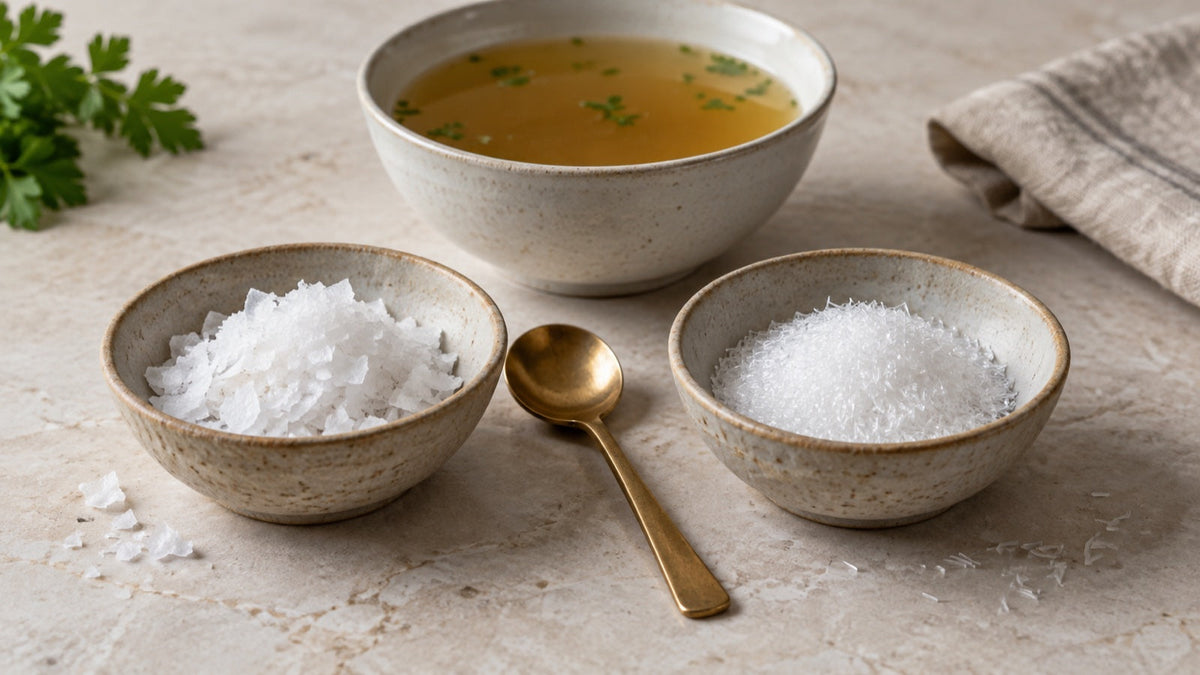
Someone told you MSG is the healthier one. Someone else told you it's the thing that gives you headaches.
Both of those people were guessing.
Here's the straight answer: gram for gram, MSG contains about 12% sodium and table salt contains about 39%. So swapping some of your salt for MSG genuinely lowers the sodium in the dish — by roughly a third in a normal home recipe. That part is real, and it's simple chemistry rather than marketing.
The catch is that it's a smaller win than the internet promises, and you can't swap all of it. I'll show you why with actual numbers.
The short version
Choose salt when the job is seasoning — making food taste like itself, pulling out sweetness, knocking back bitterness, drawing water out of a cucumber. Nothing replaces it.
Choose MSG when the food is already salted and still tastes like it's missing something. That's not a salt problem. That's a depth problem, and salt can't fix it no matter how much you tip in.
Use both if what you actually want is less sodium. Half the salt, plus a bit of MSG, gets you a dish that still tastes seasoned at roughly two-thirds of the sodium. That's the whole trick, and it's the only version of "MSG is healthier" that survives contact with a real kitchen.
The numbers nobody puts on the page
Every article ranking for this compares the two and then declines to tell you how much of anything. So:
By weight:
| Sodium content by weight | |
|---|---|
| Table salt (sodium chloride) | ~39% |
| MSG (monosodium glutamate) | ~12% |
That's the number you'll see quoted everywhere. Roughly a third.
But you don't cook by weight. You cook with a teaspoon, and here's where it gets more interesting than the chemistry sites let on:
By the teaspoon — which is how you actually season:
| 1 level teaspoon | Weighs about | Sodium |
|---|---|---|
| Table salt | 6g | ~2,300mg |
| MSG | 4g | ~500mg |
Spoon for spoon it's closer to a fifth, not a third. Salt crystals are small and dense and pack tightly. MSG crystals are bigger, lighter, more like tiny rods, so the same spoon holds noticeably less of it.
I have never seen that written down anywhere, and it's the number that actually matters, because nobody weighs their seasoning on a Tuesday night.
What that looks like in a real dish
Say you're doing a stir-fry for four. Normal seasoning, one teaspoon of salt across the whole thing.
| Salt | MSG | Total sodium | Per serve | |
|---|---|---|---|---|
| Salt only | 1 tsp | — | ~2,300mg | ~575mg |
| Half-swap | ½ tsp | ½ tsp | ~1,400mg | ~350mg |
About 900mg gone from the pan, and the food still tastes seasoned — because the glutamate is covering the savoury gap the missing salt left behind. That lands inside the 20–40% sodium reduction that the published sensory work keeps finding when researchers do this properly with taste panels.
Go further than half and it stops working. Take out all the salt and you get a dish that's loud and hollow at the same time — a strange, insistent savouriness with no floor under it. People taste that once and decide MSG is overrated. It isn't. It was just never a salt substitute.
The part that'll annoy the health-food websites
Your shaker isn't where your sodium is coming from.
The Heart Foundation puts the daily limit at about 2,000mg of sodium — one teaspoon of salt, all day, everything included. Most Australians are well over it. But FSANZ reckons around three-quarters of our sodium arrives already inside the food: bread, deli meat, sauces, stock cubes, the sandwich you bought at lunch. Only about a fifth to a quarter of it comes from cooking and the table.
So run the maths on the swap honestly. If a quarter of your sodium is under your control at the stove, and you cut a third of that quarter, you've moved your daily total by something like 7 or 8%.
Worth doing? Yes. Free flavour and less sodium is a good trade, and I do it at home.
A magic bullet? No. If you're serious about sodium, the loaf of bread in your pantry is a bigger lever than anything you'll do with a teaspoon. And if a doctor has actually told you to cut your sodium, take their number over mine — this is a cooking article, not medical advice.
They're not competing for the same job
Half the confusion here comes from treating these as rivals. In the kitchens I grew up in, nobody ever framed it as a choice.
What salt does that MSG can't:
- Suppresses bitterness — the reason a pinch of salt fixes over-steeped tea or bitter greens
- Pulls water out of things (cucumbers, cabbage, eggplant) before you cook them
- Firms up protein and helps a marinade get inside the meat
- Makes sweet things taste sweeter
What MSG does that salt can't:
- Adds length — the savoury taste that keeps going after you swallow, instead of stopping dead
- Makes a thin, watery-tasting braise or stock taste like it simmered twice as long
- Fills the gap in food that's technically well seasoned but still somehow flat
Salt makes food taste like itself. Glutamate makes it taste like more of itself. If your soup tastes like weak soup, more salt gives you salty weak soup. That's the whole distinction, and once you can feel it you'll never confuse the two problems again.
How to actually do the swap
- Season with salt first, to normal. Not half. Properly. You need to know what the dish tastes like when it's right.
- Now take a third to a half of the salt back out — meaning next time, use less. This is a next-time technique, not a rescue.
- Add MSG at about ½ teaspoon per four serves. Same dose whether it's a 500g stir-fry, a tray of roast veg or 1.5L of soup. It goes in early; it's heat-stable and won't break down.
- Taste at the end and adjust with salt, not MSG. Past roughly 1g per serve the flavour stops improving and starts flattening out. Salt is the dial you turn late.
If you want the full breakdown by dish, we've already written it up: how to use MSG in cooking, with a chef's ratio chart.
Three things people get wrong
"MSG is a chemical, salt is natural." Both are salts. Table salt is refined sodium chloride with an anti-caking agent in it, and commercial MSG is made by fermenting starch or sugar with bacteria — the same basic process behind soy sauce, vinegar and yoghurt. Neither one is scraped off a rock in its finished form.
"MSG causes headaches." The "Chinese restaurant syndrome" story has been picked apart for decades and never held up under controlled testing. We wrote a whole piece on where the headache myth actually came from — it's a wilder story than you'd expect. MSG is approved by FSANZ and appears on Australian labels as flavour enhancer 621.
"So MSG makes junk food healthy." No. Swapping some salt for MSG in a dish you're cooking is a real, modest sodium saving. It doesn't do anything for a bag of chips, and anyone selling it to you that way is overreaching. It's a seasoning, not a supplement.
Chef's note
In my dad's kitchens, salt and MSG were two different containers, both within arm's reach of the wok, and both got used on the same dish.
Salt went into the marinade and the blanching water. The glutamate went into the sauce, at the end, once everything else was already right. Different containers, different moments, different jobs. Nobody stood there deciding which one was better for you, because that isn't a question a working kitchen ever asks — you use both, and you use less of each than people assume, because a wok gets through a lot of food and you're tasting all night.
Dad had a line he applied to everything: "Until you get your fried rice right, you aren't able to serve customers. It's the easiest dish to cook, but the hardest to master." Seasoning is the last 10%. If the dish is wrong underneath, neither of these will save it.
Frequently asked questions
Is MSG healthier than salt? It has about a third the sodium by weight, so replacing part of your salt with MSG lowers the sodium in that dish. But MSG isn't a health food and salt isn't a poison. The useful version of the question is "how much of each", not "which one".
Can I replace salt with MSG completely? No, and it's the most common mistake. MSG is only about 12% sodium against salt's 39%, so a one-for-one swap leaves the food genuinely under-salted. It tastes loud and hollow. Replace about half.
Does MSG raise blood pressure? Sodium is the driver of blood-pressure risk, and MSG contains far less of it per gram than salt does. Used as a partial replacement it lowers the sodium in your cooking. It isn't a treatment for anything, and if you've been given a sodium target, follow that.
How much sodium is in a teaspoon of MSG? Roughly 500mg, against about 2,300mg in a teaspoon of table salt.
Is MSG allowed in Australia? Yes. It's an approved additive and appears on labels as flavour enhancer 621, or simply as "flavour enhancer".
Where this leaves you
If your food tastes flat and your instinct is to reach for more salt, you've probably got the wrong problem. That's usually a depth problem, not a salt problem — and it's the whole reason the fifth taste exists as a category. If you want the long version, start with umami: the fifth taste.
Dosing bare glutamate crystals from an Asian grocer works fine, and there's nothing wrong with doing it. It's just fiddly — you're managing the salt separately, guessing at the ratio, and the two only make sense together.
Which is why we built the YumYum Umami Red Can: one scoop, already balanced, so you're not standing at the stove doing arithmetic. What's in it stays our business. What it does is the easy part to explain — it doesn't overpower, it elevates. ✨
Cooking for a family? The Three-Pack is $50 and ships free (free AU shipping over $50), which works out cheaper per can than buying them one at a time. If you want the rest of the range with it, the Four-Pack of YUM is $60. 🔥
Written by Vincent Lim — chef, cookbook author, and co-founder of YumYum. Vincent grew up in his family's Chinese restaurants and learned to cook from his father, Danny. He shares the restaurant techniques most home cooks are never told.
Researched and drafted with AI assistance, edited and kitchen-checked by the YumYum team.