
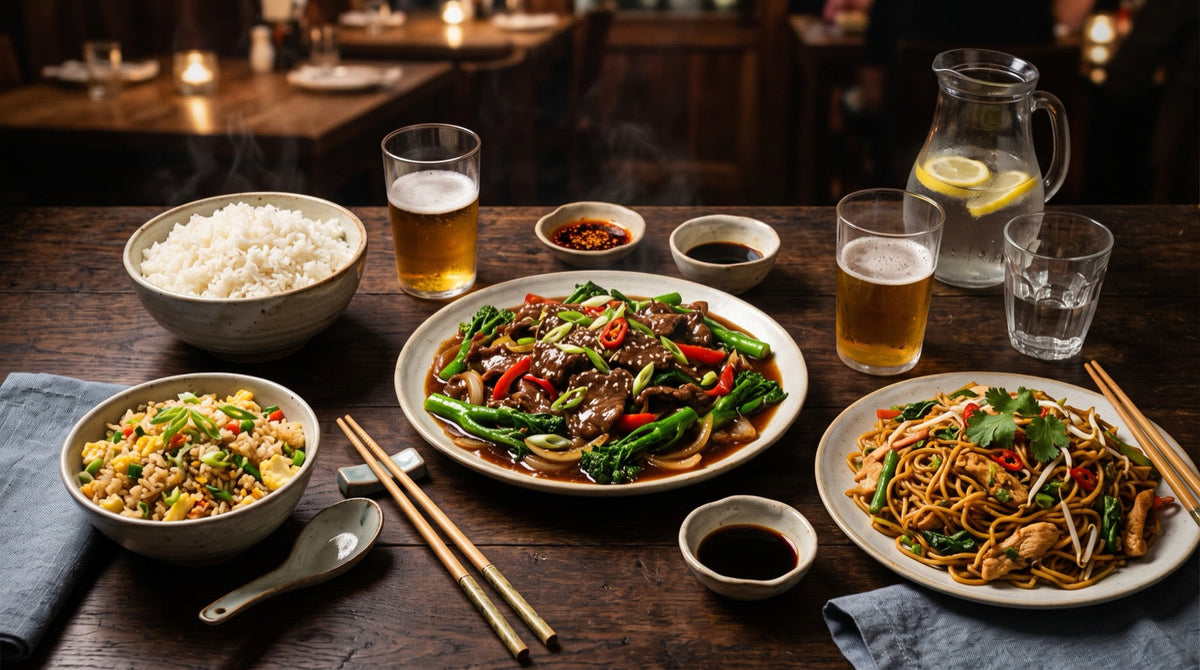
You had Chinese on Friday night. Saturday morning you woke up with a head like a wet towel.
And the first thing you blamed was the MSG.
Here’s the honest answer from a family who has cooked with the stuff for three generations, and who copped the joke about it for just as long: for the overwhelming majority of people, no — MSG is not what gave you the headache. The blind trials couldn’t find the effect. The world’s headache specialists quietly dropped MSG off their official trigger list in 2018.
But something did give you that head. So let’s do both halves properly: what the research actually found, and what’s really going on after a big takeaway. 🥡
The short answer
- Controlled double-blind studies — MSG capsules versus dummy capsules, nobody knowing which — have repeatedly failed to reproduce the headache in the general population.
- Where researchers did see reactions, it took 3 grams or more of pure MSG, swallowed on an empty stomach, with no food. The FDA puts a typical serving of MSG in actual food at half a gram or less.
- In 2018 the International Classification of Headache Disorders — the reference manual headache specialists actually use — removed MSG from its list of substances that cause headache, on the grounds the evidence didn’t hold up.
- A small number of people do report reacting to large doses. That’s real, it’s rare, and nobody should tell them otherwise.
That’s the whole thing in four lines. Now the interesting part.
Where “Chinese Restaurant Syndrome” actually came from
Not a study. A letter.
In 1968, a doctor wrote to the New England Journal of Medicine describing a numbness and heaviness he sometimes felt after eating at Chinese restaurants in the US. He floated a few possible causes — the cooking wine, the sodium, the MSG. It was a page of musing, not research.
The journal ran it under the heading “Chinese Restaurant Syndrome.” The press took it from there. Within a year there were newspaper columns, then a name that stuck for fifty years to one cuisine — while nobody thought to ask why the parmesan on their pasta, or the Vegemite on their toast, or the anchovies in their Caesar dressing, got a free pass. All of those are loaded with the same glutamate.
That’s the bit that matters to us, and I’ll say it plainly: the science was thin, and the reason it spread anyway wasn’t the science.
What the research actually found
Once people started running it properly, the story fell apart.
The blind tests. When volunteers were given capsules — some MSG, some inert, nobody told which — the rate of complaints came out roughly the same in both groups. People who were certain they were MSG-sensitive reacted to the placebo at close to the rate they reacted to the real thing.
The dose. A US expert review (FASEB) landed on the conclusion that effects showed up only when MSG was taken on an empty stomach and in large doses — 3 grams or more. For scale: that’s about six times a typical serving in real food, taken in the one way that nobody on earth actually eats it. Swallowed neat, no dinner attached.
With food, it stops happening. A 2016 systematic review in the Journal of Headache and Pain looked at the human studies and found the split ran along that exact line. In the studies where MSG was given with food, headache incidence essentially didn’t shift. It was mostly the no-food studies that turned anything up.
The biology. Glutamate is used up by your gut on the way through, and the blood-brain barrier keeps what’s left in your bloodstream out of your brain. Which is why the headache classification committee dropped it in 2018.
The everyday context. You’re already eating around 13 grams of glutamate a day from ordinary protein — meat, cheese, fish, beans. Added MSG in a Western diet is estimated at roughly half a gram a day. The bit people worry about is the smallest bit on the plate by a mile.
So what actually gave you the headache?
This is the part every article on page one skips, and it’s the useful part. After thirty years on a wok line, here’s my honest list. 🌿
1. Salt. This is my number-one suspect and it isn’t close. Restaurant and takeaway food is properly seasoned — that’s a big part of why it tastes better than yours. A heavy sodium load pulls you around on fluid balance, and dehydration headache is about as common as headaches get. You didn’t get an MSG head. You got a salt-and-not-enough-water head.
2. What you drank with it. Chinese takeaway is a beer meal. Or a wine meal. Alcohol is one of the few genuinely well-established dietary headache triggers, and it’s sitting right there on the table, unblamed.
3. The gap before it. Most takeaway nights start with someone saying “let’s not bother with lunch, we’re getting Chinese.” Skipping meals then eating a huge one late is a classic migraine pattern. The timing does damage the food gets blamed for.
4. The sheer size of the meal. Three mains, rice, spring rolls, and you ate like it was a competition. A big, fatty, late meal will give plenty of people a rough night’s sleep, and a rough night’s sleep gives you a morning head.
5. If you get migraines — the aged and fermented stuff. Soy sauce, black bean, aged and fermented ingredients carry tyramine, which is a much better-documented migraine trigger than MSG ever was. Worth knowing which one you’re actually chasing.
6. And yes — occasionally, honestly, MSG. Less than 1% of people appear to be genuinely sensitive, and mostly at doses well above what’s in a meal. If that’s you, it’s you. Don’t let anyone with a lab coat or a wok tell you your own body is wrong.
How to find out if it’s actually you
If you want a real answer instead of a hunch, isolate the variable — the same way you’d fix a dish that’s off.
- Cook it at home for two weeks. Your kitchen, your salt, your dose, no restaurant portion sizes. If the headaches stop while you’re still using umami seasoning, it was never the umami.
- Change one thing at a time. Same meal, no beer. Then same meal, less salt. Then same meal, eat at 7pm instead of 9:30pm. Most people find it in the first two.
- Write it down. Date, what you ate, what you drank, how much water, when you last ate before it. Four or five entries and the pattern usually shows itself.
- Take that to a GP. Especially if headaches are frequent or severe. A food diary is genuinely useful to them, and a persistent headache deserves a real opinion, not a blog.
The chef note
My dad, Danny, ran Chinese restaurants his whole working life — from Texas to Australia, ours was called Emperors of China. My brother and I did our homework at the back tables while the wok line roared out front.
So I grew up on the other side of this. I watched people order the same fried rice every Friday for a decade and still make the joke on the way out. Dad never argued with anyone about it. He kept his tub next to the salt, cooked the food, and let the queue out the front do the talking.
He also had a rule that’s the real answer to this whole article: the seasoning doesn’t add a flavour that wasn’t there — it amplifies the one the dish already has. A flat stir-fry doesn’t need more soy, more sugar, or a heavier hand with the salt shaker. It needs the depth turned up so everything else finally sings.
And here’s the practical kicker, given what’s actually on my suspect list. Umami seasoning carries roughly a third of the sodium of table salt. When you hit a dish with a little umami first and taste before you reach for the salt, you almost always end up salting less than you would have. If salt is the thing that’s been giving you the post-takeaway head — and I reckon for most of you it is — then that’s not a technicality. That’s the fix.
How I actually use it
- A teaspoon into a dish that serves two to four. That’s the starting dose, not a scoop.
- Add it early, when the aromatics hit the oil — not as a dusting at the end.
- Then taste before you salt. Nine times out of ten the dish didn’t want salt. It wanted depth.
- Don’t treat it like a hammer. It’s a rounding tool. Too much and you flatten the dish in the other direction.
None of the above is medical advice — if you get regular or severe headaches, see your GP.
So, should you avoid MSG?
If you’re one of the small number of people who genuinely react to a big dose, then sure — you know your body better than a study does.
For everyone else: the headache you’re blaming it for is more likely sitting in the salt, the beer, the portion size and the hour you ate it. The glutamate is the one thing on that table that’s also in your parmesan, your tomatoes, your mushrooms and your Vegemite.
Which leaves the only question worth asking — do you want that depth on tap in your own kitchen? That’s exactly what the Umami “Red Can” is built for: one teaspoon, and a flat dish turns into a restaurant one. It doesn’t overpower. It elevates. ✨
Cooking for the family? A single can sits under the $50 free-shipping line, so bridge it — the Three-Pack ($50) ships free and works out cheaper per can, or take the best-selling Four-Pack of YUM ($60) and cover umami, tender meat and the two signature flavours in one go. 🔥
More from the YumYum kitchen:
- What Is Flavour Enhancer 621? What That Number On Your Label Means — the label number this whole argument is about, explained properly.
- Why Your Fried Rice Tastes Flat (and the One Scoop That Fixes It) — the dish Dad made me master before he’d let me serve anyone.
- The Best All-Purpose Seasoning in Australia: What to Actually Buy in 2026 — including an honest note on when not to buy ours.
Written by Vincent Lim — chef, cookbook author, and co-founder of YumYum. Vincent grew up in his family’s Chinese restaurants and learned to cook from his father, Danny. He shares the restaurant techniques most home cooks are never told.
Researched and drafted with AI assistance, edited and kitchen-checked by the YumYum team.