
You’ve already got one. It’s in the cupboard door, half full, bought because the label promised it went on everything.
And your food still tastes… fine. Not restaurant good. Just fine.
Here’s the honest answer up front: most “all-purpose seasoning” sold in Australia is seasoned salt with paprika and garlic in it. It’s cheap, it’s useful, and it will never be the thing that makes your cooking taste deep — because salt makes food salty, not savoury. Those are two different jobs, and picking the right shaker means knowing which one you’re actually missing.
Straight up: I co-founded YumYum, and one of the products below is ours. So read this the way you’d read a mate’s opinion at the pub — I’ll tell you exactly where the supermarket jar beats us, and where it doesn’t. If you want a guide with no skin in the game, that’s fair enough. This one has real skin in it, and real kitchen hours behind it.
The short answer
| If you want… | Buy |
|---|---|
| An everyday shaker for chips, chops and eggs | MasterFoods All Purpose, or the Coles/Woolies own-brand |
| To cut back on sodium | A no-added-salt all-purpose blend (MasterFoods do one, 38g, in the Woolies spice aisle) |
| Food that tastes flat and hollow to finally taste deep | An umami seasoning — YumYum Umami, the Red Can |
| Meat that’s tender instead of chewy | A velveting blend, not a seasoning — Meat Velvet |
| Roasts, pork belly, five-spice anything | Emperor’s Dust |
Now the bit nobody writes down.
What “all-purpose seasoning” actually is in Australia
Go and get your jar. Read the ingredients list — they’re in descending order by weight, so the first one is most of what’s in there.
On the supermarket all-purpose blends I’ve picked up, it goes something like: salt first, then a filler or bulking agent (rice flour is common), sugar, then paprika, garlic, onion and pepper down the back end. Formulations change, so check your own jar — but if salt is sitting at number one, you’re holding seasoned salt.
That’s not a scandal. Seasoned salt is genuinely handy. It’s why hot chips taste better with it, and it’s why a lamb chop under the grill needs almost nothing else.
But it explains the thing that made you search in the first place. You’ve been shaking it over everything, and everything tastes… a bit salty and a bit the same. Because you’ve been salting your food and calling it seasoning.
The 4 things I check before buying any seasoning
1. Where salt sits in the ingredients list. Top of the list means you can’t add more of the blend without over-salting. That caps how much flavour you can ever get out of it. It’s the single biggest limitation on a cheap shaker, and no amount of marketing gets around it.
2. How long it’s been open. Ground spice blends fade — the volatile aromatics go first, and what’s left is the salt and the dust. If the jar in your cupboard door has been there since you moved in, that’s part of why your food tastes flat, and no new recipe will fix it. Smell it against a fresh one some time; it’s a shock.
3. Does it do a job my salt and pepper can’t? If a blend is salt + pepper + paprika + garlic powder, and you own salt, pepper, paprika and garlic powder, you’ve bought convenience. Fine — just know that’s what you bought. What you haven’t bought is a new flavour dimension.
4. Grind and burn point. Fine powders with sugar and garlic in them scorch fast in a hot wok or under a grill. Sugar-heavy blends belong on at the end or in a low oven, not hitting a screaming pan. Nobody tells you this and it’s why half of people’s “seasoning” tastes acrid.
The picks
Best everyday shaker: MasterFoods All Purpose (or the supermarket own-brand)
Honest verdict: it’s fine, and fine is worth having. Paprika, garlic, onion, herbs, salt. Chuck it on hot chips, wedges, a roast chook, scrambled eggs, a chop. It does that job and it does it well.
Where it falls over: it can’t fix flat food, because it’s mostly salt. That’s not a knock on it — it’s just not what it’s for.
Best if you’re watching sodium: a no-added-salt all-purpose blend
MasterFoods sell a no-added-salt version (38g) and it sits in most Woolies spice aisles. If someone in the house is on a low-sodium diet, this is a straight, sensible buy — you get the herb-and-paprika hit and you control the salt separately. It’s the right answer and it isn’t ours.
Best for food that tastes flat: YumYum Umami, the Red Can
This is the one I’d argue for, and it’s the reason this whole guide exists.
Umami is the fifth taste — the savoury depth that makes restaurant food taste like restaurant food. It’s what’s in a slow-simmered stock, aged parmesan, mushrooms, anchovies, soy. It’s the thing your cooking is missing when you describe it as “flat” or “hollow” but you can’t say what’s wrong.
The Red Can is our chef family’s blend — a wok-kitchen recipe we keep close to our chest — built to add that depth in one scoop. Vegan-friendly, chef-made, and on Woolies shelves in a 90g jar if you’d rather try it before you commit.
The whole point: it doesn’t overpower, it elevates. A teaspoon in your fried rice, your soup, your bolognese, your mashed potato, your scrambled eggs. You don’t taste “YumYum” — you taste the dish, more so.
How much: about half to one teaspoon per serve, added near the end of cooking. Taste, then adjust. Start smaller than you think.
If you want the science-y rabbit hole on where savoury depth comes from and why it’s on labels as a number, we wrote that up separately: What Is Flavour Enhancer 621?
When NOT to buy it: if your food is under-salted, umami won’t rescue it. Salt first, taste, then add depth. They’re different dials. Anyone who tells you umami replaces salt is selling you something.
Best for meat: Meat Velvet (which isn’t really a seasoning)
Different problem, different tool. If your issue is chewy stir-fry beef or dry chicken breast, no all-purpose seasoning on earth fixes texture. Meat Velvet is a velveting blend — the restaurant technique, bottled. 1–2 tbsp Meat Velvet + 1–2 tbsp water per 250g of meat, mix through, rest 30 minutes, then cook. That’s the whole method.
Best for roasts and anything five-spice: Emperor’s Dust
Five-spice is the backbone of Chinese roast pork, char siu, roast duck and half the good stuff at the barbecue-meat shop window. Emperor’s Dust is our five-spice blend, and it’s the one I reach for on pork belly, roast pumpkin and wings.
Chef’s note: restaurants don’t own an “all-purpose” shaker
My dad, Danny, ran Chinese kitchens from Texas to Australia — our family restaurants were called Emperors of China, and I grew up doing my homework at the tables before service.
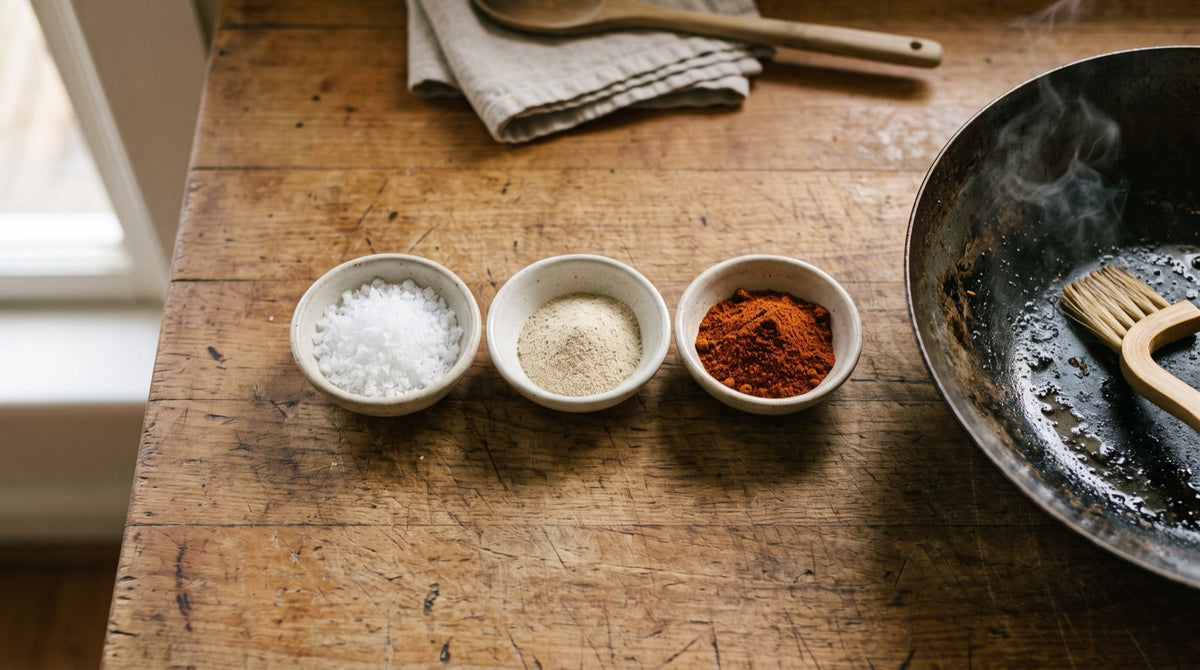
In twenty-odd years of watching that line, I never once saw a jar labelled “all-purpose” on the bench. What was there instead: salt in one tub, white pepper in another, and savoury depth as its own separate dial. Three levers, adjusted per dish. That’s it.
That’s the actual insider secret, and it’s not a product — it’s a habit. Stop looking for one blend that does everything. Own a couple that each do one thing properly, and learn which lever the dish is asking for.
Dad used to say: “Until you get your fried rice right, you aren’t able to serve customers. It’s the easiest dish to cook, but the hardest to master.” Fried rice is four ingredients. Nowhere to hide. If yours tastes flat, it isn’t the recipe — it’s the seasoning lever you’re not pulling. (We broke that one down properly in Why Your Fried Rice Tastes Flat.)
The myth worth busting
“All-purpose” is a marketing phrase, not a category with a standard behind it. Anyone can print it on anything. There’s no rule about what goes in the jar, how much salt it can be, or what it has to do.
Which means buying your fifth garlic-and-paprika blend won’t change your cooking. You’ll just have five jars that taste like each other and a cupboard door that won’t shut.
Buy for the gap — salt, depth, texture, or aroma. Then you own three or four things that each earn their space.
Common questions
What is the best all-purpose seasoning in Australia?
It depends on the job. For an everyday shaker on chips, chops and eggs, MasterFoods All Purpose or a supermarket own-brand does the job. For food that tastes flat rather than under-salted, an umami seasoning like the YumYum Red Can adds savoury depth that a salt-first blend can’t. For tough meat you need a velveting blend, not a seasoning at all.
Is all-purpose seasoning just seasoned salt?
Mostly, yes. On the majority of Australian supermarket all-purpose blends, salt is the first ingredient, followed by a filler like rice flour, then sugar, paprika, garlic and onion. Ingredients are listed in descending order by weight, so check your own jar — if salt is at the top, you’re using seasoned salt with spices in it.
Why does my food still taste bland even with seasoning?
Usually because you’re adding salt, not savoury depth. Salt makes food taste salty; umami makes it taste rich and rounded. If you’ve salted properly and it still feels hollow, you’re missing umami — the fifth taste found in stock, aged cheese, mushrooms and soy. Add it and stop reaching for more salt. The other common culprit is an old jar: ground blends fade, and a stale one is mostly salt and dust.
Do I still need salt if I use an umami seasoning?
Yes. They do different jobs and neither replaces the other. Salt makes food taste salty and it’s what makes everything else read louder; umami adds savoury depth and roundness. The right order is to salt the dish properly first, taste it, and only then add depth — if you try to use an umami seasoning as your salt, you’ll overshoot on one dial and still be short on the other.
Can I just make my own all-purpose seasoning?
Absolutely, and for a paprika-garlic-herb blend you probably should — it’s fresher, and freshness is half the battle. What you can’t easily blend at home is genuine savoury depth, which is why umami seasonings exist as a separate thing on the shelf.
So which one do you buy?
Work out which lever you’re missing.
Under-salted? Buy the supermarket shaker and stop reading. 🧂
Flat and hollow even when it’s salted right? That’s umami, and that’s the Red Can.
Tough meat? That’s texture — that’s Meat Velvet.
If you’d rather stop guessing and just own the levers, the Four-Pack of YUM is $60 and ships free (free AU shipping over $50) — Umami, Meat Velvet, Shanghai Nights and Emperor’s Dust, one of each. It’s our best-seller for the obvious reason: it’s the whole kit at once. 🔥
Just want the Red Can and never want to run out? The Three-Pack is $50 and also ships free.
More from the kitchen: The Best MSG-Free Chinese Seasonings for Big Umami Flavour · How to Add Umami Without Meat: Best Vegan Flavour Boosters · Why Your Fried Rice Tastes Flat (and the One Scoop That Fixes It)
Written by Vincent Lim — chef, cookbook author, and co-founder of YumYum. Vincent grew up in his family’s Chinese restaurants and learned to cook from his father, Danny. He shares the restaurant techniques most home cooks are never told.
Researched and drafted with AI assistance, edited and kitchen-checked by the YumYum team.